Hiển thị các bài đăng có nhãn museums. Hiển thị tất cả bài đăng

Thứ Năm, 13 tháng 6, 2013

Museum of Fine Arts Curator Offers Due Diligence Model, Saying "Ignorance is No Excuse"

The Weary Herakles has long been a poster child for the problems surrounding undocumented antiquities. The Museum of Fine Arts, Boston (MFA) acquired a partial interest in the top half of the statue in 1981 and then a full interest in 2004 under cloudy circumstances. Archaeologists in Turkey excavated the bottom half of the sculpture in 1980. But the dubious provenance surrounding the MFA's top portion of the Weary Herakles is that it belonged to the antiquities dealer's mother, who reluctantly accepted the sculpture from a German art dealer in repayment of a debt. The mother later died, and Iranian officials swiped the documents. Or so the story goes.

The tall tale of the Weary Herakles is retold in Victoria Reed's new article appearing in the DePaul Journal of Art, Technology & Intellectual Property Law (Spring 2013, Vol. 23, No.2). Reed is an expert in provenance investigations. She is the Curator for Provenance at the MFA. Her article titled "Due Diligence, Provenance Research, and the Acquisition Process at the Museum of Fine Arts, Boston" presents an honest look at the MFA's past collecting errors and the institution's current efforts to steer a different course.

The MFA agreed to repatriate the Weary Herakles statue in 2011. "In order to avoid such time-consuming and costly scenarios in our future," Reed argues that "it is necessary for the MFA not to repeat the mistakes of our past." She notes that museums generally "turned a blind eye to gaps in provenance and other red flags, such as the names of known victims and perpetrators of Nazi looting, fanciful ownership histories, or indications of illegal export." They "failed to ask specific questions about the origins of their purchases and gifts." "Today, ignorance is no excuse," Reed plainly writes.

The provenance curator outlines the MFA's current practice of questioning provenance, export, and import information before it acquires or borrows a piece, evaluating not only the information supplied to the museum but also the source of that information. The article presents a model of due diligence that may help other cultural institutions avoid traps for the unwary.

This post is researched, written, and published on the blog Cultural Heritage Lawyer Rick St. Hilaire at culturalheritagelawyer.blogspot.com. Text copyrighted 2010-2013 by Ricardo A. St. Hilaire, Attorney & Counselor at Law, PLLC. Any unauthorized reproduction or retransmission of this post is prohibited. CONTACT INFORMATION: www.culturalheritagelawyer.com

Thứ Ba, 11 tháng 6, 2013

Statues From New York's Met Museum Repatriated to Cambodia


Video source: AFP

This post is researched, written, and published on the blog Cultural Heritage Lawyer Rick St. Hilaire at culturalheritagelawyer.blogspot.com. Text copyrighted 2010-2013 by Ricardo A. St. Hilaire, Attorney & Counselor at Law, PLLC. Any unauthorized reproduction or retransmission of this post is prohibited. CONTACT INFORMATION: www.culturalheritagelawyer.com

Chủ Nhật, 26 tháng 5, 2013

Free Museum Admission for Military Personnel Starts Memorial Day

The Blue Star Museums program offers free admission to active duty, National Guard and Reserve military personnel and their families from Memorial Day through Labor Day. More than 2000 cultural institutions throughout America provide this service in honor of our nation's military.

Participating Blue Star cultural institutions can be found here.

This post is researched, written, and published on the blog Cultural Heritage Lawyer Rick St. Hilaire at culturalheritagelawyer.blogspot.com. Text copyrighted 2010-2013 by Ricardo A. St. Hilaire, Attorney & Counselor at Law, PLLC. Any unauthorized reproduction or retransmission of this post is prohibited. CONTACT INFORMATION: www.culturalheritagelawyer.com

Thứ Tư, 10 tháng 4, 2013

American Latino Museum Act Reintroduced in Congress

Photo credit: mpasquini
Lawmakers in both the Senate and the House last month reintroduced bills to create the American Latino Museum.  If passed, the museum's home would fall under the auspices of the Smithsonian Institution.

The identical bills (S. 568 and H.R. 1217) call for the creation of the museum within the Arts and Industries Building in Washington, DC. 

This same legislation was not enacted during the 112th session.

Bob Memendez (D-NJ) is joined by nine other sponsors of the Senate bill, including Harry Reid (D-NV) and Marco Rubio (R-FL). The House bill is sponsored by Xavier Beccera (D-CA34) and by Ileana Ros-Lehtinen (R-FL27).

This post is researched, written, and published on the blog Cultural Heritage Lawyer Rick St. Hilaire at culturalheritagelawyer.blogspot.com. Text copyrighted 2010-2013 by Ricardo A. St. Hilaire, Attorney & Counselor at Law, PLLC. Any unauthorized reproduction or retransmission of this post is prohibited. CONTACT: www.culturalheritagelawyer.com


Thứ Ba, 29 tháng 1, 2013

Encouraging News from the AAMD

The Association of Art Museum Directors (AAMD) announced on Facebook today that its membership voted "to strengthen and clarify its guidelines for collecting archaeological material & ancient art."

The AAMD is holding its mid-winter meeting this week in Kansas City, Missouri.  Dallas Museum of Art director Maxwell Anderson, chair of AAMD's Task Force on Archaeological Material and Ancient Art, was expected to lead a presentation discussing the AAMD’s guidelines.

Any revised guidelines should be studied with interest given Anderson's hopeful remarks in The Art Newspaper in 2011 that museums are changing from “treasure houses” to “stewards of cultural heritage ...."

UPDATE January 13, 2013:  The new guidelines are now published here.

This post is researched, written, and published on the blog Cultural Heritage Lawyer Rick St. Hilaire at culturalheritagelawyer.blogspot.com. Text copyrighted 2012 by Ricardo A. St. Hilaire, Attorney & Counselor at Law, PLLC. Any unauthorized reproduction or retransmission of this post is prohibited. CONTACT: www.culturalheritagelawyer.com

Thứ Hai, 28 tháng 1, 2013

The Law of Repatriation under "The Great Giveback"


Hugh Eakin's New York Times  commentary titled "The Great Giveback" is flawed.  The opinion piece argues that museums "are supposed to be in the business of collecting and preserving art from every era, not giving it away."  But Lee Rosenbaum and several others have correctly highlighted many of the article's problems.  Some legal observations are worth mentioning here.

"The Great Giveback" overlooks the general principle that stolen property cannot be owned lawfully or that contraband antiquities (smuggled antiquities) are legitimate. The article instead appears to encourage museums to retain tainted antiquities so long as they "have not been compelled by any legal ruling to give up the art."  This assertion is fraught with risk for museums.

Waiting for a court order to demand the repatriation of stolen or smuggled artifacts when potential settlement options are available disrespects the rule of law and undercuts a museum’s reputation.  Attorneys, museum directors and trustees, museum donors, the general public, and the courts likely would not support the courtroom clashes resulting from "The Great Giveback's" call to legal arms.  Museums are highly respected, and there is an expectation that they will "do the right thing" by finding acceptable legal solutions before initiating or inviting litigation that might result in the forced return of stolen or smuggled property.

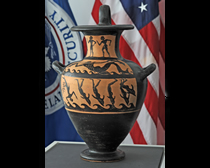
Etruscan kalpis returned to Italy.  ICE
Few museums welcome judicial oversight, which is a rare occurrence.  But it happened recently in a matter involving an illicit kalpis purchased in good faith by the Toledo Museum of Art (TMA).  Reported delays slowing the resolution of that case prompted the intervention of federal prosecutors. The matter concluded last year with a federal court order from the northern district of Ohio compelling the TMA--with the museum's assent--to forfeit the Etruscan jug to Italy.  Both the museum's lawyer and its new director agreed to "the seizure of the Kalpis by HSI [U.S. Homeland Security Investigations], the judicial forfeiture of the Kalpis pursuant to 19 U.S.C. § 1595a(c)(1), and the return of the Kalpis to the Italian Government following forfeiture to the United States," according to the June 22, 2012 order.  The court ordered the seizure and forfeiture of the kalpis from the TMA because the jug constituted stolen property unlawfully imported into the United States.  This example offers a mild preview of Eakin's sought after "legal ruling to give up the art," which museums themselves should not hope for unless their trustees desire judicial supervision.

Eakin, meanwhile, maintains that unnamed "[c]ultural property lawyers say it is doubtful that foreign governments could have successfully claimed in court most of the works museums have handed over to them." This assertion is specious.

Looking once again at the TMA kalpis case, federal prosecutors likely would have been successful had they litigated the matter under 19 U.S.C. § 1595a(c)(1)(A).  That law authorizes forfeiture when "[m]erchandise ... is introduced or attempted to be introduced into the United States contrary to law," specifically when the merchandise "is stolen, smuggled, or clandestinely imported or introduced."  The "probable cause" or "proof by a preponderance of the evidence"standards of proof used in civil forfeiture cases are lower than "proof beyond a reasonable doubt." "Probable cause" would simply require federal attorneys to show that the jug’s import more probably than not violated the law, which is not a high standard.  "Preponderance of the evidence" asks on whose side is the greater weight of the evidence.  Investigators in the kalpis collected compelling evidence for a jury to readily conclude that the Etruscan jug was stolen, smuggled, and clandestinely imported into the United States.  The Ohio district court's final order outlines the following information:

"1) an export license from Italy’s Ministry of Culture does not exist for the Kalpis which was alleged to have been originally purchased in 1935 by a private Swiss collector after Italy’s cultural patrimony laws originally took effect in 1909,

2) a Polaroid photograph was discovered amongst the entire Becchina archive of documents, invoices and photographs seized during a search warrant in Basel, Switzerland on February 23, 2002,
...
4) the Polaroid photograph appears to show mud on the Kalpis itself along with dirt on the actual photograph which demonstrates that the Kalpis was photographed in a non-institutional setting long after 1935, its alleged original sale date to the private Swiss collector,

5) similar Polaroid photographs of the Kalpis were seized during a search warrant executed in Geneva, Switzerland on September 12, 1995 at the offices/warehouse of Giacomo Medici (“Medici”), a known Italian art smuggler, who was convicted and sentenced in December 2004 by the Tribunal of Rome for violating Italy’s law of criminal association with the intent to receive stolen archaeological artifacts illegally removed from Italy’s cultural patrimony,

6) Medici’s sentencing document states that the Kalpis was sold by Medici to Becchina,

7) Medici’s sentencing document directly contradicts the information contained in the provenance and invoice provided by Becchina to the Museum at the time of purchase on August 26, 1982, that the Kalpis was (a) purchased by a private Swiss collector in 1935 at an art market and (b) sold by Karl Haug (“Haug”), the alleged son and heir of the private Swiss collector, to the Becchinas in 1980,
...
9) Ursula Becchina provided evidence after her arrest establishing that Gianfranco Becchina collected artifacts illegally in Italy from diggers and from Medici and provided fake documentation to create a provenance for the artifacts including other vases from southern Italy,

10) Ursula Becchina also provided evidence after her arrest establishing that she and Becchina used fake documents to create false provenances for other illegally obtained artifacts attesting to Haug as owner, and

11) the Kalpis, despite its high quality and worth, did not appear in any scientific publication until 1981, one year before the Museum acquired it."

A museum that is in the business of collecting and preserving legitimately excavated and imported antiquities, and in the business of following the law, could not keep the ancient Etruscan kalpis. So was the TMA case one of needless restitution?  Could this case have been won in a hard-fought and expensive court battle?  No.  That is why "The Great Giveback" should reexamine its opinion about the legal issues surrounding the repatriation of stolen and smuggled cultural heritage.

This post is researched, written, and published on the blog Cultural Heritage Lawyer Rick St. Hilaire at culturalheritagelawyer.blogspot.com. Text copyrighted 2012 by Ricardo A. St. Hilaire, Attorney & Counselor at Law, PLLC. Any unauthorized reproduction or retransmission of this post is prohibited. CONTACT: www.culturalheritagelawyer.com

Thứ Ba, 13 tháng 11, 2012

New Allegations Raised in Sotheby's Forfeiture Case: Cambodian Statue Stolen in 1972 - Trafficked through Thailand with Head Removed - Scientist Fired [UPDATED]

Federal prosecutors on Friday filed a motion to amend their forfeiture complaint in the case of United States of America v. A 10th Century Cambodian Sandstone Sculpture, Currently Located at Sotheby's in New York, New York.  The U.S. Attorney's Office for the Southern District of New York filed the petition in Manhattan federal district court following a September 27 hearing on the claimants' motion to dismiss.

The government's case is an attempt to seize, forfeit, and repatriate a statue (the so-called Defendant in rem) offered for auction by Sotheby's this past spring. Sotheby's and Decia Ruspoli di Poggio Suasa are the claimants who want the Duryodhana sculpture to remain under their legal control.  Both claimants have vigorously contested the civil forfeiture action.

Federal lawyers, in their memorandum asking the court to accept the amended complaint, write that "[at the September 2012 hearing] the Court repeatedly inquired as to the facts the Government expected to be able to prove at trial with respect to the theft of the Defendant in rem from Prasat Chen, and Sotheby's knowledge that the Defendant in rem was stolen."  The proposed amended complaint and the supporting memorandum filed on November 9 contain the government's response to the court's inquiry, supplementing information provided by prosecutors in their initial April 2012 court complaint.

The  Duryodhana is alleged by prosecutors
to have passed through Bangkok (above).
The government's latest memorandum contends that the Duryodhana statue "was stolen from Prasat Chen in 1972, with the head removed first and the torso afterwards, and acquired by a well­ known collector of Khmer antiquities (the "Collector"), via an organized looting network. (Am. Compl. ¶  17-18). The Amended Complaint further alleges that the 1975 sale of the Defendant in rem was conducted for the Collector by an auction house which had full knowledge of its illicit origin. (Id. 19-20)."  The amended complaint specifically claims that the Duryodhana and a companion piece, termed "the Museum Statue," were transited through Thailand. "The heads of the statues were removed and transported first, followed by the torsos, and ultimately delivered to a Thai dealer based in Bangkok (the 'Thai Dealer'). The Defendant in rem and the Museum Statue were then obtained by a well-known collector of Khmer antiquities ('the Collector'). At the time of this purchase, the Collector knew that the statues had been looted from Koh Ker," write the government's lawyers.

[Author's sidebar: A companion statue to the Duryodhana, a Bhima sculpture, has been identified at the Norton Simon Museum in Pasadena, California.  Meanwhile, two other related statues are reportedly located at the Metropolitan Museum of Art in New York.  See e.g., PRI's The World.]

The government's memorandum further avers that the "Amended Complaint ... alleges additional facts regarding Sotheby's knowledge that the Defendant in rem was stolen. Among other things, the Amended Complaint alleges that (1) Sotheby's and Ruspoli were aware that the Collector had been the seller of the Defendant in rem in 1975; (2) that Sotheby's consulted with the Collector prior to the importation of the Defendant in rem and throughout the 2010-2011 sale process; (3) that Sotheby's never included information about the Collector's pre-1975 acquisition of the Defendant in rem, or his role as the seller in 1975, in the provenance information it disclosed to the public, potential buyers, the Kingdom of Cambodia, or United States law enforcement; and (4) Sotheby's provided inaccurate provenance information to potential buyers, the Kingdom of Cambodia, United States law enforcement, and others, specifically that the Defendant in rem had been seen in the United Kingdom in the late 1960s, at least three years prior to its actual removal from Prasat Chen. (Am. Compl. ¶ ¶ 21, 29-30, 37, 43-44.)"

The proposed amended complaint specifically claims that "in or around 1974, representatives of [a United Kingdom] Auction House conspired with the Collector and the Thai Dealer to fraudulently obtain export licenses for the Defendant in rem and other antiquities to be shipped to the Auction House in the future."  The proposed complaint asserts that "prospective buyers were unwilling to purchase the Defendant in rem due to its lack of legitimate provenance and missing feet. The Auction House, however, ultimately succeeded in selling the Defendant in rem in 1975, with the torso and head now reattached, to a Belgian businessman, on behalf of a Belgian corporation he controlled. After a transfer to a second corporation, and the death of the businessman, the Defendant in rem was ultimately transferred to his widow, Decia Ruspoli di Poggio Suasa (“Ruspoli”), in 2000."

The amended complaint continues with allegations that an officer in Sotheby's Indian and Southeast Asian Art section "retained a[] professional art scientist (the 'Scientist') to prepare a report on the authenticity of the head of the Defendant in rem and the condition of the work done prior to the 1975 sale to rejoin it to the torso. The Officer informed the Scientist that the head had been separated from the torso 'in antiquity,' rather than in 1972."  The proposed complaint cites an internal Sotheby's email that purports to describe the scientist's observation regarding "the perfect condition of the head compared to the distress suffered by the body." The email allegedly offers the scientist's explanation "that the sculpture was either forcibly broken for ease of transport from the find site and then put back together later OR that the head and torso do not belong together." The government writes that Sotheby's later"terminated the Scientist's engagement."

The government also alleges that Sotheby's agreed to contact the Cambodian government about the sale of the sculpture but advised that "this communication should not come from the senior Sotheby's officer" so as not to attract attention.

The claimant's will have an opportunity to respond to the pleadings filed by the U.S. Attorney's Office.

_________________
UPDATE 11/15/2012

The New York Times reports that Sotheby's denies the claims made by federal attorneys.

The news outlet also writes, "Prosecutors say that in 2010, when the statue was being imported into the United States, the owner submitted an inaccurate affidavit to American customs officials, at Sotheby’s request, stating the statue was 'not cultural property' belonging to a religious site."  This statement has prompted some confusion in the blogosphere, which is important to address here.

By way of background, federal prosecutors allege in both their original complaint and their proposed amended complaint the following:

"In or about late April 2010, Sotheby’s imported the Defendant in rem into the United States in order to offer it for sale at auction. In the commercial invoice prepared in connection with the importation, the Defendant in rem is identified as a 10th Century 'Khmer stone guardian' from Cambodia. The Defendant in rem arrived at JFK Airport on or about April 23, 2010.

"On or about April 26, 2010, at the request of Sotheby's, Ruspoli executed an affidavit that was submitted to United States Customs and Border Protection stating, among other things, '[t]o the best of my knowledge, the [Defendant in rem] is not cultural property documented as appertaining to the inventory of a museum or religious or secular monument or similar institution in Cambodia.'"

This information is not new to the proposed amended complaint.  But some readers may have thought otherwise, given that the latest news in the forfeiture case is the government's petition to file a newly amended complaint.  The New York Times story did not report that prosecutors petitioned to file a new complaint.

Meanwhile, The New York Times' description of the Ruspoli affidavit differs from what is reported by federal prosecutors in their proposed complaint quoted above. The newspaper's truncated description may have opened speculation that federal prosecutors might be attempting to build their forfeiture case on the basis of false statements made to U.S. Customs and Border Protection.  But government lawyers thus far have not presented this argument either in their initial complaint nor in the proposed amended complaint.

Of the several legal grounds on which prosecutors seek forfeiture of the Cambodian sculpture, none is based on the contention that anyone entered false information on customs paperwork in violation of 18 U.S.C. § 542.  That federal statute prohibits the import of goods by means of false statements, and that statute can serve as the basis for a forfeiture of illegally imported goods as it did in the famous case of United States v. An Antique Platter of Gold.  While the government intends to support its forfeiture case by referencing the Ruspoli affidavit, it has not argued clearly how the affidavit should be weighed by the court.  Prosecutors have been careful to not explicitly characterize the Ruspoli affidavit as either false or true. The government, nevertheless, strongly implies that the affidavit in some way supports its legal theory of forfeiture of the Duryodhana statue, but not under 18 U.S.C. § 542.

A final observation. Federal prosecutors are likely aware that the language contained in the Ruspoli affidavit parrots the Cultural Property Implementation Act (CPIA) at 19 USC § 2607, which states, "No article of cultural property documented as appertaining to the inventory of a museum or religious or secular public monument or similar institution in any State Party [to the 1970 UNESCO Convention on cultural property] which is stolen from such institution after the effective date of this chapter, or after the date of entry into force of the Convention for the State Party, may be imported into the United States."  It is important to observe that the government does not argue forfeiture of the Cambodian statue based on a CPIA violation.


This post is researched, written, and published on the blog Cultural Heritage Lawyer Rick St. Hilaire at culturalheritagelawyer.blogspot.com. Text copyrighted 2012 by Ricardo A. St. Hilaire, Attorney & Counselor at Law, PLLC. Any unauthorized reproduction or retransmission of this post is prohibited. CONTACT: www.culturalheritagelawyer.com

Thứ Năm, 25 tháng 10, 2012

Cassirer Case Stays the Dispute Between The Getty and Armenian Church over the Zeyt'un Gospel Pages


The Los Angeles County Superior Court has agreed to follow a joint stipulation filed by the Getty Museum and the Western Prelacy of the Armenian Apostolic Church of America by ordering a suspension of the court case between the parties.

In June 2010 the Armenian Church sued the J. Paul Getty Museum for the return of seven missing pages from an illuminated Bible created in 1256.  The court last year ordered the parties to mediate the dispute. As recently as August 8, the parties told the court that they needed additional time to mediate. The parties earlier informed the court that they were discussing a possible solution to the Zeyt'un Gospel pages controversy, saying that a May 10, 2012 mediation session resulted in "substantial progress . . . toward a potential voluntary resolution of this dispute . . . ."

In their stipulation to stay the proceedings filed on October 19, the litigants both conclude that the case should be placed on hold pending the outcome of Claude Cassirer et al. v. Thyssen-Bornemisza CollectionFoundation.

Before he died, Cassirer filed a lawsuit in 2005 in the United States District Court for the Central District of California for the return of a painting titled “Rue Saint-Honoré, Afternoon, Rain Effect.” Cassirer's attorneys argue that the painting, now in Spain, was taken unlawfully from his grandmother.

The Cassirer case focuses on the same statute of limitations relied on by the Armenian Church in its dispute with The Getty, specifically Cal. Code. Civ. Proc. §338(c). Signed into law in 2010, the statute was primarily designed to allow lawsuits for the recovery of Nazi looted art by extending the time period that stolen art claims could be filed--from a six year statue of limitations to a statute of limitations that begins from the time of the actual discovery of the elements of a claim.  The federal district court struck down this statute in May 2012 because the law unconstitutionally intrudes upon the federal government’s exclusive power to conduct foreign affairs, according to the reasoning of the lower court.  The matter is on appeal in the Ninth Circuit.

Given that "the resolution of that appeal may determinethe outcome of this case," the Armenian Church and The Getty have agreed in writing to suspend their court proceedings so as "to avoid potentially unnecessary litigation efforts and expenses pending the outcome of that appeal."

This post is researched, written, and published on the blog Cultural Heritage Lawyer Rick St. Hilaire at culturalheritagelawyer.blogspot.com. Text copyrighted 2012 by Ricardo A. St. Hilaire, Attorney & Counselor at Law, PLLC. Any unauthorized reproduction or retransmission of this post is prohibited. CONTACT: www.culturalheritagelawyer.com

Thứ Ba, 4 tháng 9, 2012

Rigorous Due Diligence: Tax and Appraisal Forms May Supply Important Information to Museums Regarding Antiquities

Object donated to the Walters Art Museum.
Source: AAMD Object Directory

Donated cultural artifacts listed in the annual reports of museums or on the Association of Art Museum Directors (AAMD) Object Registry do not always report the same information that the Internal Revenue Service (IRS) demands when a donor files for the tax deduction offered.  Sometimes the gift of a cultural object is made by a donor to his or her nonprofit foundation first and then to a qualified nonprofit museum, and sometimes the gift is made by the donor directly to the museum.  In either situation, there should be appraisal and tax records available upon request to a museum, which can examine these sources of information when conducting a rigorous due diligence collecting history investigation to determine whether to accession the cultural artifact.

IRS Publication 526 discusses charitable contributions in general and explains how donating property such as art and antiquities to a qualified organization can provide an income tax deduction to the donor.  A donor may also steer clear of capital gains taxes on appreciated assets by donating antiquities.

IRS Publication 561 discusses paintings, antiques, and other art objects.  Any antiquities that are worth $5001 or more "should be supported by a written appraisal from a qualified and reputable source." An appraisal is mandatory for any cultural object valued at $20,000 or more. The IRS writes, "If you claim a deduction of $20,000 or more for donations of art, you must attach a complete copy of the signed appraisal to your return. For individual objects valued at $20,000 or more, a photograph of a size and quality fully showing the object, preferably an 8 x 10 inch color photograph or a color transparency no smaller than 4 x 5 inches, must be provided upon request." The determination of authenticity for tax purposes is made by a qualified appraiser.

The IRS gives examples of what information should be included in a description of donated property, including:
  • the name of the artist or culture,
  • the approximate date of creation,
  • the cost of acquisition,
  • the date of acquisition,
  • the manner of acquisition,
  • a history of the item,
  • proof of authenticity, and
  • the facts on which the appraisal was based.
The donation information is placed by the donor on IRS Form 8283, submitted with the donor's regular income tax form.

These appraisal and tax forms may supply important authenticity and collecting history information to a museum's provenance curator or other official as a museum determines whether to accept the gift of an antiquity from a donor.

This post is researched, written, and published on the blog Cultural Heritage Lawyer Rick St. Hilaire at http://culturalheritagelawyer.blogspot.com. Text copyrighted 2012 by Ricardo A. St. Hilaire, Attorney & Counselor at Law, PLLC. CONTACT: www.culturalheritagelawyer.com

Thứ Năm, 2 tháng 8, 2012

Grand Jury Hands Up Indictment in Matisse FBI Sting

A federal grand jury in the southern district of Florida (Miami) handed up indictments on Tuesday against a pair with alleged ties to the stolen Henri Matisse painting, Odalisque in Red Pants.  The grand jury charged Pedro Antonio Marcuello Guzman and Maria Martha Elisa Ornelas Lazo with a three count indictment.

The indictment alleges that on or about December 1, 2011, Guzman met with an undercover  Federal Bureau of Investigation (FBI) agent an agent and a confidential informant (CI) of the Federal Bureau of Investigation "to discuss the sale of the Henri Matisse painting 'Odalisque in Red Pants' which had been reported stolen from the Caracas Museum of Contemporary Art (Museo de Arte Contemporaneo de Caracas (MACCSII) in Caracas, Venezuela in or around December 2002." Guzman allegedly gave the CI a password four days later to access an email file containing photographs of the artwork.

Talks continued to work out the payment and transfer of the painting, and Lazo allegedly agreed to transport the stolen artwork from Mexico to the United States. A transaction date of July 17, 2012 was set up where both cash and a wire transfer totaling $740,000 would purchase the painting.

Lazo flew from Mexico City to Miami International Airport on July 16 carrying a red tube that contained the Matisse painting.  She then met with the undercover FBI agent and a second one "posing as an art dealer" in order to close the deal.  Arrests followed.

A July 19, 2012 press release issued by the United States Attorney for the Southern District of Florida, and the FBI Miami Field Office reported that the painting is valued at $3 million.

Guzman and Lazo are each charged with conspiring to transport and sell stolen property (18 USC 371), interstate transportation of stolen property (18 USC 2314), and possession of stolen property (18 USC 2315).  They face potential maximum penalties of five years in prison on the conspiracy count, ten years on the transportation count, and another ten years on the possession count.

Prosecutors also filed a criminal forfeiture action under 18 USC 981(a)(1)(C) in order to gain custody of the painting.  Both the criminal and forfeiture cases are docketed at 12-CR-20559.

An indictment is simply a process of bringing persons into the court process.  The defendants in this case are presumed innocent unless the government proves guilt beyond a reasonable doubt in a court of law.

This post is researched, written, and published on the blog Cultural Heritage Lawyer Rick St. Hilaire at http://culturalheritagelawyer.blogspot.com. Text copyrighted 2012 by Ricardo A. St. Hilaire, Attorney & Counselor at Law, PLLC. CONTACT: www.culturalheritagelawyer.com

Thứ Tư, 18 tháng 7, 2012

American Museums and Subhash Kapoor's Artifacts


Inside the Art of the Past gallery in New York.
Source: Google Local
The arrest and extradition of Subhash Kapoor has made headlines in India and garnered the attention of several cultural heritage observers.  He stands accused by Indian police of allegedly participating in an antiquities trafficking ring.  Artifacts from Kapoor are reportedly located in American museums' collections.

Kapoor is an American citizen and antiquities dealer who last year celebrated 35 years on Madison Avenue in New York City. Kapoor is the owner of the Art of the Past, Inc. gallery in Manhattan as well as Nimbus Import Export, a corporation formed on August 17, 2005 and bearing the same address as Art of the Past according to New York Department of State records.

Kapoor wrote in his March 2011 Art of the Past catalog, “There have been some obstacles and hardships during the past thirty-five years, but there have been many more rewards.” A hardship currently faced by Kapoor is his arrest in Germany on October 30, 2011, which resulted in his extradition to India on July 14, 2012.

Kapoor is presumed innocent. India follows the common law system where the burden is on the prosecution to show a crime has been committed beyond a reasonable doubt before a person is judged guilty.

The Art of the Past web site, now shut down, once described how its gallery’s artifacts could be found in the collections of major American cultural institutions. The “About Us” web page noted that “[t]he gallery has sold to some of the most celebrated public and private collections in the world. These include The Metropolitan Museum of Art, New York City; Arthur M. Sackler Gallery, Washington D.C.; Los Angeles County Museum of Art, Los Angeles; Museum of Fine Arts, Boston; Asian Art Museum of San Francisco, San Francisco (sic); The Art Institute, Chicago; and Virginia Museum of Fine Arts, Richmond; Honolulu Academy of Arts, Honolulu ....”  An internet search shows that the Birmingham Museum of Art in Alabama and the Norton Simon Museum in California list objects from Kapoor.

The Toledo Museum of Art, in its fiscal year 2007-2008 annual report, catalogs the accession of many Indian pieces from Kapoor in 2007.  A representative sample of the 44 objects gifted to the museum include:

• Indian, Gupta Period, Seated Mother, 5th century, terra cotta, terra cotta, Gift of Subhash Kapoor, 2007.107

• Indian (Chandraketugarh), Mithuna Plaque, 1st century B.C.–1st century A.D., terra cotta, Gift of Subhash Kapoor, 2007.109

• Indian (Chandraketugarh), Fertility Goddess Sitting with Star, 1st century B.C.–1st century A.D., terra cotta, Gift of Subhash Kapoor, 2007.116

• Indian (Uttar Pradesh), Gupta Period, Head, 5th century, terra cotta, Gift of Subhash Kapoor, 2007.147

• Indian (Western India), Female Head, Gupta period, 5th century, terra cotta, Gift of Subhash Kapoor, 2007.158

It is unknown if any museums are currently examining the provenances of their collections.

Sources:
http://www.artofpast.com/wp-content/uploads/2011/02/March11_Cataloge.pdf
http://web.archive.org/web/20080828191430/http://www.artofpast.com/AboutUsPage.html
http://blog.al.com/mhuebner/2011/04/callahan_lecture_to_feature_ar.html
http://www.nortonsimon.org/collections/browse_title.php?id=P.1997.1.1
http://www.toledomuseum.org/wordpress/wp-content/uploads/AnnualReport07081.pdf

CONTACT: www.culturalheritagelawyer.com

Thứ Năm, 31 tháng 5, 2012

Rubin v. Iran: Harvard Art Museums and Boston Museum of Fine Arts File Appellate Briefs in First Circuit

"The order of the district court should be affirmed."  That is the simple conclusion written in the Harvard Art Museums' appellate brief filed yesterday in the case of Rubin et al. v. Islamic Republic of Iran v. Museum of Fine Arts and Harvard University et al.  The appeal is pending in the U.S. Court of Appeals for the First Circuit.

The Boston Museum of Fine Arts
Source: Alex Feldstein.  CC.
The Boston Museum of Fine Arts (MFA) also filed an appellate brief. The museum argues that "[a]llowing Plaintiffs to execute on property long held and owned by an innocent third party, the MFA, does nothing to punish Iran," they write.

Jenny Rubin and other appellants filed an appeal with the First Circuit in March, contending that a federal district court in Massachusetts was wrong when it dismissed their attempt to attach Iranian cultural artifacts located in Boston area museums. The objects include eight stone reliefs from ancient Persepolis and two Luristan bronzes now at Harvard, as well as 977 artifacts acquired by the MFA through scientific expeditions during the 1930s at Rayy and Persepolis. Nearly 2000 artifacts in total are at issue in the First Circuit case.

Rubin and others filed a lawsuit in 2001 in the United States District Court for the District of Columbia and won a court judgment against Iran for its sponsorship of a terrorist attack in Jerusalem in 1997.  In order to collect the money owed to the appellants, the Rubin parties sought to attach Iranian assets in the United States.  They attempted to seize ancient Iranian artifacts housed at Harvard's museums as well as the Museum of Fine Arts (MFA) in Boston, but the effort failed in the district court. That is why the appellants filed an appeal.  Harvard and the MFA object.

Harvard's attorneys say this case "should never have been brought" against the Busch-Reisinger Museum, the Fogg Art Museum, Harvard University, the Harvard University Art Museums, the Peabody Museum of Archaeology and Ethnology, the President and Fellows of Harvard College, the Sackler Museum and the Semitic Museum.  They argue in a lengthy brief that the Rubin appellants "failed to prove that any Harvard artifact belongs to Iran." Harvard asserts that the claim by Rubin and others "fails because it rests on a meritless legal premise—that Iranian law ever gave Iran title to any object."

The MFA, meanwhile, criticizes the Rubin appellants/plaintiffs because they "have conceded that they have no evidence at all that Iran owns a single object at the MFA. Rather, Plaintiffs effectively contend that the possibility that some of the objects may have been illegally removed from Iran decades ago somehow allows Plaintiffs to attach the objects now as if they were property of Iran." "Allowing Plaintiffs to take property from the MFA to which Iran has no valid claim would force the MFA, not Iran, to pay for Iran’s misdeeds," the museum's lawyers complain.

The MFA's legal counsel argues that "the District Court correctly ruled that Iranian Law does not vest Iran with ownership of any of the objects" in its collection. The museum adds that cultural objects specifically not subject to attachment are at least 319 artifacts found outside Iran before November 3, 1930; 107 cultural objects excavated outside Iran's borders; at least nine artifacts made after 1779; scientifically excavated material dug up from Rayy as part of the Joint Expedition to Iran funded by the MFA and the University Museum at the University of Pennsylvania; and items from the Persepolis Expedition sponsored by the Oriental Institute at the University of Chicago, the University of Pennsylvania, and the MFA.

Both Harvard and the MFA take the appellants to task for claiming that Iran maintains a "regulatory" interest in Persian cultural objects.  The lawyers opine that a mere regulatory interest in property is not enforceable in an American court.  To enforce a regulatory interest would amount to "an unconstitutional taking of property," Harvard's counsel writes.

Harvard's attorneys add that the lower district court "correctly ruled that Iranian law does not vest Iran with ownership of the artifacts."  The MFA make a similar argument.  The two institutions maintain that the Rubin appellants cannot bring a legal action to dispute the ownership of ancient Iranian artifacts because such a claim is barred by a three year statute of limitations.

Harvard and the MFA, in any case, claim that they own the artifacts in their collections by adverse possession. "Even if Harvard did not acquire ownership of the objects by gift or purchase—and it did—Harvard acquired title to the objects by adverse possession."  The MFA says as well: "Here, because Iran has never made any claim of ownership to works in the MFA, despite knowledge for many decades that the MFA’s collection included numerous antiquities that originated in Iran, any such claim is time-barred. And because of the MFA’s well-known possession of such antiquities for those decades, the MFA has acquired title to the objects under the doctrine of adverse possession, also barring any claim of ownership by Iran."

Adverse possession is a legal doctrine that awards title of property to a possessor who maintains hostile, open, notorious, exclusive, and continuous possession of the property over a specified period of time. "Harvard’s possession has undisputedly been open and notorious, adverse, and exclusive and continuous for the three-year statutory period," argue its lawyers.

Alternatively, Harvard's attorneys maintain that "if the antiquities belong to Iran, they are immune from execution under" the Foreign Sovereign Immunity Act (FSIA).  The MFA joins Harvard's argument. Harvard's attorneys point out that FSIA's "commercial activity" exception does not apply.   They write that "the objects are not subject to the FSIA’s 'commercial activity' exception, because Iran never used them for a commercial activity in the United States."

The FSIA exception states:
"A foreign state shall not be immune from the jurisdiction of courts of the United States or of the States in any case . . . in which rights in property taken in violation of international law are in issue and that property or any property exchanged for such property is present in the United States in connection with a commercial activity carried on in the United States by the foreign state; or that property or any property exchanged for such property is owned or operated by an agency or instrumentality of the foreign state and that agency or instrumentality is engaged in a commercial activity in the United States."

[Author's sidebar: there has been much discussion recently about legislation to clarify the meaning of FSIA's "commercial activity" provision when applied to foreign art and artifacts in the United States.  See "The Foreign Cultural Exchange Jurisdictional Immunity Clarification Act (S.2212) Should Be Passed" and "U.S. House Passes Foreign Cultural Exchange Jurisdictional Immunity Clarification Act"].

Harvard's lawyers also write that the Terrorism Risk Insurance Act (TRIA) does not put the objects in the hands of the appellants:  "Nor are the [cultural] objects subject to execution under TRIA’s limited authorization of execution against certain 'blocked assets' of terrorist states." "Congress provided that only blocked assets owned by a terrorist party may be used to satisfy judgments against that party," and the cultural artifacts at Harvard are neither owned by Iran nor "blocked assets," the attorneys argue.  The MFA further argues that the appellant's "interpretation of TRIA leads to a constitutional takings problem."

UPDATE August 2012: The plaintiffs-appellants filed their response to the museums' briefs.

For more on the parallel Seventh Circuit / U.S. Supreme Court case, click here.

Bài đăng phổ biến