Hiển thị các bài đăng có nhãn looted antiquities. Hiển thị tất cả bài đăng

Thứ Hai, 1 tháng 7, 2013

Emergency Protection of Egyptian Cultural Antiquities Act

The pillage of Egyptian cultural heritage continues. The latest news of ravaged archaeological sites comes from El Hibeh and Abu Sir Al Malaq where photos depict thrown-away bones and broken artifacts that mar ancient archaeological sites, a grisly byproduct of destructive digging by reckless looters. Political leaders must act.

The illegal trade in cultural heritage is a transnational, for-profit business that depends on moving looted objects to the market. The number of Egyptian cultural objects smuggled into the U.S. remains unknown. What is known is that the United States is a significant consumer of Egyptian cultural artifacts. Last year nearly 14% of all archaeological, historical, or ethnographic objects imported for consumption into the U.S.--as a percentage of the total customs value of all such imports--came from Egypt, making The Land of The Pharaohs the third top supplier of declared cultural goods entering America.

Just as Congress passed legislation targeting plundered Iraqi heritage, lawmakers should adopt similar legislation authorizing the President to implement emergency import protections covering at-risk Egyptian cultural heritage. Its language could mirror the language of the Emergency Protection of Iraqi Cultural Antiquities Act:
SHORT TITLE
Emergency Protection of Egyptian Cultural Antiquities Act

EMERGENCY IMPLEMENTATION OF IMPORT RESTRICTIONS.

(a) AUTHORITY- The President may exercise the authority of the President under section 304 of the Convention on Cultural Property Implementation Act (19 U.S.C. 2603) with respect to any archaeological or ethnological material of Egypt without regard to whether Egypt is a State Party under that Act, except that, in exercising such authority, subsection (c) of such section shall not apply.

(b) DEFINITION- In this section, the term `archaeological or ethnological material of Egypt means cultural property of Egypt and other items of archaeological, historical, cultural, rare scientific, or religious importance illegally removed from locations in Egypt since [date to be agreed upon].

TERMINATION OF AUTHORITY.
The authority of the President under section 3002(a) shall terminate five years from the date of enactment.
The passage of the Emergency Protection of Egyptian Cultural Antiquities Act would heighten American attention to the increasing cultural heritage crisis in Egypt and give federal law enforcement an additional tool to stop antiquities trafficking at the border.

Photo credit: exkrupier


This post is researched, written, and published on the blog Cultural Heritage Lawyer Rick St. Hilaire at culturalheritagelawyer.blogspot.com. Text copyrighted 2010-2013 by Ricardo A. St. Hilaire, Attorney & Counselor at Law, PLLC. Any unauthorized reproduction or retransmission of this post is prohibited. CONTACT INFORMATION: www.culturalheritagelawyer.com

Thứ Bảy, 27 tháng 4, 2013

Antiquities Looting and the War in Syria

The U.S. Committee of the Blue Shield met earlier this month in Washington, D.C. to discuss the impact on cultural heritage caused by Syria's armed conflict. The Blue Shield is paying close attention to the situation as wartime traffickers spill artifacts onto the black market and looters trade artifacts for guns.

Several news outlets have described the deteriorating situation, including TIME MagazineThe Washington Post, and The New York Times. The April 7, 2013 CNN report below sheds light on how antiquities are exchanged for gun money.


This post is researched, written, and published on the blog Cultural Heritage Lawyer Rick St. Hilaire at culturalheritagelawyer.blogspot.com. Text copyrighted 2010-2013 by Ricardo A. St. Hilaire, Attorney & Counselor at Law, PLLC. Any unauthorized reproduction or retransmission of this post is prohibited. CONTACT INFORMATION: www.culturalheritagelawyer.com

Thứ Ba, 23 tháng 4, 2013

Terrorist Financing Risks and the Illegal Trade in Cultural Property

There is sufficient anecdotal evidence to conclude that the illegal trade in cultural property may constitute a source of funding for terrorist networks.* This judgment is tacitly acknowledged by the Financial Action Task Force (FATF), an independent inter-governmental organization that helps to identify, assess, and understand terrorist financing (TF) and money laundering (ML).

I
n recommendations published earlier this year
, FATF expressly takes into account the illegal cultural property trade. 
Its 2013 guidance report titled "National Money Laundering and Terrorist Financing Risk Assessment" describes categories that should be included when authorities assess terror funding and money laundering risks. The report lists illicit trafficking of cultural goods, counterfeiting of antiquities, and the illegal trade of antiquities. The report also identifies art and antique dealers and auction houses as businesses "that may be useful [to include] in building a list of the ML/TF vulnerabilities that can be exploited in regulated entities."

FATF recommends that risk assessments focused on terrorist financing and money laundering "should ultimately allow public authorities to make a judgment on the levels of the risks and priorities for mitigating those risks."

One policy response that authorities might consider is the adoption of record keeping laws that spotlight black market antiquities. Such laws would foster transparency, helping to separate the legal cultural property trade from the illegal trade and serving to identify potential ML/TF crimes. A proposal describing these laws can be found in "Spotlighting Black Market Antiquities with Record Keeping Laws."
____________________
* See e.g., Eti Bonn-Muller, Inside the Israel Antiquities Authority: Interview with Amir Ganor, Archeology.org, 2010, http://www.archaeology.org/israel_antiquities_authority/ganor.html;
Blood Antiques (LinkTV broadcast Oct. 8, 2009); S Fidler, A black art: how the trade in stolen artifacts aids money laundering, organized crime, and terrorism. Financial Times. (May 24, 2003).

Research credit: Jayna Sutherland.  Photo credit: darrendean.

This post is researched, written, and published on the blog Cultural Heritage Lawyer Rick St. Hilaire at culturalheritagelawyer.blogspot.com. Text copyrighted 2010-2013 by Ricardo A. St. Hilaire, Attorney & Counselor at Law, PLLC. Any unauthorized reproduction or retransmission of this post is prohibited. CONTACT INFORMATION: www.culturalheritagelawyer.com

Thứ Tư, 6 tháng 2, 2013

Spotlighting Black Market Antiquities with Record Keeping Laws


Antiquities traffickers make their money by selling artifacts bulldozed from archaeological sites, sawed from ancient tombs, and chiseled from revered temples. Fences often convert these legacies of civilization into cash by misusing the services of legitimate dealers and auction houses. Along the way customs documents may be forged, fake collecting histories created, and the physical signs of looting wiped clean by conservation techniques in order to make the cultural objects marketable.  But behind this facade of legitimacy, humanity's heritage vanishes.

Source: Andy Reis
Identifying and separating the black trade from the legitimate art and antiquities marketplace requires sunshine. “If the broad light of day could be let in upon men's actions, it would purify them as the sun disinfects," advised U.S. Supreme Court Justice Louis Brandeis. These words from a century ago ring true today. That is why the adoption of record keeping legislation spotlighting the sales of antiquities and other cultural artifacts should be considered by lawmakers.

Meaningful record keeping laws might require documentary evidence of transactions involving the purchase, sale, consignment, or transfer of archaeological material over 250 years old and valued at $10,000 or more, individually or collectively. Auction houses, dealers, galleries, shops, and other entities engaged in the trade of would maintain the records. To be effective, the records should minimally contain:

• Descriptions of the names and addresses of the parties involved in a transaction, a description of the cultural object, and the amount of money exchanged.

• All available import documents and export permits connected with the object.

• A description of the provenance/chain of custody/collecting history of the object known to the seller or consignor along with supporting documents, photos, affidavits, and the like when available.

• Any condition reports associated with conservation reports, insurance documents, shipping paperwork, etc.

Such record keeping laws could help identify illegal activities. As a result, authorities could more easily spot and investigate suspected antiquities trafficking. Where there was probable cause to investigate, police and prosecutors could efficiently gather potential evidence of theft, smuggling, fraud, tax evasion, money laundering, or other crimes associated with antiquities trafficking by probing relevant records. Subsequent prosecutions and/or asset forfeitures based on this evidence could then be used to take legal action against traffickers. The record keeping laws may even serve as an initial deterrent to criminals, causing them to think twice about participating in illegal antiquities transactions in the first place for fear that they would be exposed by the paper trail.

Record keeping laws, meanwhile, would elevate the market. They would bolster efforts by sellers and consignors wishing to cultivate an ethical, authentic, and profitable trade by boosting the integrity of the marketplace. Collectors, in turn, would be better protected against sales of stolen, smuggled, fake, or legally questionable merchandise.

The idea of record keeping laws to shine a light on crime that has threaded itself within lawful commerce is nothing new. The metals industry, for example, has seen an explosion of stolen copper and aluminum finding their way into the legitimate business operations of scrap metal dealers and recyclers. In response, campaigns to enact state record keeping legislation have been launched. And Sen. Charles Schumer (D-NY) last August announced an effort to pass similar federal legislation. The senate bill would make it illegal to sell scrap metal unless the seller documents ownership of the metal and supplies purchase records. Scrap dealers, meanwhile, would be required to keep detailed records of their purchases. Similar state laws exist that cover pawnbroking, another industry burdened by wrongdoers who weave stolen merchandise into legitimate commerce. Record keeping statutes benefiting the art and antiquities marketplace would be based on these precedents.

Source: Plex
Spotlighting black market antiquities would not impose any extraordinary requirement. That is because everyday business practices presumably demand the collection of basic purchase and sales information already. It is common for businesses, for example, to keep detailed records for purposes of income and sales taxes, inventory, customer service, marketing, and the like. Moreover, both Internal Revenue Code 6050I and 31 USC § 5331 mandate business operators--including sellers of antiquities--to document sales transactions over $10,000 on Form 8300. That form requires information about the identities of the parties who made and received a transaction payment, the method of payment, and a description of the transaction. This reporting requirement helps uncover money laundering that could aid terror funding, drug trafficking, or tax evasion. A New York state court decision, meanwhile, in the case of William J. Jenack Estate Appraisers and Auctioneers v. Albert Rabizadeh is expected to motivate parties in the busy Manhattan art and antiquities marketplace to more completely preserve auction sales records. The appellate court ruled that an auction contract, to be enforceable under the statute of frauds, must identify the buyers and sellers in some fashion.

Preserving provenance/chain of custody information, financial transaction records, import documents, and other records that could help spotlight black market antiquities would not be expected to place an unwieldly requirement on legitimate dealers and auction houses. Critics may still characterize the record keeping as an attempt to over-regulate.  It is true that over-regulation can be a problem both for an industry and for law enforcement, and Winston Churchill rightly observed, "If you make ten thousand regulations you destroy all respect for the law." But the art and antiquities market is already minimally regulated, built less on codified rules and more on personal relationships between sellers and collectors whose purchase agreements might even be executed by a handshake. Record keeping laws would not significantly alter the informality of the industry's culture. Rather, they would improve trust in the market by helping to protect sellers from conveying looted or forged cultural heritage; better safeguarding consumers from purchasing illegally looted, smuggled, and inauthentic artifacts; and exposing wrongdoers who use the legitimate marketplace to fence illegally acquired cultural material.

Commentators on another end of the spectrum may desire more stringent regulations. But in the same way that scrap metal record keeping legislation has needed the support of the metals industry, the adoption of art and antiquities record keeping laws must have the support of dealers, auction houses, and galleries. A more transparent marketplace would be highly desirable, but there would be little political support for policies that do not preserve the discretion found in the current marketplace. An opinion by David Hewett ("New York Auction Houses Must Reveal Consignor's Name to Buyer," Maine Antiques Digest, November 12, 2012) explains the argument favoring auction house discretion: "Consignors welcome anonymity for a variety of reasons. Some consignors do not want relatives and/or debtors to know they sold the family valuables. Museums and historical societies dread the fact that it may become public knowledge they've had to sell assets to survive. Dealers don't want it known that they're dumping dead stock."

Recognizing these privacy interests, business records should be protected from unauthorized disclosure so that transacting parties could not be identified except by consent, operation of law, a lawful request from an enforcement agency, or through judicial process. This approach strikes the right balance to garner broad support for record keeping legislation.

No one wants an art and antiquities marketplace filled with heritage supplied by thieves, smugglers, forgers, and fences who seek illegal profits.  Effective record keeping laws to identify and expose cultural property criminals should describe the details of purchase and sales transactions, the identities of parties involved, and the chains of custody of the cultural objects. Shining a spotlighting on the black market would ultimately help safeguard an increasingly endangered archaeological record and work to preserve culture. Greater confidence in the art and antiquities marketplace would result as a step is taken towards expelling the black market. Because criminal activity thrives in darkness, lawmakers should consider the adoption of laws that that illuminate the black trade.


This post is researched, written, and published on the blog Cultural Heritage Lawyer Rick St. Hilaire at culturalheritagelawyer.blogspot.com. Text copyrighted 2012 by Ricardo A. St. Hilaire, Attorney & Counselor at Law, PLLC. Any unauthorized reproduction or retransmission of this post is prohibited. CONTACT: www.culturalheritagelawyer.com

Thứ Sáu, 1 tháng 2, 2013

The 1970 Rule and the AAMD Guidelines

The Revisions to the 2008 Guidelines on the Acquisition of Archaeological Material and Ancient Art issued this week by the Association of Art Museum Directors (AAMD) requires study. Lee Rosenbaum's blog post titled "AAMD’s “Strengthened” Antiquities-Collecting Guidelines Boost the Loopholes" offers keen analysis at this early stage.

An additional observation worth highlighting is the AAMD's request for others--besides museums--to follow the 1970 rule.  The 1970 rule is described in the latest Revisions this way:

"The AAMD, along with others in the international community, including source countries, recognizes the date of this Convention [1970 UNESCO Convention on the Means of Prohibiting and Preventing the Illicit Import and Export and Transfer of Ownership of Cultural Property], November 17, 1970, as providing the most pertinent threshold for the application of more rigorous standards to the acquisition of archaeological materials and ancient art as well as for the development of a unified set of expectations for museums, sellers and donors."

Despite the AAMD's aspirations, the organization has not convinced many relevant governmental authorities to abide by the 1970 rule when cultural property forfeiture and repatriation claims are pursued. So it is not surprising to read the Revision's latest plea:

"The AAMD was encouraged in 2008 to see that the date of adoption of the UNESCO Convention was recognized not only by museums as a threshold for more rigorous analysis of acquisitions, but also by some countries as a voluntary limitation for enforcement of their cultural patrimony laws that predate the UNESCO Convention. The AAMD hopes that other countries will follow this precedent of voluntary restraint as the AAMD continues to encourage its members to pursue voluntary standards for acquisitions that are stricter than the requirements of applicable law.

The 1970 rule is laudable and worth promoting.  But how does the AAMD intend to convince domestic and foreign governmental authorities to follow it when the latest Revisions do not appear to go far enough to prevent the accession by museums of post-1970 looted, smuggled, or fraudulently sold antiquities?


This post is researched, written, and published on the blog Cultural Heritage Lawyer Rick St. Hilaire at culturalheritagelawyer.blogspot.com. Text copyrighted 2012 by Ricardo A. St. Hilaire, Attorney & Counselor at Law, PLLC. Any unauthorized reproduction or retransmission of this post is prohibited. CONTACT: www.culturalheritagelawyer.com

Thứ Ba, 29 tháng 1, 2013

Encouraging News from the AAMD

The Association of Art Museum Directors (AAMD) announced on Facebook today that its membership voted "to strengthen and clarify its guidelines for collecting archaeological material & ancient art."

The AAMD is holding its mid-winter meeting this week in Kansas City, Missouri.  Dallas Museum of Art director Maxwell Anderson, chair of AAMD's Task Force on Archaeological Material and Ancient Art, was expected to lead a presentation discussing the AAMD’s guidelines.

Any revised guidelines should be studied with interest given Anderson's hopeful remarks in The Art Newspaper in 2011 that museums are changing from “treasure houses” to “stewards of cultural heritage ...."

UPDATE January 13, 2013:  The new guidelines are now published here.

This post is researched, written, and published on the blog Cultural Heritage Lawyer Rick St. Hilaire at culturalheritagelawyer.blogspot.com. Text copyrighted 2012 by Ricardo A. St. Hilaire, Attorney & Counselor at Law, PLLC. Any unauthorized reproduction or retransmission of this post is prohibited. CONTACT: www.culturalheritagelawyer.com

Thứ Năm, 20 tháng 12, 2012

U.S. Supports U.N. Resolution Urging Countries to Take Antiquities Trafficking Seriously

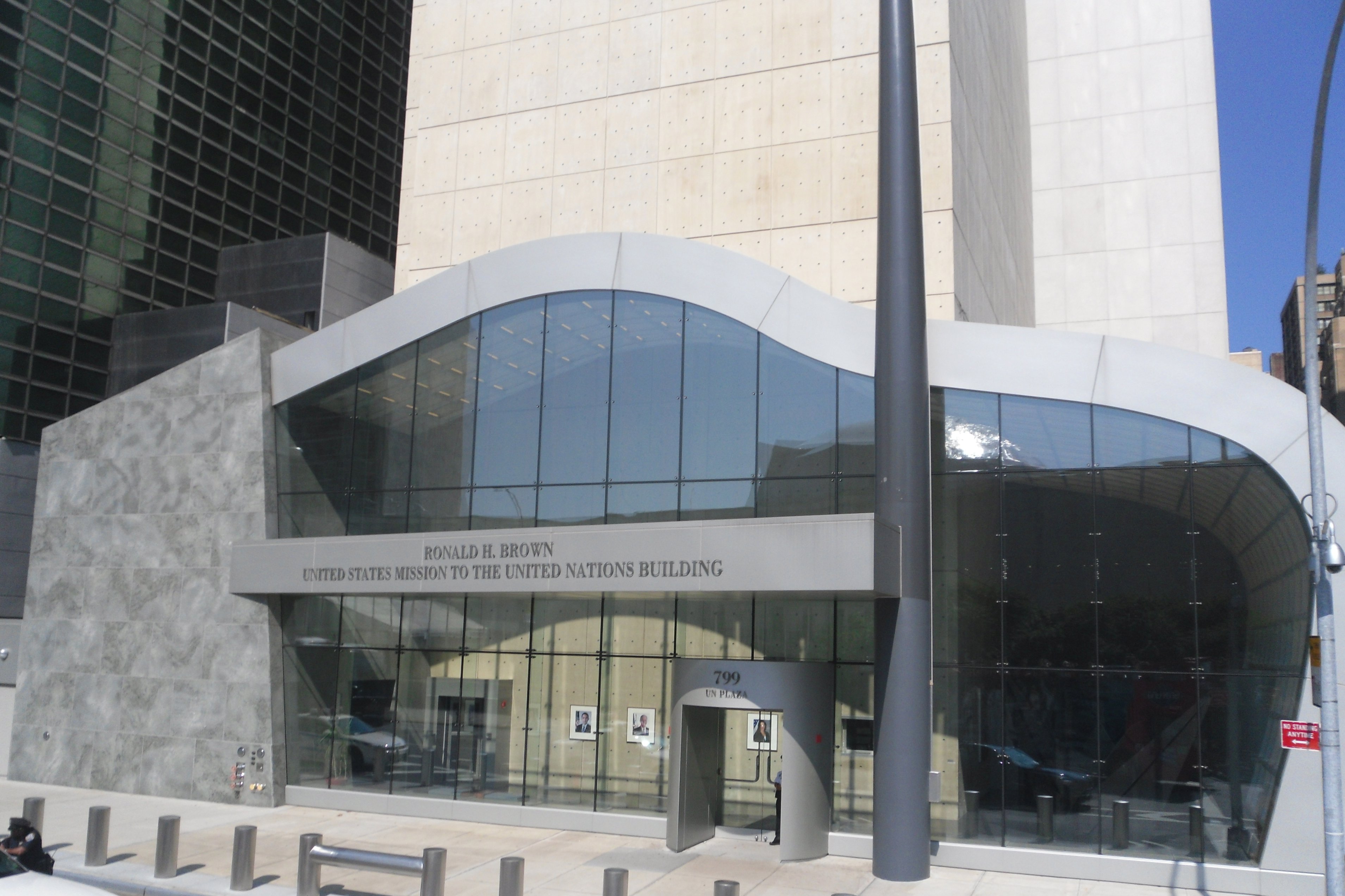
U.S. Mission to the U.N.  Source: Elmschrat CC
The United States has supported a Greek-sponsored UN resolution (A/RES/67/80) titled "Return or restitution of cultural property to the countries of origin."  The resolution (A/67/L.34), adopted by a consensus the General Assembly on December 12, urges nations to take antiquities trafficking seriously.  It was co-sponsored by 98 member states, including Canada, China, Italy, Mexico, Russia, Spain, and the United States.

A United Nations press statement remarked,"By the text, the Assembly deplored damage to world cultural heritage sites, particularly in recent conflict and crisis situations, and called for an immediate end to such acts, reminding States Parties to the 1970 Convention on the Means of Prohibiting and Preventing the Illicit Import, Export and Transfer of Ownership of Cultural Property of their obligations."

In his address to the UN General Assembly, Ambassador Anastassis Mitsialis of Greece said, "Despite concerted international efforts to tackle the problem, illicit traffic of cultural property continues to pose a serious threat to cultural heritage of States. This threat is higher in situations of crisis and conflict, when cultural objects are often smuggled outside their countries of origin."  Ambassador Mitsialis added that "interaction with the international art market in view of improving practices in various areas of expertise such as provenance, investigation, ethics and procedures of restitution proves to be of paramount importance."  Representatives from Argentina, Cyprus, Italy, and Turkey also spoke on the assembly floor in support of the resolution.

The resolution, in part, "Urges Member States to introduce effective national and international  measures to prevent and combat illicit trafficking in cultural property, including  publicizing legislation and offering special training for police, Customs and border services and to consider such trafficking a serious crime, as defined in the United Nations Convention against Transnational Organized Crime."  UNTOC, ratified by the U.S. in 2005, defines serious crime as "conduct constituting an offence punishable by a maximum deprivation of liberty of at least four years or a more serious penalty."

The UN resolution "Also recognizes the importance of cooperation among States in the fight against illicit trafficking of cultural property, as well as its illegal removal from the countries of origin, through, inter alia, the conclusion of bilateral agreements and  mutual legal assistance, including the prosecution of persons involved in such activities and extradition, in accordance with the laws of cooperating States and under applicable international law."

A video covering the introduction, discussion, and adoption of the resolution appears below (total time: 30 minutes).  The discussion references an August 1, 2012 report of the Director-General of the United Nations Educational, Scientific and Cultural Organization on the return or restitution of cultural property to the countries of origin, which can be viewed here.


This post is researched, written, and published on the blog Cultural Heritage Lawyer Rick St. Hilaire at culturalheritagelawyer.blogspot.com. Text copyrighted 2012 by Ricardo A. St. Hilaire, Attorney & Counselor at Law, PLLC. Any unauthorized reproduction or retransmission of this post is prohibited. CONTACT: www.culturalheritagelawyer.com

Thứ Năm, 13 tháng 12, 2012

Importing Cultural Objects Legally: Information Required for U.S. Customs Import Rulings

On December 3, 2012 this blog discussed The Cultural Property Importer's Responsibility.  Today's post continues that discussion by describing the information required by U.S. Customs and Border Protection (CBP) when assessing whether a cultural object may be imported lawfully.

Source: CBP
CBP will issue binding interpretations of law regarding cultural property imports when requested in writing.  19 CFR 177.  CBP, for example, will determine the tariff schedule that a cultural property import falls under, such as subheading 9705.00.0070 of the Harmonized Tariff Schedule of the United States (HTSUS), which typically covers collectors' pieces of archaeological, historical, paleontological, ethnographic, numismatic, and similar categories.  More importantly, CBP will definitively rule whether a cultural object is permitted into the United States.

Museums, antiquities dealers, ancient coin sellers and others are keenly aware of the variety of cultural property, criminal, customs, civil, and other laws that can affect the lawful import of cultural objects.  These laws potentially can subject cultural objects to seizure and forfeiture, and they can prompt criminal charges against individuals for smuggling, receiving stolen property, or other crimes.  That is why a binding customs ruling can be a great benefit.  An official ruling can ensure the legality of an object's import, offering protection from legal liability and preventing "hot" objects from entering the U.S. in violation of American import rules.

A March 10, 2011 customs ruling (NY N148735) describes the types of information that importers or other interested parties should provide to CBP so that the agency can evaluate the lawful entry of a cultural good.  That case ruled on the tariff classification of a silver Dancing Satyr sculpture from the Roman era, and was decided in response to a request filed on behalf of art dealer Robert Haber and Associates.  CBP's National Commodity Specialist Division gives this important advice, applicable to all importers of cultural property:

"If you want a ruling on the admissibility of the Dancing Satyr statue, please furnish to the best of your abilities the following information on the provenance of the antiquity, the history of the item since its removal from the area of origin:

(1) verifiable documentation that the item has been in a private collection or in the same family for several generations or that it was acquired a long time ago,

(2) full names and contact information for all private parties that the seller claims previously owned the item,

(3) full names and contact information of all galleries or auction houses that the seller claims previously owned the item – if the gallery is the owner verifiable information on the previous owner/s as in [1] and [2] above,

(4) an illustration of the item taken from a dated, old auction catalog depicting and describing the exact item,

(5) a dated, signed certificate or statement of authenticity with illustrative photo associated to the item’s description from a respected authority or expert within the field,

(6) all original sales receipts establishing date of purchase,

(7) a film or recording or magazine (literature) talking about the item that can establish time of original purchase or subsequent purchases,

(8) dated letters or papers from recognized experts or authorities discussing the item,

(9) a dated appraisal from a recognized authority or expert with photo and description of the item, and

(10) an analytical investigation report with photo, description and technical write-up establishing a relative timeframe of the piece."

Following customs rules is important and mandatory for cultural property importers.  There is no better way to comply with import regulations than to seek a binding customs ruling and by providing complete information about an object's history to the fullest extent possible.


This post is researched, written, and published on the blog Cultural Heritage Lawyer Rick St. Hilaire at culturalheritagelawyer.blogspot.com. Text copyrighted 2012 by Ricardo A. St. Hilaire, Attorney & Counselor at Law, PLLC. Any unauthorized reproduction or retransmission of this post is prohibited. CONTACT: www.culturalheritagelawyer.com

Thứ Hai, 10 tháng 12, 2012

Cracking Down on Antiquities Trafficking by Changing Homeland Security's "Seize and Send" Policy


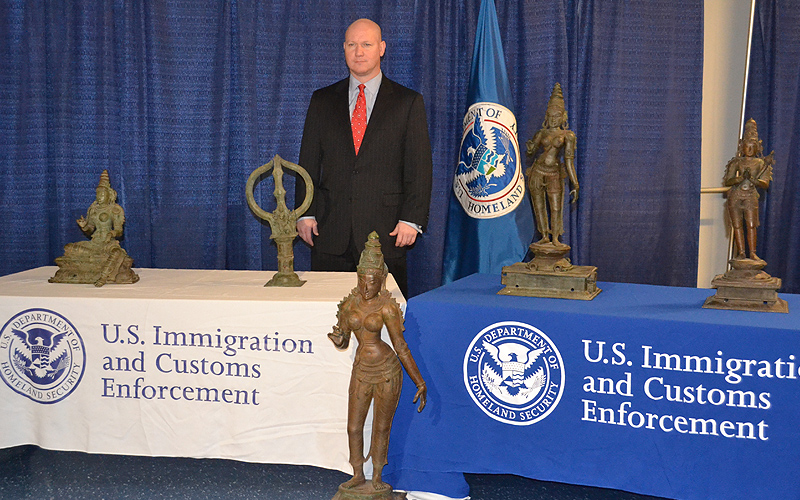
Cracking down on the illegal antiquities trade by regularly prosecuting criminal offenders and dismantling their infrastructure must be a leadership priority for U.S. Immigration and Customs Enforcement's (ICE).  The Homeland Security Investigations (HSI) directorate of ICE currently pursues a "seize and send" policy focused on recovering and repatriating antiquities rather than investigating and indicting criminals.  That policy must change in order to effectively combat a crime that permanently destroys the archaeological record and injures both history and culture. 

HSI Special Agent-in-Charge James Hayes with Indian idols seized last week.
ICE's seize and send policy is illustrated by many of the agency's press releases.  It was restated last week during a Chasing Aphrodite interviewwith James T. Hayes, Jr., Special Agent-in-Charge of HSI New York.  Hayes defended the seize and send policy: "'The focus is always to return stolen property to its rightful owners,' Hayes acknowledged, saying making criminal cases was desirable, but challenging. 'You have to have a legal basis to prove those items, and you have to prove certain things and that proves very difficult.  We’re dealing with laws around the world, in foreign courts and different jurisdictions.'"  HSI's chief added, "At the end of the day, our primary responsibility is to get stolen property back to its rightful owners."

Returning stolen property to owners is a regular goal of many law enforcement agencies.  But there is little indication that simply recovering and repatriating cultural property puts smuggling networks out of business.  Criminals engaged in the illegal antiquities trade surely realize that they face little or no risk of legal accountability for their actions. They must also be aware that the occasional confiscations by police of portions of their inventories do not actually take down their supply, transportation, conservation, distribution, marketing, and sales infrastructures.  That is why prosecutions, coupled with forfeitures of infrastructure assets (instrumentalities forfeitures), should be made part of law enforcement's response.

The decision not to pursue prosecutions and instrumentalities forfeitures on a regular basis produces several negative outcomes:

First, because antiquities traffickers go unindicted, the risk of offenders facing the consequences of prosecution--jail, fines, probation, and/or a criminal record--is eliminated.  Naturally, there is neither general nor specific deterrence against the commission of antiquities trafficking when there is no fear of getting caught.

Second, court sentences will continue to be light in those rare circumstances when antiquities smuggling prosecutions are actually brought forward.  That is because the judiciary, not seeing many cases on their dockets, will believe that this criminal activity is insignificant in scope or impact.

Third, the infrastructures used to facilitate antiquities trafficking will remain intact.  Seizures of ancient pots or Egyptian sarcophagi may remove the fruits of an antiquities trafficker's crime, but their confiscation by authorities likely represents a only portion of the trafficker's illegal inventory at any given moment.  Such limited seizures cannot be expected to shut down expansive global networks operating continuously.  Seizures of the instrumentalities used to commit antiquities trafficking, by contrast, could help dismantle large swaths of trafficking infrastructures.  Just as asset forfeitures in drug cases confiscate the automobiles, boats, planes, homes, etc. used in unlawful narcotics manufacturing and distribution networks, seizures of the instrumentalities used to traffic illegal antiquities could disrupt or shut down antiquities trafficking chains.

Finally, prosecutors and police will continue to confront both a learning curve and inefficiency so long as there iis no change in enforcement policy.  Routine antiquities trafficking prosecutions and enforcement, by contrast, would prompt prosecuting attorneys and detectives to meticulously learn how the crime operates, what evidence is commonly found in such cases, and what legal defenses typically arise.  The experiences gained would foster more efficient criminal investigations in the field and more effective legal cases in the courtroom.

HSI's chief is correct to observe that antiquities trafficking cases can be complex.  But law enforcement authorities over the decades have discovered ways to unravel complex transnational transactions.  If complicated international money laundering, commodities smuggling, and drug trafficking cases can be solved and prosecuted, so too can antiquities trafficking cases.  Indeed, criminal organizations would have little incentive to cease trafficking operations if law enforcement conceded that their activities were too hard to prosecute.

When criminal investigations become too complex to warrant effective action under one set of laws, one enforcement tactic is to separate the overall crime into component parts, examining the parts under different statutes.  So instead of building an antiquities trafficking case broadly around the National Stolen Property Act, for example--which relies on an review of foreign ownership laws to determine if a trafficking suspect has knowingly received stolen antiquities in violation of the statute--authorities might shift their focus to build a case on the basis of false statements.  Put another way, one method of not "dealing with laws around the world, in foreign courts and different jurisdictions" is to focus on the cover-up rather than the crime.

It is widely known that criminals rarely act in the open, committing fraud and deceit to conceal their activities.  That is why criminal cultural property importers oftentimes falsify customs paperwork, classifying looted antiquities as something else on import forms.  Making a false statement on an official customs form is a crimeunder 18 U.S.C. 542, and prosecutions under this statute do not require reliance on anything except evidence of criminal falsification.  Juries simply need to be shown that an ancient antiquity found in a cargo crate is not a "garden table set" or some other false description written down on a customs form. Criminal knowledge of the false statement, meanwhile, can be demonstrated by additional positive evidence and/or by circumstantial evidence--which counts in a criminal case--showing that the criminal defendant was “without reasonable cause to believe the truth of such statement.”  This example demonstrates that there may be other, potentially simpler, legal and investigative options available to authorities.

Cicero said, "What one has, one ought to use: and whatever he does he should do with all his might."  HSI agents are seasoned investigators who should be given the green light to use their skills with all their might in an effort to expose the illegal antiquities trade and take down its networks.  Partnering with prosecutors, HSI should systematically apply the National Stolen Property Act, the false statements law, and many other federal laws to successfully combat antiquities trafficking.  Referring cases for state prosecution should also be a routine consideration rather than an occasional one.  Coupled with the seizure of assets used to facilitate antiquities trafficking, regular prosecutions in the courts would dismantle or disrupt these criminal networks more effectively than the current seize and send policy.


This post is researched, written, and published on the blog Cultural Heritage Lawyer Rick St. Hilaire at culturalheritagelawyer.blogspot.com. Text copyrighted 2012 by Ricardo A. St. Hilaire, Attorney & Counselor at Law, PLLC. Any unauthorized reproduction or retransmission of this post is prohibited. CONTACT: www.culturalheritagelawyer.com

Thứ Sáu, 6 tháng 1, 2012

Documentary - "Fighting Illicit Traffic of Cultural Heritage in South Eastern Europe"

UNESCO has produced the short documentary below titled "Fighting Illicit Traffic of Cultural Heritage in South Eastern Europe."  The report is especially relevant as the Cultural Property Advisory Committee (CPAC) this month considers requests by Bulgaria and Cyprus for cultural property protections under the Cultural Property Implementation Act (CPIA).


CONTACT: www.culturalheritagelawyer.com

Thứ Ba, 22 tháng 11, 2011

Status Conference Held in Case of US v. Khouli, Alshdaifat, Lewis

Egyptian coffin seized by ICE
in the case of US v. Khouli et al.
Photo: ICE
The US District Court for the Eastern District of New York held a status conference in the criminal matter of United States v. Khouli et al. on November 17, 2011.  The court waived all three of the defendants’ presence at the hearing.  The defendants include Mousa “Morris” Khouli, Salem Alshdaifat, and Joseph A. Lewis II.  Ayman Ramadan remains a fugitive.

By way of letter dated November 4, 2011 and written by his attorney, Khouli sought leave to attend a coin show in Baltimore, Maryland, reportedly scheduled for November 16 and 20.  The short letter explained: “As an antiquities dealer, Mr. Khouli’s livelihood depends on his ability to attend coin shows and other similar events.”  The court granted Khouli’s request and extended the ruling, waiving the appearance of the other co-defendants.

Internet records reveal that the Whitman Coin & Collectibles Baltimore Expo was held during this time.  Palmyra Heritage, the name of the business owned and operated by Khouli, was listed as occupying booth #1107 while Holyland Numismatics, the name of the business owned and operated by Alshdaifat, was listed as occupying booth #1154 at the event that took place at the Baltimore Convention Center.

Salem Alshdaifat’s attorney filed documents soon after the November 17 status hearing requesting a change of venue in an effort to curtail any hardship to Alshdaifat, who lives in Michigan.  Submitted on November 21, the pleadings reveal more information about Alshdaifat’s background and his association with co-defendant Ayman Ramadan.  The pleadings also supply a preview of Alshdaifat’s possible legal defenses.  These topics are discussed here.

The next court status conference is scheduled for January 27, 2012.

Chủ Nhật, 16 tháng 10, 2011

Recovery of Looted Egyptian Tomb Reliefs Leaves Unanswered Questions

The ancient Egyptian tomb of Hetepka featured prominently in the widely publicized court cases against Frederick Schultz in the United States and Jonathan Toleley-Parry in Britain as well as in a related criminal case in Egypt. Schultz, Tokeley-Parry, Ali Farag, Toutori Farag, Andrew May, and Mark Parry were all convicted during the late 1990's and early 2000's for their roles in an international antiquities trafficking scheme. That is why Ahram Online’s October 15, 2011 report that two looted limestone reliefs from Hetepka's tomb were “newly recovered” by the Egyptian Tourism and Antiquities Police is noteworthy.

Hetepka served as a royal hairdresser during the pyramid age, and modern-day looters dismembered and destroyed his tomb located at Saqqara. Police eventually found some of the tomb artifacts in Tokeley-Perry’s possession in England, but did not recover all the items that were looted. Ahram Online’s report suggests that the newly recovered reliefs are part of the original cultural objects that went missing from the tomb.

News of the recovery raises many questions:

• On what date and under what circumstances were the reliefs found?

• What information, and from what source(s), led the Egyptian Tourism and Antiquities Police to the reliefs?

• Where exactly were the reliefs found and under what circumstances?

• Whose possession were they in?

• What other items, if any, were also found?

• How are these reliefs related to items that may have been stolen from the tomb recently. Recall that former point-man for Egyptian antiquities, Dr. Zahi Hawass, referenced the Hetepka tomb when discussing his resignation on his blog at http://www.drhawass.com/blog/why-dr-hawass-resigned, saying: “The group now in charge of the protection of these sites is the Tourist Police, but there are no Tourist Police to do this either. Therefore, what happens? Egyptian criminals, thieves (you know, in every revolution bad people always appear…), have begun to destroy tombs. They damaged the tomb of Hetep-ka at Saqqara . . . . They attacked a storage magazine at Saqqara and we do not yet know how many artifacts are missing . . . . People have begun to build houses and to excavate at night, everywhere, putting heritage sites all over the country at risk.”

• Ahram Online reports that the recovered Hetepka reliefs were stolen in 1986. How is this known by the news outlet, especially since prior investigative information revealed that Hetepka’s tomb had been plundered in 1991?

Ahram Online’s report is conspicuously vague. You can read the article at http://english.ahram.org.eg/~/NewsContent/9/40/24162/Heritage/Ancient-Egypt/Two-reliefs-stolen-from-Hetepka-tomb-found.aspx.


Contact information may be found at www.culturalheritagelawyer.com. DISCLAIMER: The information provided on this web site/email/blog/feed is general information only, not legal advice, and not guaranteed to be current, correct, or complete. No attorney-client relationship is formed, and no express or implied warranty is given. Links or references to outside sources are not endorsements. This site may be considered attorney advertising by some jurisdictions. The attorney is licensed in NH. The attorney is not certified by the TX Board of Legal Specialization, nor certified by NY regulators as a so-called "specialist" or "expert." Do not send confidential communications through this web site or email.

Thứ Tư, 12 tháng 10, 2011

Ancient Egyptian Relief from Abusir Recovered

A February 1, 2011 post on this blog spoke about the conflicting reports out of Egypt regarding looting at Abusir. The government reported that the area was safe, while other information suggested otherwise. Now there is information from Ahram Online of the following:

"On Tuesday [October 11, 2011], the Egyptian Tourism and Antiquities Police succeeded in recovering an ancient Egyptian limestone relief which had been reported missing during the chaos that followed the January 25 Revolution.

The relief, which was discovered by the Czech archaeological mission in Abusir, was one metre tall and 60 centimetres wide. It depicted four walking geese with a hieroglyphic text.

Atef Abul Dahab, head of the ancient Egyptian department at the Supreme Council of Antiquities (SCA), told Ahram Online that the relief was one amongst those that were looted from the Abusir storage, following the lack of security after the events in January."


Contact information may be found at www.culturalheritagelawyer.com. DISCLAIMER: The information provided on this web site/email/blog/feed/podcast is general information only, not legal advice, and not guaranteed to be current, correct, or complete. No attorney-client relationship is formed, and no express or implied warranty is given. Links or references to outside sources are not endorsements. This site may be considered attorney advertising by some jurisdictions. The attorney is licensed in NH. The attorney is not certified by the TX Board of Legal Specialization, nor certified by NY regulators as a so-called "specialist" or "expert." Do not send confidential communications through this web site or email.

Thứ Ba, 1 tháng 2, 2011

Conflicting Reports About Abusir: "Nothing Has Been Stolen" v. "Targeted By Thieves"

Starkly contrasting reports have been given about the condition of archaeological sites at Abusir. Abusir is home to a Fifth Dynasty royal necropolis containing over a dozen pyramids, including those of Sahure and Nefirirkare.

Zahi Hawass, newly appointed Minister for Archaeology, told Fox News today: “Everything is safe at the site of Abusir." “Nothing has been stolen from Abusir.”
(Source: www.foxnews.com/scitech/2011/01/31/egypts-treasures-saved-looters-vandals/#ixzz1CegBUuMY)

But Miroslav Barta, a leading archaeologist who conducted the first satellite mapping of the pyramid fields of Abusir, yesterday reported the following for Czech Position:
"Archeological objects in the pyramid field of Abusir uncovered by Czech expeditions over the last 50 years were also targeted by thieves. The extent of the damage caused will have to be examined later because organized gangs are operating in the desert both night and day. Although these gangs’ raids are haphazard, it’s almost certain that artifacts of immeasurable historical value have been destroyed or damaged." Professor Barta added that "[t]he information about the state of the monuments in the pyramid field came from Egyptian colleagues who had been shot at by gangs of raiders."
(Source: www.ceskapozice.cz/en/news/foreign-affairs/czech-egyptologist-ancient-egyptian-sites-damaged-during-unrest)

Meanwhile Nick Parker, Chief Foreign Correspondent at The Sun, today reported from Abusir that archaeology in the area had been hit by thieves.
(Source: www.thesun.co.uk/sol/homepage/news/3383389/SCHOLARS-fear-losing-Egypts-antiquities-as-museums-are-looted-in-revolt-against-tyrant.html)

The reports by Barta and Parker support information contained in an email posted earlier on this blog by Sarah H. Parcak, Assistant Professor at the Department of History and Anthropology at the University of Alabama at Birmingham. The email described archaeological damage at the Abusir site.

Chủ Nhật, 30 tháng 1, 2011

LCCHP and Other Organizations Warn of Cultural Heritage Emergency in Egypt

The Lawyer's Committee for Cultural Heritage Preservation, joined by other organizations, has issued on the situation involving cultural heritage in Egypt. That statement is below:

The undersigned cultural heritage and archaeological organizations express their concern over the loss of life and injury to humans during the protests in Egypt this week. We support the desire of the Egyptian people to exercise their basic civil rights. We also share their concern about the losses to cultural heritage that Egypt has already sustained and the threat of further such losses over the coming days.

Brave actions taken by the citizens of Cairo and the military largely protected the Cairo Museum. However, the numerous sites, museums and storage areas located outside of Cairo are even more vulnerable. As the prisons are opened and common criminals are allowed to escape, the potential for greater loss is created. A recent report from Egyptologist Professor Sarah Parcak of the University of Alabama in Birmingham states that damage has been done to storage areas and tombs in Abusir and Saqqara and that looting is occurring there and in other locations.

We call on the Egyptian authorities to exercise their responsibilities to protect their country’s irreplaceable cultural heritage. At the same time, we call on United States and European law enforcement agencies to be on the alert over the next several months for the possible appearance of looted Egyptian antiquities at their borders.


Archaeological Institute of America
Cultural Heritage Center, The University of Pennsylvania
Lawyers’ Committee for Cultural Heritage Preservation
U.S. Committee of the Blue Shield

Bài đăng phổ biến