Hiển thị các bài đăng có nhãn US v. Khouli et al.. Hiển thị tất cả bài đăng

Thứ Ba, 8 tháng 1, 2013

U.S. v. Khouli et al. Update: Motion to Defer Prosecution Ushers Rapid End to Antiquities Case

Prosecutors in Brooklyn last week entered into a deferred prosecution agreement with defendant Joseph Lewis, II, completing the alleged antiquities trafficking case of United States v. Khouli et al.  One co-defendant's sentence to house arrest in November for smuggling and making  false statements, and a second co-defendant's plea in December to misdemeanor accessory after the fact, with a sentence of a $1000 fine, appear to have accelerated the case to its rapid conclusion.

A deferred prosecution typically involves an agreement between the prosecution and defense whereby the case is suspended for a period of time and upon certain conditions such as good behavior.  Court documents do not reveal the specific agreement in the case involving Lewis, but one document suggests that the deferral period is for one year beginning January 3, 2013.  At the end of the deferral period, the case is dismissed.  For all intents and purposes, a deferred prosecution generally ends the criminal prosecution.  No conviction is entered.

Last year at this time, Lewis' attorney filed a motion to dismiss arguing that the government could not prove its case.

A fourth co-defendant, Ayman Ramadan, remains a fugitive.  However, the completion of the antiquities case in the Eastern District of New York suggests that the fugitive warrant may not be executed by the U.S. Attorney if he were to be arrested.


This post is researched, written, and published on the blog Cultural Heritage Lawyer Rick St. Hilaire at culturalheritagelawyer.blogspot.com. Text copyrighted 2012 by Ricardo A. St. Hilaire, Attorney & Counselor at Law, PLLC. Any unauthorized reproduction or retransmission of this post is prohibited. CONTACT: www.culturalheritagelawyer.com

Thứ Sáu, 21 tháng 12, 2012

U.S. v. Khouli et al. Update: Second Guilty Plea Expected Today in Egyptian Antiquities Case


Earlier this week, Holyland Numismatics coin dealer Salem Alshdaifat signaled his intention to plead guilty to one charge of accessory after the fact in the case of U.S. v. Khouli et al.  The reduced offense is a class B misdemeanor under 18 USC 1018, subject to a maximum punishment of six months incarceration and a fine of $5000.

A federal grand jury sitting in the Eastern District of New York originally indicted Alshdaifat in May 2011 with conspiracy to smuggle.  The indictment alleged that he directed Mousa Khouli to wire $20,000 to Ayman Ramadan’s bank account.  It also alleged that Alshdaifat received an airway bill from Ramadan incorrectly showing that “wooden panels” were shipped by Ramadan’s company in the United Arab Emirates to JFK airport in New York.  Alshdaifat was also charged with money laundering conspiracy, smuggling goods into the United States, and fraudulent importation and transportation of goods.  The indictment described the goods as an Egyptian inner coffin, Egyptian funerary boats and limestone figures, and a portion of an outer lid of a nesting Egyptian coffin set.  

A grand jury indictment is simply a mechanism that initiates a criminal case; it is not a finding of guilt.

In a December 19 letter sent to the federal district court in Brooklyn, which describes today's expected plea of guilty to the substituted misdemeanor charge, Alshdaifat's attorney writes:

"The specific conduct to which Mr. Alshdaifat is charged in the misdemeanor information, and is expected to allocute to in court on Friday [December 21, 2012], involves the importing, on or about May 7, 2009, of certain Egyptian artifacts, including limestone funerary objects, from the United Arab Emirates to the United States by other co-defendants in the case. The airwaybill for this shipment was required by United States Customs law and regulations to include "such information as is necessary to enable the Customs Service to determine whether the merchandise may be released from customs custody." 19 U.S.C. § 1484(a)(l)(A)(i). This information includes, inter alia, the value of the goods being imported. 19 U.S.C. § 1485(a). In this case, the importer of  record, Mousa Khouli, intentionally misled Customs by placing merchandise in international mail that exceeded the value authorized to be entered into the United States by informal entry through the post. 19 C.F.R. Part 145, subp. B, § 145.12(a)(2).  On the airwaybill, he intentionally omitted the value and country of origin of the merchandise included in the mail package.  This certification made to the United States Customs Service was knowingly false in violation of 18 U.S.C. § 1018 and 19 U.S.C. §§ 1484-85. 

"After the international mail shipment arrived in the United States and was received by Mr. Khouli, he asked Mr. Alshdaifat, the seller on consignment of this merchandise, not to require him to make a direct payment of $40,000 for these items.  Instead, the two agreed to credit their accounts on other business.  By doing this, Mr. Khouli was able to avoid creating evidence that he knew that the value of the objects he imported was more than $2,000 and that he made intentionally false statements to Customs.  After the importation had been completed, Mr. Alshdaifat agreed to this financial arrangement knowing that it was intended to avoid creating evidence of Mr. Khouli's earlier violation of the U.S. Customs laws."

Last month the federal district court sentenced Khouli to house arrest after he pleaded guilty on April 18 to smuggling Egyptian cultural property into the United States and making a false statement to law enforcement.  Prosecutors were unable to obtain the prison term they requested.

Alshdaifat too seeks the court's leniency.  His lawyer writes, "The offense to which Mr. Alshdaifat is pleading guilty is substantially less serious and his conduct much less culpable than that of Mr. Khouli."  Counsel for the defendant adds:

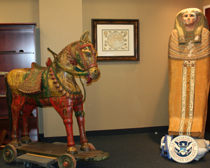
ICE: Artifacts seized in US v. Khouli et al.
"Because Mr. Alshdaifat had only an accessory-after-the-fact role in Mr. Khouli's scheme to make false statements to U.S. Customs, and because he otherwise has a commendable personal history, no prior criminal history, and sympathetic family circumstances, he respectfully requests that the Court not impose a term of imprisonment or probation as part of his sentence for this conduct.  Also, because Mr. Alshdaifat already has suffered substantial economic harm from the fact that this case was brought against him, in both the form of lost business and from the government's improper seizure of his entire inventory of ancient coins for several months after raiding his home at the time of his arrest, we respectfully ask the Court not to impose a significant fine."

Antiquities collector and businessman Joseph A. Lewis, II was also indicted as a co-defendant last year.  His next court hearing is scheduled for January 3, 2013.  The fourth co-defendant indicted, Ayman Ramadan, remains a fugitive.  Both are presumed innocent unless the prosecution proves guilt beyond a reasonable doubt in a court of law.

In 2011, Homeland Security Investigations (HSI) of Immigration and Customs Enforcement (ICE) reportedly seized a large quantity of artifacts associated with the criminal investigation, including hundreds of allegedly smuggled antiquities from throughout the world, an Egyptian sarcophagus, two Indian wooden horses, and thousands of antique coins from ancient Greece, Rome, Egypt and Ancient Mesopotamian.  Authorities last year returned coins seized from Alshdaifat's home back to him. In 2011, Homeland Security Investigations (HSI) of Immigration and Customs Enforcement (ICE) reportedly seized a large quantity of artifacts associated with the criminal investigation, including hundreds of allegedly smuggled antiquities from throughout the world, an Egyptian sarcophagus, two Indian wooden horses, and thousands of antique coins from ancient Greece, Rome, Egypt and Ancient Mesopotamian.  Authorities last year returned coins seized from Alshdaifat's home back to him.

UPDATE December 31, 2012

Court papers published on Friday reveal that Alshdaifat pled guilty on December 21 pursuant to an agreement with federal prosecutors.  He pleaded to accessory after the fact to making a false official writing, a misdemeanor.  The information filed by U.S. Attorney Loretta Lynch charged the defendant with the following:

"In or about and between October 2008 and November 2009, both dates being approximate and inclusive, within the Eastern District of New York and elsewhere, the defendant SALEM ALSHDAIFAT, together with others, knowing that an offense against the United States had been committed, to wit: making and delivering as true a certificate or other writing containing a false statement, contrary to Title 18, United States Code, Section 1018, did knowingly and intentionally receive, relieve, comfort and assist the offender, to wit: Mousa Khouli, also known as "Morris Khouli," in order to hinder and prevent his apprehension, trial and punishment. (Title 18, United States Code, Sections 3 and 3551 et seq.)"

The court imposed a penalty of $1000 plus $10 special assessment.
 

This post is researched, written, and published on the blog Cultural Heritage Lawyer Rick St. Hilaire at culturalheritagelawyer.blogspot.com. Text copyrighted 2012 by Ricardo A. St. Hilaire, Attorney & Counselor at Law, PLLC. Any unauthorized reproduction or retransmission of this post is prohibited. CONTACT: www.culturalheritagelawyer.com

Chủ Nhật, 18 tháng 11, 2012

Jail or No Jail? Sentencing Arguments Filed in US v. Khouli

Mousa "Morris" Khouli will be sentenced this week in federal court in Brooklyn.  Khouli's lawyer, Gerald Shargel, seeks a sentence of probation while the prosecution wants imprisonment.

[UPDATE 11/21/12: Judge Edward R. Korman on November 20 sentenced Khouli to terms that included six months home confinement, one year probation, up to 200 hours of community service, and a criminal monetary assessment of $200.  Judge Korman departed from the federal sentencing guidelines when issuing the order.  Khouli also agreed to forfeit the property seized.]

Assistant United States Attorney Karin Orenstein submitted written arguments to the U.S. District Court for the Eastern District of New York in advance of the sentencing, asking for 46-57 months of incarceration. The prosecutor writes:

Source: ICE
"The smuggling of the Egyptian antiquities that are the subject of the Indictment comprised but a small part of the defendant's smuggling career. ... His willingness to invent provenances to 'launder' cultural property has added an air of legitimacy to items that should be scrutinized as potential stolen property. Indeed, the defendant sold at least one antiquity, the terre-crue head, that was stolen from Iraq. Last, the defendant lied to government agents repeatedly to cover up his criminal conduct."

But Khouli's lawyer argues in court papers that similarly situated defendants have not received sentences of imprisonment. Cultural property dealers, an American soldier, a book author, and a hand surgeon have all received probation for smuggling cultural property, the defense argues.  The defense points to ten criminal cases involving 25 defendants to show that probation is the typical sentence handed down by the courts.

Federal prosecutors counter in their pleadings "that the combination of the rarity of cultural property smuggling prosecutions accompanied by a pattern of non-incarcerative sentences has failed to have a deterrent effect. To the contrary, the remote possibility of a non-jail felony conviction has become the cost of doing business." They add, "Unlike securities dealers or government contractors, dealers in cultural property can continue to work in the same field despite convictions for smuggling and lying to government agents."

Prosecutors concede that "smugglers of cultural property have generally received non-incarcerative sentences" but observe "that that these sentences often include a period of six months or a year of home detention as well as forfeiture and fines." Cases cited by federal prosecutors include (with descriptions and sentences supplied by this author):
  • United States v. Malter, (a case that includes Malter Galleries, Inc.) 09-CR-834 (C.D. Cal.): Pleas of guilty in 2012 to illegal trafficking of artifacts from federal land in violation of the Antiquities Resources Protection Act. Charges dropped involving illegal pre-Hispanic ceramic vessels and artifacts from El Salvador.  Sentence imposed of one year home detention, two years probation, payment of $10,000 of community service to the National Park Foundation Pacific West Region Archaeological Investigation fund, special assessment of $100, restitution in the amount of $6,215.57, and a fine of $8,000.
  • United States v. Perez, 07-CR-499 (C.D. Cal.):  Plea of guilty in 2012 to a single count indictment of smuggling a pre-Hispanic bowl from El Salvador in violation of 18 USC 545 without an export permit as required by 19 USC 2606(a) of the Cultural Property Implementation Act (CPIA). Sentenced to six months house arrest and a fine of $10,000.
  • United States v. Johnson, 08-CR-491 (S.D.N.Y.):  Egyptian stolen property case with a plea of guilty in 2008 to misdemeanor count (dropped from a felony) of receiving stolen property within special maritime and territorial jurisdiction pursuant to 18 USC 662.  Sentenced to restitution in the amount of $21,200 plus a special assessment of $25 and 18 months probation with the first six months served in home detention.
  • United States v. Braude, 03-CR-1009 (E.D.N.Y.):  Pleas of guilty to smuggling under 18 USC 545 and false statements under 18 USC 1001 for trafficking three Iraqi cylinder seals. Sentenced to six months house arrest and a fine of $2000 plus $300 assessment.
"Khouli's professional life has suffered tremendously," argues Khouli's attorney, adding that others do not want to engage in business with a felon who is seen a "a pariah in the industry."  That is why "the government's deterrence arguments [in favor of incarceration] are meritless," he writes.

The defense additionally takes issue with the prosecution's assertion that Khouli had knowledge that an Iraqi terre-crue artifact was stolen.  The defense also emphasizes that "their is no claim that any antiquities at issue in this case were stolen or looted, possessed by Khouli in violation of U.S. law, or imported in violation of Egyptian patrimony laws" (emphasis in the original).

Federal prosecutors want the court to consider that "the defendant flouted Customs regulations time and time again for his own pecuniary gain" and that "Khouli lied to Customs for years and covered up those lies by making false statements directly to investigating agents." They conclude, "A nonincarcerative sentence under these circumstances does not promote respect for the law."

Mousa "Morris" Khouli pleaded guilty on April 18, 2012 to smuggling Egyptian cultural property into the United States and making a false statement to law enforcement authorities.  The antiquities dealer was indicted by a federal grand jury in 2011.  Also indicted were Joseph A. Lewis II, Salem Alshdaifat, and Ayman Ramadan who continue to litigate their cases. Ramadan remains at large.


This post is researched, written, and published on the blog Cultural Heritage Lawyer Rick St. Hilaire at culturalheritagelawyer.blogspot.com. Text copyrighted 2012 by Ricardo A. St. Hilaire, Attorney & Counselor at Law, PLLC. Any unauthorized reproduction or retransmission of this post is prohibited. CONTACT: www.culturalheritagelawyer.com

Thứ Sáu, 28 tháng 9, 2012

Hearing Scheduled in Antiquities Trafficking Case - U.S. v. Khouli et al.

Source: US District Court, Eastern District of New York
The U.S. District Court for the Eastern District of New York has scheduled an important hearing in the alleged antiquities trafficking case involving Joseph A. Lewis, II and Salem Alshdaifat, known as U.S. v. Khouli et al.

The evidentiary hearing will focus on the admissibility of the Alshdaifat's statements to law enforcement as well as the portions of the defendants' omnibus motions that have not been dismissed already.

A summary of the government's written arguments can be found here.  A summary of the defendants' written arguments can be found here: Part I and Part II.

The hearing will take place before Senior District Judge Edward R. Korman on November 19, 2012 at 11:30 a.m.

Lewis and Alshdaifat were charged by a federal grand jury in 2011.  They are presumed innocent unless the government proves guilt beyond a reasonable doubt.  Another defendant in the case, Mousa Khouli, pleaded guilty to charges in April.  A fourth alleged conspirator, Ayman Ramadan, remains a fugitive. 


This post is researched, written, and published on the blog Cultural Heritage Lawyer Rick St. Hilaire at culturalheritagelawyer.blogspot.com. Text copyrighted 2012 by Ricardo A. St. Hilaire, Attorney & Counselor at Law, PLLC. Any unauthorized reproduction or retransmission of this post is prohibited. CONTACT: www.culturalheritagelawyer.com

Thứ Năm, 20 tháng 9, 2012

Cultural Property Cases Roundup - Khouli et al., Sandstone Cambodian Sculpture, Weiss, and ACCG Appeal [UPDATED]

September is a busy month for cultural property law cases.  More activity is expected in the case of United States v. Mask of Ka Nefer Nefer soon, a case that involves the U.S. government's attempt to forfeit a mummy mask from the St. Louis Art Museum and repatriate it to Egypt.   [UPDATE 9/25/12: The 8th circuit has lately granted an order permitting the government to file its brief in the case on October 26 rather than in September].  Thus far there has been activity in four other important cases.

The case of U.S. v. Khouli et al. saw the submission of legal memoranda by defendants Joseph Lewis, II and Salem Alshdaifat urging the court to dismiss the criminal charges against them.  A grand jury alleges that the pair had roles in trafficking antiquities.  Lewis and Alshdaifait vigorously deny the charges.  A third co-defendant, Mousa Khouli pleaded guilty in April 2012.

On September 18, 2012 the eastern federal district court in New York ruled on Lewis' arguments.  Judge Edward R. Korman denied the Motion to Dismiss but the omnibus motions remain.  The court on September 10, meanwhile, granted Alshdaifat's request to travel to England to meet with overseas business partners and to attend the Coinex London 2012 numismatics show.  The prosecution objected to the request.  According to Alshdaifat's lawyer in a September 5 letter to the court, Alshdaifat "has a joint venture with a business in London, called Roma Numismatics."  It appears, however, that the joint venture is actually Athena Numismatics Ltd., which is listed on VCoins.

In the southern district New York federal court, Sotheby's and Ms. Ruspoli di Poggio Suausa filed a reply memorandum on September 17 to bolster their June 5, 2012 motion arguing that the government cannot forfeit a statute in the case of United States Of America v. A 10th Century Cambodian Sandstone Sculpture, Currently Located at Sotheby's.  The claimants' reply brief was filed in response to the government's pleading submitted last month.

New York state court, meanwhile, scheduled the case against Arnold Peter Weiss for sentencing on September 17.  Weiss pleaded guilty in July to attempted criminal possession of stolen property in the fourth degree.  Terms of his sentence, pursuant to the plea agreement, are outlined here.  As part of the sentence, Weiss published an essay titled "Caveat Emptor: A Guide to Responsible Coin Collecting" in American Numismatic Society Magazine.

In Virginia, oral argument in the fourth circuit court of appeals took place on September 19 before judges J. Harvie Wilkinson, III, Stephanie D. Thacker and Michael F. Urbanski in the case of Ancient Coin Collectors Guild v. U.S. Customs and Border Protection; U.S. Department of State; Assistant Secretary of State, Educational and Cultural Affairs.  The ACCG appealed their August 2011 loss in the lower federal district court in Baltimore.  The organization submitted its written arguments in October 2011, and the federal government replied in January 2012.

The attorneys' oral arguments in the ACCG case can be heard in their entirety here.  In sum, Judge Wilkinson appeared unwilling to involve the judiciary in foreign affairs decisions of the executive branch, which can be overseen by the legislative branch. He had apparent trouble finding that  the U.S. State Department acted arbitrarily or capriciously when implementing import controls over ancient coins under the Cultural Property Implementation Act (CPIA). "Why should we jump into this and make it a tri-cornered mess," asked the court in its apprehension of being drawn into a matter that involves the two other branches of government.

The court appeared to believe that there is a "slight burden" placed on the importer--not on the government--to show where ancient Chinese and Cypriot coins have been in the past few years; the inquiry is not where the coins have traveled in ancient times. And this burden, which is "not a huge hurdle to surmount,"should be placed on importers because importers have the most knowledge.

[Hat tip to Nathan Elkins for highlighting the Weiss article in ANS Magazine].


This post is researched, written, and published on the blog Cultural Heritage Lawyer Rick St. Hilaire at http://culturalheritagelawyer.blogspot.com. Text copyrighted 2012 by Ricardo A. St. Hilaire, Attorney & Counselor at Law, PLLC. CONTACT: www.culturalheritagelawyer.com

Thứ Hai, 23 tháng 7, 2012

Objection Filed: Prosecution Outlines Factual Claims in U.S. v. Khouli et al.

Assistant United States Attorneys Karin Orenstein and Claire Kedeshian have filed an 87 page objection in response to motions filed on April 30, 2012 by Joseph Lewis, II and Salem Alshdaifat.  The government objects to the defendants' efforts to scuttle the case of United States v. Khouli et al., and the prosecutors take the opportunity to present the court with their evidence.

Lewis and Alshdaifat were charged by a federal grand jury in 2011 with crimes related to antiquities trafficking.  They are presumed innocent unless the government proves beyond a reasonable doubt that they had knowledge of the illegality and acted unlawfully. Another defendant in the case, Mousa Khouli, pleaded guilty to charges in April, while a fourth alleged conspirator, Ayman Ramadan, remains a fugitive at large.

In its objection filed with the U.S. District Court for the Eastern District of New York, the government argues, in part, that
  • the warrants authorizing searches of Lewis' home in Virginia and Alshdaifat's home in Michigan and their execution by federal agents were proper;
  • the search of the two defendants' emails were reasonable and properly authorized by three valid warrants;
  • Alshdaifat did not suffer violations of his right to remain silent or his right to counsel;
  • the smuggling statute (18 USC 545) is not unconstitutionally vague;
  • the government did not engage in any alleged overreaching or misconduct in the case;
  • the venue of the court (eastern district of New York) is proper; and
  • the money laundering conspiracy charge is valid.
Source: ICE
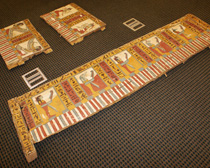
To support its legal arguments, and to paint a picture of the alleged smuggling and money laundering conspiracy, the government presents the court with a narrative describing the movements of an allegedly smuggled Greco-Roman coffin, a mummy board, a 3-piece nesting Egyptian coffin set, and Egyptian boats and limestone artifacts.

Federal prosecutors outline how Khouli and Ramadan smuggled the Greco-Roman coffin into JFK Airport in New York by transferring two payments of $10,000 and $3400 and submitting false customs information.  "While Lewis and Alshdaifat are not charged with smuggling the Greco-Roman coffin . . . the facts surrounding this transaction are revealing with regard to Lewis’s mens rea [i.e. criminal knowledge] for his subsequent transactions with Khouli," write the attorneys. The attorneys highlight that the customs papers listed the Greco-Roman coffin's country of origin as United Arab Emirates and not Egypt and described the coffin as "antique wood panel" valued at $3400. Prosecutors also tell how a sales invoice that did not originate from the actual seller, who was Ayman Ramadan/Nefertiti Eastern Sculptures Trading, was attached to the customs papers.

The government's lawyers go on to describe that the first artifact purchased by Lewis from Khouli was a mummy board, eventually seized by federal agents during a July 13, 2011 search of Lewis' Virginia home:

"Khouli sold an Egyptian mummy board to a customer .... A mummy board is a decorated wooden board that fits inside a coffin along with a mummy. On January 9, 2009, before [the customer] took physical possession of the mummy board from Khouli, Lewis purchased it from [the customer] for $60,000.  The bill of sale between Lewis and [the customer] included a photograph of the mummy board and identified its prior owners as Khouli’s company, Windsor Antiquities (“Windsor”), and previously, a private Dutch collection that acquired the item in the 1960s. The mummy board depicted in the bill of sale appears to have a transverse cut across the middle. On January 14, 2009, several days after the sale, Khouli and Lewis were in direct e-mail contact about shipping the mummy board from Khouli to Lewis.

"On February 10, 2009, Khouli advised Lewis by e-mail that he had obtained the mummy board from a restorer and offered to ship it to Lewis. Lewis inquired as to whether the repair at the 'joints' was invisible, referring to where the cut pieces were joined together."

On the same day, February 10, 2009, an Immigration and Customs Enforcement Agent (ICE) agent questioned Khouli about the importation of the Greco-Roman coffin.  The government reports that "[o]n the following day, February 11, 2009, Khouli offered Lewis two Egyptian antiquities: the Greco-Roman coffin and a bronze figure. Khouli advised Lewis by e-mail, 'Let me know what you think about the two Egyptian pieces[;] these are from my dad[’]s collection[;] he passed away about three years ago and my brothers and I want to sell them and split the money.'"  Lewis reportedly purchased the coffin for $32,500, not $65,000 as proposed by Khouli.

Because "[n]o mention was made of any other objects remaining from Khouli’s father’s collection [and because] Lewis’s dealings with Khouli the previous month indicated that Khouli had ... acquired the mummy board from a private Dutch collection, not from his father," federal prosecutors argue that "[t]hese facts belie Lewis’s argument that he had a basis for believing that every item he purchased from Khouli came from Khouli’s father’s collection."

In fact, government attorneys suggest that Khouli signaled to Lewis that the Greco-Roman coffin did not actually come from his father, stating:

"On March 6, 2009, after Khouli and Lewis had agreed to the sale of the Greco-Roman coffin, but months before Lewis took possession of it, Khouli offered Lewis a mummy linen and mask, writing in an e-mail, 'I just got th[e]s[e] items[;] i described them to you last week . . . .' (Gov’t Exh. 1; emphasis added). On the same date, Lewis responded, in sum and substance, that he already had four such items and that they were not very expensive. Khouli replied on the same date, 'It is very interesting[;] it was inside the coffin you bought from me according to the owner but he sold I[t] to me separately son of a gun.' (Id.; emphasis added). The statement that the Greco-Roman coffin had belonged to a separate 'owner' who 'sold' both the coffin and a related mummy linen and mask to Khouli was inconsistent with Khouli’s earlier representation that the Greco-Roman coffin had been sitting in his father’s collection for decades.  Upon learning this information, Lewis did not cancel the Greco-Roman transaction or request a new provenance from Khouli. Rather, he agreed to purchase the mummy linen and mask. In addition, despite Lewis’s only information about the mummy linen and mask’s provenance being that Khouli had 'just' received them and they were 'sold' to Khouli by another dealer, Lewis’s records for these antiquities include a Windsor bill of sale stating that these items were 'legally acquired by the late Jack Khouli in Israel in the 1960s.' While Lewis is not charged with smuggling the Greco-Roman coffin, his experience with Khouli in early 2009 told him that (1) not every Egyptian antiquity Khouli sold was from his father’s collection, and (2) any provenance that included Khouli’s father was unreliable."

The next day, on March 7, 2009, Khouli offered Lewis both a middle and outer coffin of an ancient Egyptian nesting coffin set, according to the prosecution.  Khouli reportedly went to Dubai in April to view them and discovered a third inner coffin.  Prosecutors say that  "Lewis’s e-mail messages indicate that he believed that the inner coffin was part of the same set as the middle coffin and outer coffin lid, making a three-piece nesting set. In these email messages, Khouli advised Lewis that the inner coffin had already been sold to another buyer and Lewis agreed to pay $150,000 for the inner coffin to avoid breaking up the set. The total agreed price for the nesting set was $310,000. Nothing in these e-mail exchanges suggested that Khouli had previously been aware of any of these coffins let alone that they had ever been in his father’s collection."

The government's lawyers add:
"On April 12, 2009, Lewis sent an e-mail message to Khouli confirming the details of the sale of the three piece coffin set. Lewis’s terms included that Khouli would provide “[p]rovenance from [his] late father’s collection, Israel 1960s” and a guarantee that the items would be cleared by Customs within 30 days of arrival. Khouli agreed to these terms. (Gov’t Exh. 4)."

The nesting coffins were sent to the United States in pieces using different transportation methods--international mail, air cargo, and sea cargo--and sent through separate points of entry, specifically JFK Airport in New York and the Port of Newark in New Jersey.  Prosecutors write in their pleading that the shipments were variously described for Customs as wooden panels, Indian furniture, purchased by a Connecticut third-party, or valued at $900. The coffin set was delivered to a Connecticut address.

Prosecutors further allege that Lewis knew that the Egyptian coffin parts required assembly.  "Lewis was therefore aware that pieces of the inner coffin and the remaining parts of the coffin set were being shipped in pieces, over an extended time period, because there was some risk attached to their importation."  Federal attorneys describe how Khouli sent an email to Lewis on April 29, 2009: "“i (sic) got the first half of the cut inner coffin the second half is on the way, shall I send it to you or should I wait for the second half and have [a certain person] look at it and have it fixed?” (Gov’t Exh. 6; emphases added). Lewis responded, “[The certain person] needs to put them together, when will the other two coffins arrive?” (Id.; emphasis added)."

Then in May 2009, Alshdaifat allegedly sold Khouli two ancient Egyptian funerary boats and five limestone figures for $40,000, which made their way from Ramadan to Khouli by international mail and then to Lewis. Prosecutors say that Ramadan sent the shipping label, which described the package as "antiques," to both Alshdaifat and Khouli.

The defendants may file a reply to the government's objection.  Meanwhile, Khouli's sentencing hearing is scheduled for next month.

CONTACT: www.culturalheritagelawyer.com
(c) 2012 Ricardo A. St. Hilaire, Attorney & Counselor at Law, PLLC

Thứ Năm, 31 tháng 5, 2012

Prosecution Specifies Laws Allegedly Violated in U.S. v. Khouli et al. Prosecution

The prosecution has more particularly identified the laws it will use to prosecute Joseph A. Lewis, II and Salem Alshdaifat, both indicted last year by a New York federal grand jury for crimes relating to alleged antiquities trafficking.  Earlier this month, Chief Magistrate Steven M. Gold denied the defendants' motion for a bill of particulars.  However, the court ordered government attorneys to further crystallize the laws it would rely on during trial.

The U.S. Attorney's Office for the Eastern District of New York, in part, explained the following in a recent letter to the court:

"The Indictment alleges that the defendants acted contrary to law by providing Customs with false declarations of county of origin, seller, consignee and purchaser; providing Customs with vague and misleading descriptions of shipments' contents; failing to declare that multiple shipments contained a single purchase or to declare the full value of that purchase; and failing to file entry on international mail shipments, and accordingly, failing to make required declarations regarding those shipments. . . . The applicable Customs regulations that were violated by the above-described conduct are contained in Title 19, Code of Federal Regulations, Part 141 (“Entry of Merchandise”), Part 142 (“Entry Process”), Part 143, Subpart C (“Informal Entry”), and Part 145 (“Mail Importations”). . . . "

"In addition, by making material false statements to Customs, the charged conduct was contrary to Title 18, United States Code, Section 542 (“Entry of Goods by Means of False Statements”). See, e.g., United States v. An Antique Platter of Gold, 184 F.3d 131, 134-37 (2d Cir. 1999)(finding that a false declaration regarding an item’s country of origin violated Section 542, and the importation was therefore “contrary to law” for purposes of forfeiture of that item pursuant to Section 545)."

Thứ Hai, 21 tháng 5, 2012

U.S. v. Khouli et al. Update: Judge Denies Defendants' Discovery Motion... With An Exception

"In general, defendants' motion for a bill of particulars is denied ...."  That was the order of Chief Magistrate Steven M. Gold in the alleged antiquities trafficking cases of Joseph A. Lewis, II and Salem Alshdaifat. Together with Mousa Khouli and Ayman Ramadan, the defendants were indicted by a New York federal grand jury in 2011.  Lewis and Alshdaifat deny the charges.  Khouli  pleaded guilty to the charges in April. Ramadan remains a fugitive from justice.

Cultural property seized in U.S. v. Khouli et al.
Courtesy ICE
On April 11, 2012 co-defendants Lewis and Alshdaifat submitted a bill of particulars requesting more specific discovery from the prosecution.  The prosecution objected, saying "the government has already provided more than the law requires."

After a hearing last Friday, the U.S. District Court for the Eastern District of New York ruled against the defendants "with the exception that the United States shall, by May 25, 2012, identify any regulations, treaty provisions, or foreign laws it will rely on at trial as 'laws' in connection with the charge that defendants 'fraudulently or knowingly import[ed or brought] into the United States, any merchandise, contrary to law' in violation of 18 USC 545."

18 USC 545 is the federal smuggling statute.  That law states in relevant part:

"Whoever fraudulently or knowingly imports or brings into the United States, any merchandise contrary to law, or receives, conceals, buys, sells, or in any manner facilitates the transportation, concealment, or sale of such merchandise after importation, knowing the same to have been imported or brought into the United States contrary to law—

Shall be fined under this title or imprisoned not more than 20 years, or both.

Proof of defendant's possession of such goods, unless explained to the satisfaction of the jury, shall be deemed evidence sufficient to authorize conviction for violation of this section."

CONTACT: www.culturalheritagelawyer.com

Thứ Năm, 3 tháng 5, 2012

Part II: Motions Filed by Lewis and Alshdaifat in U.S. v. Khouli et al. Take Aim at the Government -- Smuggling Statute Claimed to be Overbroad


Continued from yesterday.

CC. Source: www.legaleducation.org.uk
Salem Alshdaifat’s attorney also filed an omnibus motion in the matter of U.S. v. Khouli et al.  He claims that his client was a broker or middleman who did not participate in the importation of the cultural objects that are part of the criminal case.   He seeks to dismiss all counts of the indictment against Alshdaifat; suppress physical and digital evidence; suppress post-arrest statements of his client; have an evidentiary hearing to resolve any factual disputes related to the motions; compel the government to produce expert witness discovery; provide notice of any “prior bad acts” evidence; and have permission to join in motions filed by Joseph A. Lewis, II.

Specifically, Alshdaifat contends that the smuggling statute (18 U.S.C. § 545) is void for vagueness.  Therefore, Alshdaifat cannot be prosecuted under the statute.  To quote from Alshdaifat’s memo of law:

“The federal smuggling statute … has been interpreted by federal courts to mean different things depending on where a defendant conducts his business. Mr. Alshdaifat could not be charged with a smuggling crime had the merchandise been mailed to New Jersey, Pennsylvania, or Delaware because the Third Circuit has ruled since 1994 that Section 545 requires an intent to deprive the United States of revenue.  In this case, the merchandise involved in the Section 545 offenses are classified as 'antiques,' and under the Harmonized Tariff Schedule of the United States, Heading 9706, they are duty free. Thus, in the Third Circuit, there would be no crime here. However, in the Second Circuit [covering New York], the Section 545 smuggling crime has been more expansively interpreted to cover conduct beyond an intent to defraud the United States of its right to revenue. Given that the courts cannot agree on the meaning of this statute, ordinary people will find it difficult to understand what conduct is actually prohibited by the statute.” (Citations omitted).

Alshdaifat’s lawyer adds that “the current expansive interpretation in the Second Circuit of Section 545's ‘intent to defraud’ provision is unconstitutionally vague,” requiring dismissal of charges against the defendant.

Improper venue is also argued as a basis for dismissing the charges.  Counsel for Alshdaifat contends that points of entry for certain goods that are the subject of the indictment are not articulated, or that points of entry mentioned in the discovery materials specifically relate to places outside the Eastern District of New York such as Manhattan or Connecticut.

Alshdaifat’s motion additionally argues that evidence must be suppressed that was derived from “defective” search warrants granting seizure of emails.  Alshdaifat’s lawyer claims that one warrant lacked probable cause for the government to believe that “evidence of a crime would be found within the Alshdaifat Yahoo! e-mail account.”  “This request … was quite expansive and intrusive. It sought authorization to search literally tens of thousands of e-mail communications of several individuals.” Alshdaifat’s lawyer adds that the Magistrate issuing the warrant was “misled.”  A second warrant authorizing the search and seizure of emails must also be struck down, it is argued, because it is tainted by the fruits of the first search warrant.

Meanwhile, federal agents’ search of Alshdaifat’s Michigan home is alleged to be improper because the magistrate's warrant was based on tainted evidence, the warrant was unconstitutionally overbroad, and the agents who executed the warrant went beyond their authority.  The evidence gathered must therefore be suppressed.

Alshdaifat’s lawyer takes pointed aim at statements made in the warrant affidavit by one Immigration and Customs Enforcement (ICE) agent, which describe a past allegation of smuggling by Alshdaifat in Detroit.  The Agent's account of this incident is emblematic of the reckless way the government conducted this investigation and how they repeatedly misreported information to force the ‘facts’ to fit their theory,” writes counsel. “The Agent's rendition of the incident at Detroit Metro Airport with Mr. Alshdaifat should not contribute to a probable cause showing to invade his home because it does not suggest crimes involving violations of Customs laws or the National Stolen Property Act.” (Citations omitted).

The manner in which federal agents searched Alshdaifat’s home last year also earns scrutiny by legal counsel:  “While the Warrant's Attachment specifically limited the items to be seized to those ‘which are evidence of . . . art or antiquities that were illegally imported,’ the searching agents took everything—every last coin and trinket in the house. There was no attempt to connect these items with evidenc[e] that they were illegally imported—none at all.”

Moreover, it is argued that statements made by Alshdaifat to authorities should not be introduced at trial because the defendant was represented by legal counsel when authorities questioned him outside his home in Michigan.  The attorney writes that “Mr. Alshdaifat requested the opportunity to call his lawyer, and was denied. Under these circumstances, Mr. Alshdaifat did not voluntarily waive his right to have counsel present at his post-arrest interview and his statements were far from voluntary.  Moreover, because at the time of his arrest, Mr. Alshdaifat was already under indictment in the Eastern District of New York and represented by counsel on matters related to that indictment, the government also violated his attached Sixth Amendment right to counsel.” (Citations omitted).

The prosecution will have a chance to respond to the omnibus motions filed by Lewis and Alshdaifat.

Thứ Tư, 2 tháng 5, 2012

Part I: Motions Filed by Lewis and Alshdaifat in U.S. v. Khouli et al. Take Aim at the Government -- SLAM Forfeiture Lawsuit and Sotheby's Cambodian Case Cited


Objects seized in U.S. v. Khouli et al.


Attorneys for Joseph A. Lewis, II and Salem Alshdaifat both filed omnibus motions this past Monday in the criminal case of U.S. v. Khouli et al.  They argue multiple grounds for relief.

A federal grand jury sitting in the Eastern District of New York indicted antiquities collector and businessman Lewis as well as ancient coin dealer Alshdaifat for their roles in an alleged antiquities trafficking conspiracy.  They are presumed innocent.  Their efforts appear more vigorous now that a third co-defendant, antiquities dealer Mousa "Morris" Khouli, pleaded guilty last week.  A fourth co-defendant, Ayman Ramadan, remains a fugitive.

Joseph Lewis’ lawyers seek to dismiss the case against their client; suppress evidence seized by authorities from email accounts; dismiss specified counts of the indictment; have the grand jury minutes reviewed by the court; seek to obtain advance notice of any prior bad acts by Lewis that the prosecution may raise at trial; and join arguments made by Alshdaifat’s attorney.  Some of the arguments made by Lewis’ lawyers are discussed here.

Lewis’ attorneys say that the evidence obtained by court issued search warrants must be suppressed.  The attorneys argue that affidavits in support of searches of Lewis’ home and emails were misleading and contained material omissions.  “In each supporting affidavit the government repeatedly presented exaggerated, conclusory assertions and omitted contextually important material facts.  Most blatantly, these affidavits painted Mr. Lewis and the alleged conspirators as grave robbers trafficking in stolen property, when the government knew that that was not true and more important, that it lacked proof to support these allegations.”  For example the government “never disclosed the absence of proof that any piece was stolen, preferring instead to create an aura that such proof did exist.”  The government also did not mention anything about Lewis’ inquiries to Khouli, made in order to confirm the provenance of an Egyptian coffin, instead implying that Lewis “asked [Mr. Mousa] Khouli to create a false provenance ….”  Had the government presented a full picture of its evidence and not made improper implications, Lewis’ attorneys contend that the “Magistrate Judge would have been deeply troubled by the [search warrant] application …”

The lawyers for Lewis protest that “the government baldly asserted . . . that ‘persons who smuggle cultural property of questionable provenance into the United States typically avoid detection by Customs by means of false statements . . . .”  Lewis’ attorneys attack this line of reasoning, in part, because they say that Lewis was never part of the importation process of antiquities and because “hundreds of foreign antiquities … lawfully exist throughout the United States despite their bearing explicitly uncertain provenances.”

To support their client’s claims, Lewis’ attorneys cite the recent dismissal of the federal government’s forfeiture case in the matter of US. v. Mask of Ka Nefer Nefer:  “[I]t has become the practice of the government in the antiquities field [to make assertions] without regard for the truth as was shown recently, when the government was badly rebuffed and excoriated in a recent effort to seize an antiquity from the St. Louis Art Museum.”

Lewis’ attorneys also contend that federal agents acted beyond the scope of the warrant authorizing a search of Lewis’ Virginia home last year.  Instead of simply taking relevant antiquities—e.g. a Greco Roman coffin, an Egyptian nesting coffin, limestone figures, and funerary boats—as well as related items such as documents, the agents took items well beyond what the warrant authorized.  The attorneys claim that the seizure of documents related to Lewis’ insect collection, personal documents, and more was outside the scope of the warrant’s authority.  The lawyers state that “U.S. Fish and Wildlife Service agents were inappropriately invited to participate, undoubtedly contributing to the massive number of unrelated and unauthorized seizures.”  The only way to cure the problem of an overly broad execution of a search warrant is to suppress the evidence obtained by it, the lawyers argue.

Attorneys for Lewis further argue that the case against their client should be dismissed because of government excesses.  They urge the court to drop the criminal case against Lewis because of the alleged misconduct described above, because of reckless media statements, and because of selective prosecution.  The attorneys say that Lewis has been unfairly characterized in the press by government misrepresentations, and that there is “an overall campaign to harm Joe Lewis” as illustrated by “damaging accusations” made to CNN, The New York Times, and elsewhere. 

Lewis has also been unfairly targeted for prosecution, they say.  “Indeed, outside of this case, the number of traded antiquities with dubious , questionable or unknown provenances are too numerous to count and yet none of those sellers or buyers have been prosecuted based on questionable provenance alone—the only factor here,” the lawyers argue. (Emphasis in the original).  To further illustrate the claim, Lewis’ lawyers point to the lack of prosecution occurring in the Sotheby’s case involving forfeiture of a Cambodian statue.

Legal counsel also asks the court to dismiss the money laundering count against Lewis, in part, because the charge is not based on Lewis paying money for the importation of cultural property.

Because Customs seized the components of an Egyptian nesting coffin in Newark, New Jersey, the case should also be dismissed for improper venue.  The court for the Eastern District of New York does not cover cases arising in Newark, Lewis’ lawyers say.

Attorneys for Lewis conclude by asking the court to review the transcript of the grand jury session.  Normally grand jury proceedings are confidential.  But the attorneys state that the government’s excesses were so pervasive in this case that a judge should review the testimony given to the grand jury.

To be continued tomorrow ...

Thứ Hai, 30 tháng 4, 2012

Objection to Bill of Particulars Filed in U.S. v. Khouli et al.


The defendants have more than enough information.  So says the government’s 17 page objection to a bill of particulars filed by defendants in the case of United States v. Khouli et al.

Earlier this month co-defendants Joseph A. Lewis II and Salem Alshdaifat submitted a bill of particulars requesting detailed discovery from the prosecution.  The two were indicted last year in a New York federal district court in for their alleged roles in trafficking antiquities.  They want information from the prosecution about which ports were used to import the antiquities, what documents were provided to Customs, and which representations on Customs forms were false.  Mousa "Morris" Khouli, another co-defendant and an antiquities dealer, pleaded guilty to charges on April 18.

Assistant United States Attorney Karin Orenstein on Aprl 27 filed an objection to the bill of particulars, arguing “The defendants’ demands for particulars seek granular detail of the government’s proof, and the government has already provided more than the law requires. The Indictment and the discovery, which includes a verified civil complaint and multiple search warrants, provide the defendants with all the information they need to understand the specific acts of which they are accused.”

Attached to AUSA Orenstein’s objection is a sheet outlining the information that has been provided to the defense. It lists such items as bank records; search warrant affidavits concerning homes, emails, and businesses; postal records; UPS records; photographs of antiquities; Paypal records; travel records; customs documents; insurance documents; and Go Daddy accounts.


Thứ Năm, 19 tháng 4, 2012

Antiquities "Launderer" Pleads Guilty As Co-Defendants Continue to Litigate Case of US v. Khouli et al.

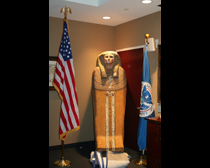
Egyptian coffin seized in
US v. Khouli et al.
Courtesy ICE.
Mousa "Morris" Khouli pleaded guilty yesterday to smuggling Egyptian cultural property into the United States and making a false statement to law enforcement authorities, according to the United States Attorney for the Eastern District of New York.  Khouli, a New York based antiquities dealer, was indicted by a federal grand jury in 2011 for his role in illegally importing ancient artifacts.  Also indicted were Joseph A. Lewis II, Salem Alshdaifat, and Ayman Ramadan. Ramadan remains at large.  (Those indicted are considered innocent unless proven guilty).

A press release issued by U.S. Attorney Loretta Lynch states the following:
"The defendant [Mousa Khouli] entered his plea before the Honorable Edward R. Korman, United States District Judge, at the U.S. Courthouse in Brooklyn. The defendant faces a maximum sentence of 20 years’ imprisonment. The defendant also entered into a stipulation of settlement resolving a civil complaint seeking forfeiture of the Egyptian antiquities, Iraqi artifacts, cash and other pieces of cultural property seized in connection with the government’s investigation." (See here for background).

This guilty plea follows a motion hearing held on March 23, 2012 where co-defendant Joseph Lewis II's lawyer argued a motion to dismiss the case against Lewis.

Lewis is alleged to have received contraband Egyptian archaeological material from Khouli.  But Lewis' lawyer maintained at the hearing that Lewis was never part of the illegal importation process.  At the March court proceeding, Lewis' attorney argued: "The issue for this case is whether this man participated in or agreed to participate in the process by which these objects were brought in deceitfully through United States Customs.  That's the issue.  There's no evidence of that."

Assistant United States Attorney Karin Orenstein countered that it is inappropriate for the court to dismiss a case based on facts that should be heard and evaluated during a trial.  She also stated that Lewis' involvement in an illegally imported Egyptian coffin found in Miami, Florida in 2008 would be used as evidence to show that Lewis knew about the mechanics of the import process into the U.S. of cultural property.

Attorney Orenstein further described how Khouli acted as "a cultural property launderer."  "He creates good provenance for a piece, so that when it comes through Customs, if it is scrutinized, they will see this is an item that left Egypt at a time when there were no laws protecting it from leaving Egypt."  She added that the Egyptian sarcophagus at issue in this criminal case was described as coming from Khouli's father's collection from Israel in the 1960s. Orenstein alleged that Lewis told Khouli: "Put in the provenance from your late[] father's collection, Israel, 1960s."  Orenstein also alleged that "Mr. Lewis had no reason to believe it came from [Khouli's] father's collection."

Lewis' attorney disagreed with the prosecutor, maintaining that the government lacked trial witnesses to back up its suggested evidence.

The court expressed reluctance to rule on the matter prior to trial when a fact finder would hear and weigh all the evidence.

Meanwhile, on April 11, 2012, co-defendants Lewis and Alshdaifat filed a bill of particulars requesting detailed discovery from the prosecution.  The co-defendants seek information about which ports were used to import the cultural property, what documents were provided to Customs, and which representations on the Customs forms were false.

Khouli is scheduled to be sentenced on September 14, 2012.

Reference: Transcript of March 23, 2012 hearing filed as attachment to Joseph Lewis II Bill of Particulars.

CONTACT: www.culturalheritagelawyer.com

Bài đăng phổ biến