Hiển thị các bài đăng có nhãn Customs and Border Protection (CBP). Hiển thị tất cả bài đăng

Thứ Tư, 10 tháng 7, 2013

Do CPIA Import Restrictions Constitute an Embargo?

Do import restrictions derived from the Convention on Cultural Property Implementation Act (CPIA) constitute an embargo? That is a question that has resurfaced after reading Erik Smithweiss, "A Race To The Courthouse: Jurisdiction Over Customs Admissibility Decisions," 21 Tul. J. Int’l & Comp. L. 291 (2013) and Stephen C. Tosini, "The Embargo Upon Endangered Species: Accidental Jurisdiction In The Court of International Trade," 21 Tul. J. Int’l & Comp. L. 311 (2013).

CPIA import restrictions prohibit designated archaeological and ethnological objects from entering the United States. The prohibitions serve to safeguard endangered cultural heritage. Once the President determines that specific cultural material originating in a foreign nation is in jeopardy of pillage, protective import controls are put in place. U.S. Customs and Border Protection (CBP) agents are given authority to detain, seize, and forfeit the protected cultural objects. Should an importer choose to challenge a CBP decision, there may be a question about which court can hear the case depending on how once understands an "embargo."

U.S. Court of International Trade
The Court of International Trade (CIT), based in New York, possesses national jurisdiction over what its title suggests, namely international trade. The CIT is given exclusive jurisdiction by Congress under 28 U.S.C. § 1581(i)(3) over embargo enforcement actions covering "embargoes or other quantitative restrictions on the importation of merchandise for reasons other than the protection of the public health or safety." What constitutes an embargo is outlined by the U.S. Supreme Court's decision in K Mart Corp. v. Cartier, Inc., 485 U.S. 176, 185, aff’d in relevant part, rev’d in part, 486 U.S. 281 (1988), which explains that “the ordinary meaning of ‘embargo,’ and the meaning that Congress apparently adopted in the statutory language ‘embargoes or other quantitative restrictions,’ is a governmentally imposed quantitative restriction--of zero--on the importation of merchandise.” Congress, meanwhile, has also empowered all 94 federal district courts under 28 U.S.C. § 1356 with jurisdiction to hear import seizure cases. The district courts' decisions have the force of law over their designated geographic areas.

In the case of Ancient Coin Collectors Guild v. U.S. Customs and Border Protection Agency, Department of Homeland Security et al., the ACCG filed a lawsuit challenging import restrictions on ancient Chinese and Cypriot coins in federal district court in Maryland. But Smithweiss points out, "It is quite possible that a district court could conclude that 19 U.S.C. § 2602 [the CPIA] imposes an embargo, in which case the CIT might properly exercise jurisdiction over an action challenging an admissibility decision [on the importation of cultural property] made pursuant to that statute." In fact, the federal district court itself questioned whether it had authority to hear the ACCG's lawsuit. The court concluded that it did, writing that its subject matter jurisdiction over "any seizure" was rooted in 28 U.S.C. § 1356, despite the tension raised by the CIT's exclusive jurisdiction over embargoes found in 28 U.S.C. § 1581(i). The fact that neither the government nor the ACCG objected to the federal district court's authority to hear the ACCG's legal challenge almost certainly helped the court reach the conclusion that the parties did not need to go to the CIT to resolve their differences. However, it is possible that another court would reach a different result.

Indeed, Tosini educates us about what has happened in the realm of endangered species, and his observations should offer parallels with regard to the protection of archaeological and ethnological objects in jeopardy of pillage. Import restrictions rooted in the Endangered Species Act (ESA) and similar laws that protect threatened wildlife, flora, fauna have been found to amount to embargoes. As a result, the Court of International Trade has been identified as the court possessing jurisdiction to hear several cases in this area. Tosini reflects:
There is currently significant confusion in the environmental arena, and even the splitting of jurisdiction within certain statutory schemes. Accordingly, although the Government may be subject to suit in the Court of International Trade, individual defendants would be sued in the district courts. Furthermore, some actions that involve international trade and commerce are relegated to district courts, whereas identical actions involving ESA-listed species may wind up before the Court of International Trade. Should there ultimately be a larger number of such cases, this confusion will only compound.
Tosini recommends that Congress clarify these jurisdictional issues. He favors outcomes that leave matters of “classification, valuation or rate of duty” to the CIT and that give "district courts ... exclusive jurisdiction with respect to environmental laws relating to the importation of wildlife."

There may not be enough cultural property cases winding their way through the judicial system to spark interest about whether CPIA's import prohibitions amount to an embargo. But the topic deserves consideration. That is because future litigants will undoubtedly confront the issue. For example, what if a CBP seizure of an archaeological artifact in Chicago compels a claimant to file a civil action 800 miles away in the CIT rather than at the local courthouse sitting in the northern district of Illinois? Will that distance deter the legal action? Or what if a federal district court in Wyoming hears a cultural property import case of national significance? Should the federal court's decision simply be cited authoritatively in the "Cowboy State" alone, or should the decision instead be made by the CIT, which has national authority? Alternatively, shouldn't a local CBP decision made at the Natrona County Airport in Casper be reviewed by a federal judge sitting in Cheyenne?

Of equal importance is the framing of cultural heritage policy discussions. The K Mart decision identifies an embargo as a restriction that protects public health, safety, or morality or that advances foreign affairs, law enforcement, or ecology. In contrast, we might call an import restriction that is not "a governmentally imposed quantitative restriction--of zero--on the importation of merchandise" a non-tariff barrier. There are those at one edge of the cultural property spectrum who view import restrictions on archaeological material from the perspective of trade regulations that govern consumer products in the marketplace. This view considers how import prohibitions could adversely affect U.S. art and antiquities sellers by denying dealers and auction houses the opportunity to trade in goods that may be bought and sold by consumers elsewhere. Proponents of this viewpoint might describe CPIA import restrictions as being part of a broader range of trade regulations codified under Title 19 - Customs Duties. Defining CPIA import restrictions as non-tariff barriers may advance this line of reasoning.  At the other end of the spectrum are those who see import prohibitions on archaeological artifacts as protective measures designed to safeguard culture and preserve historical and scientific evidence contained within archaeological sites. This viewpoint focuses on curtailing illegal antiquities trafficking, preserving archaeological evidence, and protecting culture from looting and vandalism. And calling CPIA import protections an embargo may advance this argument in policy discussions.

This post is researched, written, and published on the blog Cultural Heritage Lawyer Rick St. Hilaire at culturalheritagelawyer.blogspot.com. Text copyrighted 2010-2013 by Ricardo A. St. Hilaire, Attorney & Counselor at Law, PLLC. Any unauthorized reproduction or retransmission of this post is prohibited. CONTACT INFORMATION: www.culturalheritagelawyer.com

Thứ Bảy, 11 tháng 5, 2013

U.S. Attorney Files Complaint to Forfeit Peruvian Artifacts Seized at Miami International Airport

Federal prosecutors in Miami on Friday filed a complaint to forfeit ancient artifacts from Peru. The office of U.S. Attorney Wilfredo Ferrer (right) alleges that Peruvian citizen Jean Combe Fritz transported 29 banned heritage objects on a flight to Miami International Airport on August 21, 2010. U.S. Customs and Border Protection (CBP) detained the items following a secondary examination of Combe's luggage that revealed "ancient indigenous artifacts."

The court pleading cites a violation of the Convention on Cultural Property Implementation Act (CPIA). The CPIA is the federal law that implements the 1970 UNESCO Convention on the Means of Prohibiting and Preventing the Illicit Import, Export and Transfer of Ownership of Cultural Property. Under the terms of the CPIA's Memorandum of Understanding (MoU) between the U.S. and Peru, designated cultural heritage materials from Peru are restricted from America's shores unless authorized.

The U.S. Attorney's verified complaint recites that Dr. Carol Damien Ferrer, Pre-Columbian art expert at Florida International University, concluded that the cultural objects were the kind of archaeological and ethnological material covered by the MoU. Luis Chang, Minister Counselor of the Embassy of Peru, also confirmed that the MoU covered the detained items.

Ferrer's office subsequently filed a forfeiture action in the U.S. District Court for the Southern District of Florida, asserting:
the United States has a reasonable basis to believe: that the defendant artifacts were produced by indigenous tribal people in Peru during the Pre-Columbian period, or in the Colonial period; that they are important to the cultural heritage of the Peruvian people; that they are designated Pre-Columbian and Colonial  textiles, metals, lithics, and perishable remains as listed in 19 C.F.R. 12.104(g) and are thus subject to export control by Peru.
The Defendant Artifacts were imported into the United States without any certification from Peru that the exportation of the artifacts from Peru was lawful under Peruvian law, as required by the CPIA, 19 U.S.C. § 2606(a).
The objects seized by CBP include a Moche bone carving (left), a 12 piece Inca burial bundle, an Early Horizon/Chavin stone carving, a Moche copper and bronze spatula, a Nazca mantle, and a Chimu weave fragment.


This post is researched, written, and published on the blog Cultural Heritage Lawyer Rick St. Hilaire at culturalheritagelawyer.blogspot.com. Text copyrighted 2010-2013 by Ricardo A. St. Hilaire, Attorney & Counselor at Law, PLLC. Any unauthorized reproduction or retransmission of this post is prohibited. CONTACT INFORMATION: www.culturalheritagelawyer.com

Thứ Hai, 25 tháng 3, 2013

U.S. Supreme Court Rejects ACCG's Coins Case

Photo credit: David Lat
The Ancient Coin Collectors Guild (ACCG) suffered another defeat as the U. S. Supreme Court declined to hear the trade organization's appeal. The case of ACCG v. U.S. Customs and Border Protection Agency, Department of Homeland Security et al. (docket 12-996) challenged America's import controls over Chinese and Cypriot cultural property.  The ACCG lost in both the federal district court and the circuit court of appeals before filing a petition for certiorari in the nation's highest court. The Supreme Court reviewed the ACCG's case on Friday and issued a ruling this morning denying certiorari.

The ACCG began the case in order to challenge the government's application of the Cultural Property Implementation Act (CPIA), the federal law that implements the 1970 UNESCO Convention on the Means of Prohibiting and Preventing the Illicit Import, Export, and Transfer of Ownership of Cultural Property. The trade organization imported ancient coins from a London dealer in 2009 that were minted in China and Cyprus. But they had no provenance and no description of their find spots. U.S. Customs and Border Protection (CBP) detained the coins under authority of CPIA import controls restricting ancient Chinese and Cypriot coins of a certain type. The ACCG then filed suit to challenge the cultural property import protections.

Today's Chasing Aphrodite interview with Peter Tompa, attorney for the ACCG, offers additional information about the ACCG's test case.

This post is researched, written, and published on the blog Cultural Heritage Lawyer Rick St. Hilaire at culturalheritagelawyer.blogspot.com. Text copyrighted 2012 by Ricardo A. St. Hilaire, Attorney & Counselor at Law, PLLC. Any unauthorized reproduction or retransmission of this post is prohibited. CONTACT: www.culturalheritagelawyer.com

Thứ Bảy, 23 tháng 3, 2013

New York Prosecutors Seek to Forfeit Ancient Egyptian Artifacts


­­­The U.S. Attorney’s Office for the Eastern District of New York on March 20 filed a complaint in federal court seeking to forfeit five ancient Egyptian objects. U.S. Customs and Border Protection (CBP) seized the items in 2010. The artifacts include:
  • Amarna-style carving in Egypt.  Photo credit: PocketAces
    An Amarna Period sunken limestone relief of offering bearers with an appraised fair market value of $18,000.
  • A Late Period fragment block statue made of gray schist, having an appraised fair market value of $12,000.
  • A New Kingdom limestone relief displaying the arms of offering bearers, appraised at $2,000.
  • A New Kingdom limestone relief depicting a man, valued at $5,000.
  • A Middle Kingdom funerary boat valued at $20,000.
Government lawyers write that the archaeological material arrived in a FedEx shipment on August 20, 2010 at Newark's Liberty International Airport. The ancient Egyptian objects "were sold in and exported from Dubai, UAE by Hassan Fazeli Trading Company, LLC (‘Fazeli Trading’). [They] were purchased and imported by [Salem] Alshdaifat, by and through Holyland [Numismatics],” allege the prosecutors.

[Sidebar: Alshdaifat, owner of Holyland Numismatics, pleaded guilty on December 21, 2012 to a reduced charge of misdemeanor accessory after the fact in the cultural property case of U.S. v. Khouli et al. The present forfeiture case, however, is not directed against Alshdaifat as it is a civil matter naming the ancient Egyptian artifacts as the defendants in rem.]

The government argues that the objects should be forfeited because of false statements regarding the reported values of the cultural artifacts, false statements about the country of origin, and false declarations made to customs regarding their descriptions.

Prosecutors cite four legal grounds. First, they argue that the objects must be forfeited under 18 U.S.C. § 545 (smuggling) because the archaeological material "are goods or merchandise smuggled, clandestinely introduced into the united States, imported contrary to law ....” Second, the artifacts constitute unlawfully imported merchandise under 18 U.S.C. § 545 and/or 18 U.S.C. § 542 (false statements). Third, they "were imported into the United States without the merchandise invoices setting forth accurate information necessary for proper appraisement, examination and classification” in violation of 19 U.S.C. § 148.  Fourth the cultural items "were not imported into the United States with reasonable care to make entry therefore by filing with the CBP documentation and information necessary to determine whether the  [objects] may be released from custody of Customs and Border Protection” contrary to 19 U.S.C. § 1484 (a)(1).

The forfeiture complaint alleges that the value of the goods was understated. The government hired National Appraisal Consultants, LLC, who estimated the fair market value of the archaeological objects to be $57,000. But the import value reported to CBP was below that figure.

The government, meanwhile, claims that discrepant values were placed on customs forms and invoices. Prosecutors write, "The value declared on the FedEx airwaybill and the Fazeli Trading invoice to Holyland was $17,500. The value declared on the Customs Form 3461 was $1,334. The value declared on the Customs Form 7501 was $17,881, broken down into one line item valued at $17,500 and a second line item valued at $381. No invoice was provided for the second line item.” Moreover, “The Fazeli Trading invoice lists four items sold to Holyland: one 'Ancient Egyptian Wooden Boat' ... for $3,500 and three 'Ancient Egyptian Stone Fragment[s]' for $14,000, for a total of $17,500. This information is repeated on the Commercial Invoice supplied to FedEx Brokerage. Although the shipment contained four stone fragments, both invoices state that there were only three stone fragments sold. Neither invoice reflects an object sold for $381."

The government's complaint also argues the listing of a false country of origin. While prosecutors point out that “[t]he Fazeli Trading invoice and Commercial Invoice describe the Defendants inrem as ‘Ancient Egyptian,’” the lawyers add that “the Commercial Invoice listed the ‘country of manufacture’ as ‘Turkey.’” Government attorneys additionally say that “the documents available to Customs upon the shipment's arrival … did not list Egypt as the country of origin or country of manufacture ….” Prosecutors specify that “[t]he country of manufacture declared on the FedEx airwaybill was Turkey, [t]he country of origin declared on the Customs Form 3461 was the UAE, [t]he country of origin declared on the Customs Form 7501 was ‘Multi.’”

The government's complaint additionally alleges false descriptions, arguing "The Fazeli Trading invoice and Commercial Invoice list only three stone fragments, while there were in fact four stone pieces in the shipment...." The complaint also claims that the import description of "Stone Wooden Antique Lime" was inadequate. Morevoer, the listed Harmonized Tariff Schedule (HTS) 9703 number, which designates original sculptures and statuary, was off target say the prosecutors.  The government alleges that when CBP detained the archaeological objects the importer of record supplied a new HTS number of 9706.00.0060, which covers antiques over 100 years old. The objects should have been classified as HTS 9705.00.0070, argue prosecutors.  HTS 9705.00.0070 covers collections and collectors' pieces of archaeological, historical, or ethnographic pieces.

 The government's complaint states that Alshdaift filed a response to the CBP seizure, writing
"Alshdaifat and Holyland submitted a petition for remission through counsel dated September 23, 2010. In his petition, Alshdaifat claimed that he 'conducted his due diligence' to ensure that the [objects] 'were not stolen from Egypt.' In particular, Alshdaifat averred that he had asked Hassan Fazeli, proprietor of Fazeli Trading, about the origin ... to which Fazeli responded that [they] had been part of a private Turkish collection of decorative antiques that he purchased in 2008. Alshdaifat also submitted a copy of Fazeli's export commercial invoice and UAE Customs declaration which purportedly established Fazeli' s purchase and importation of the private collection.”  The forfeiture complaint notes that “none of the items described in the export commercial invoice for Fazeli's purchase correspond to the [objects]."

The forfeiture case is docketed as 13-CV-1462.

This post is researched, written, and published on the blog Cultural Heritage Lawyer Rick St. Hilaire at culturalheritagelawyer.blogspot.com. Text copyrighted 2012 by Ricardo A. St. Hilaire, Attorney & Counselor at Law, PLLC. Any unauthorized reproduction or retransmission of this post is prohibited. CONTACT: www.culturalheritagelawyer.com

Thứ Sáu, 15 tháng 2, 2013

ACCG Files Cert Petition in U.S. Supreme Court

Bronze doors inside the U.S. Supreme Court.
Photo by David Lat.
Following losses in the district and appellate courts, the Ancient Coin Collectors Guild (ACCG) has brought another court action against the executive branch, this time in the U.S. Supreme Court. The case of ACCG v. U.S. Customs and Border Protection Agency, Department of Homeland Security et al. (docket 12-996) challenges America's import controls over Chinese and Cypriot cultural property.

The U.S. government initiated import controls on ancient coins from China and Cyprus after finding that the cultural objects required protection from pillage and illegal trafficking under the Convention on Cultural Property Implementation Act (CPIA). The ACCG designed a test case in 2009 to contest these import restrictions by attempting to bring ancient Chinese and Cypriot coins into Baltimore from abroad.  U.S. Customs seized the coins, and the ACCG sued.

The ACCG failed to win its case in federal district court in 2011 and appealed.  But the fourth circuit court of appeals struck down the case unanimously in October 2012. The ACCG then filed a petition for rehearing, which the appeals court also rejected.

The ACCG has now filed a petition for certiorari in the U.S. Supreme Court, arguing that the appeals court committed legal errors.  The U.S. Solicitor General has by March 15, 2013 to reply before the justices vote on whether to hear the ACCG's case.

It is not likely that the case will be accepted since the supreme court rejects almost three quarters of petitions for cert.


This post is researched, written, and published on the blog Cultural Heritage Lawyer Rick St. Hilaire at culturalheritagelawyer.blogspot.com. Text copyrighted 2012 by Ricardo A. St. Hilaire, Attorney & Counselor at Law, PLLC. Any unauthorized reproduction or retransmission of this post is prohibited. CONTACT: www.culturalheritagelawyer.com

Thứ Sáu, 21 tháng 12, 2012

U.S. v. Khouli et al. Update: Second Guilty Plea Expected Today in Egyptian Antiquities Case


Earlier this week, Holyland Numismatics coin dealer Salem Alshdaifat signaled his intention to plead guilty to one charge of accessory after the fact in the case of U.S. v. Khouli et al.  The reduced offense is a class B misdemeanor under 18 USC 1018, subject to a maximum punishment of six months incarceration and a fine of $5000.

A federal grand jury sitting in the Eastern District of New York originally indicted Alshdaifat in May 2011 with conspiracy to smuggle.  The indictment alleged that he directed Mousa Khouli to wire $20,000 to Ayman Ramadan’s bank account.  It also alleged that Alshdaifat received an airway bill from Ramadan incorrectly showing that “wooden panels” were shipped by Ramadan’s company in the United Arab Emirates to JFK airport in New York.  Alshdaifat was also charged with money laundering conspiracy, smuggling goods into the United States, and fraudulent importation and transportation of goods.  The indictment described the goods as an Egyptian inner coffin, Egyptian funerary boats and limestone figures, and a portion of an outer lid of a nesting Egyptian coffin set.  

A grand jury indictment is simply a mechanism that initiates a criminal case; it is not a finding of guilt.

In a December 19 letter sent to the federal district court in Brooklyn, which describes today's expected plea of guilty to the substituted misdemeanor charge, Alshdaifat's attorney writes:

"The specific conduct to which Mr. Alshdaifat is charged in the misdemeanor information, and is expected to allocute to in court on Friday [December 21, 2012], involves the importing, on or about May 7, 2009, of certain Egyptian artifacts, including limestone funerary objects, from the United Arab Emirates to the United States by other co-defendants in the case. The airwaybill for this shipment was required by United States Customs law and regulations to include "such information as is necessary to enable the Customs Service to determine whether the merchandise may be released from customs custody." 19 U.S.C. § 1484(a)(l)(A)(i). This information includes, inter alia, the value of the goods being imported. 19 U.S.C. § 1485(a). In this case, the importer of  record, Mousa Khouli, intentionally misled Customs by placing merchandise in international mail that exceeded the value authorized to be entered into the United States by informal entry through the post. 19 C.F.R. Part 145, subp. B, § 145.12(a)(2).  On the airwaybill, he intentionally omitted the value and country of origin of the merchandise included in the mail package.  This certification made to the United States Customs Service was knowingly false in violation of 18 U.S.C. § 1018 and 19 U.S.C. §§ 1484-85. 

"After the international mail shipment arrived in the United States and was received by Mr. Khouli, he asked Mr. Alshdaifat, the seller on consignment of this merchandise, not to require him to make a direct payment of $40,000 for these items.  Instead, the two agreed to credit their accounts on other business.  By doing this, Mr. Khouli was able to avoid creating evidence that he knew that the value of the objects he imported was more than $2,000 and that he made intentionally false statements to Customs.  After the importation had been completed, Mr. Alshdaifat agreed to this financial arrangement knowing that it was intended to avoid creating evidence of Mr. Khouli's earlier violation of the U.S. Customs laws."

Last month the federal district court sentenced Khouli to house arrest after he pleaded guilty on April 18 to smuggling Egyptian cultural property into the United States and making a false statement to law enforcement.  Prosecutors were unable to obtain the prison term they requested.

Alshdaifat too seeks the court's leniency.  His lawyer writes, "The offense to which Mr. Alshdaifat is pleading guilty is substantially less serious and his conduct much less culpable than that of Mr. Khouli."  Counsel for the defendant adds:

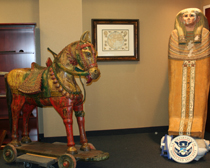
ICE: Artifacts seized in US v. Khouli et al.
"Because Mr. Alshdaifat had only an accessory-after-the-fact role in Mr. Khouli's scheme to make false statements to U.S. Customs, and because he otherwise has a commendable personal history, no prior criminal history, and sympathetic family circumstances, he respectfully requests that the Court not impose a term of imprisonment or probation as part of his sentence for this conduct.  Also, because Mr. Alshdaifat already has suffered substantial economic harm from the fact that this case was brought against him, in both the form of lost business and from the government's improper seizure of his entire inventory of ancient coins for several months after raiding his home at the time of his arrest, we respectfully ask the Court not to impose a significant fine."

Antiquities collector and businessman Joseph A. Lewis, II was also indicted as a co-defendant last year.  His next court hearing is scheduled for January 3, 2013.  The fourth co-defendant indicted, Ayman Ramadan, remains a fugitive.  Both are presumed innocent unless the prosecution proves guilt beyond a reasonable doubt in a court of law.

In 2011, Homeland Security Investigations (HSI) of Immigration and Customs Enforcement (ICE) reportedly seized a large quantity of artifacts associated with the criminal investigation, including hundreds of allegedly smuggled antiquities from throughout the world, an Egyptian sarcophagus, two Indian wooden horses, and thousands of antique coins from ancient Greece, Rome, Egypt and Ancient Mesopotamian.  Authorities last year returned coins seized from Alshdaifat's home back to him. In 2011, Homeland Security Investigations (HSI) of Immigration and Customs Enforcement (ICE) reportedly seized a large quantity of artifacts associated with the criminal investigation, including hundreds of allegedly smuggled antiquities from throughout the world, an Egyptian sarcophagus, two Indian wooden horses, and thousands of antique coins from ancient Greece, Rome, Egypt and Ancient Mesopotamian.  Authorities last year returned coins seized from Alshdaifat's home back to him.

UPDATE December 31, 2012

Court papers published on Friday reveal that Alshdaifat pled guilty on December 21 pursuant to an agreement with federal prosecutors.  He pleaded to accessory after the fact to making a false official writing, a misdemeanor.  The information filed by U.S. Attorney Loretta Lynch charged the defendant with the following:

"In or about and between October 2008 and November 2009, both dates being approximate and inclusive, within the Eastern District of New York and elsewhere, the defendant SALEM ALSHDAIFAT, together with others, knowing that an offense against the United States had been committed, to wit: making and delivering as true a certificate or other writing containing a false statement, contrary to Title 18, United States Code, Section 1018, did knowingly and intentionally receive, relieve, comfort and assist the offender, to wit: Mousa Khouli, also known as "Morris Khouli," in order to hinder and prevent his apprehension, trial and punishment. (Title 18, United States Code, Sections 3 and 3551 et seq.)"

The court imposed a penalty of $1000 plus $10 special assessment.
 

This post is researched, written, and published on the blog Cultural Heritage Lawyer Rick St. Hilaire at culturalheritagelawyer.blogspot.com. Text copyrighted 2012 by Ricardo A. St. Hilaire, Attorney & Counselor at Law, PLLC. Any unauthorized reproduction or retransmission of this post is prohibited. CONTACT: www.culturalheritagelawyer.com

Thứ Năm, 13 tháng 12, 2012

Importing Cultural Objects Legally: Information Required for U.S. Customs Import Rulings

On December 3, 2012 this blog discussed The Cultural Property Importer's Responsibility.  Today's post continues that discussion by describing the information required by U.S. Customs and Border Protection (CBP) when assessing whether a cultural object may be imported lawfully.

Source: CBP
CBP will issue binding interpretations of law regarding cultural property imports when requested in writing.  19 CFR 177.  CBP, for example, will determine the tariff schedule that a cultural property import falls under, such as subheading 9705.00.0070 of the Harmonized Tariff Schedule of the United States (HTSUS), which typically covers collectors' pieces of archaeological, historical, paleontological, ethnographic, numismatic, and similar categories.  More importantly, CBP will definitively rule whether a cultural object is permitted into the United States.

Museums, antiquities dealers, ancient coin sellers and others are keenly aware of the variety of cultural property, criminal, customs, civil, and other laws that can affect the lawful import of cultural objects.  These laws potentially can subject cultural objects to seizure and forfeiture, and they can prompt criminal charges against individuals for smuggling, receiving stolen property, or other crimes.  That is why a binding customs ruling can be a great benefit.  An official ruling can ensure the legality of an object's import, offering protection from legal liability and preventing "hot" objects from entering the U.S. in violation of American import rules.

A March 10, 2011 customs ruling (NY N148735) describes the types of information that importers or other interested parties should provide to CBP so that the agency can evaluate the lawful entry of a cultural good.  That case ruled on the tariff classification of a silver Dancing Satyr sculpture from the Roman era, and was decided in response to a request filed on behalf of art dealer Robert Haber and Associates.  CBP's National Commodity Specialist Division gives this important advice, applicable to all importers of cultural property:

"If you want a ruling on the admissibility of the Dancing Satyr statue, please furnish to the best of your abilities the following information on the provenance of the antiquity, the history of the item since its removal from the area of origin:

(1) verifiable documentation that the item has been in a private collection or in the same family for several generations or that it was acquired a long time ago,

(2) full names and contact information for all private parties that the seller claims previously owned the item,

(3) full names and contact information of all galleries or auction houses that the seller claims previously owned the item – if the gallery is the owner verifiable information on the previous owner/s as in [1] and [2] above,

(4) an illustration of the item taken from a dated, old auction catalog depicting and describing the exact item,

(5) a dated, signed certificate or statement of authenticity with illustrative photo associated to the item’s description from a respected authority or expert within the field,

(6) all original sales receipts establishing date of purchase,

(7) a film or recording or magazine (literature) talking about the item that can establish time of original purchase or subsequent purchases,

(8) dated letters or papers from recognized experts or authorities discussing the item,

(9) a dated appraisal from a recognized authority or expert with photo and description of the item, and

(10) an analytical investigation report with photo, description and technical write-up establishing a relative timeframe of the piece."

Following customs rules is important and mandatory for cultural property importers.  There is no better way to comply with import regulations than to seek a binding customs ruling and by providing complete information about an object's history to the fullest extent possible.


This post is researched, written, and published on the blog Cultural Heritage Lawyer Rick St. Hilaire at culturalheritagelawyer.blogspot.com. Text copyrighted 2012 by Ricardo A. St. Hilaire, Attorney & Counselor at Law, PLLC. Any unauthorized reproduction or retransmission of this post is prohibited. CONTACT: www.culturalheritagelawyer.com

Chủ Nhật, 2 tháng 12, 2012

The Cultural Property Importer's Responsibility

When cultural material is brought into the United States from abroad, the country of origin must be listed accurately on customs import forms. See 19 U.S.C. 1304. There are some, nevertheless, who argue that this duty and many other import mandates are too difficult to bear.  It has even been claimed in some instances that these requirements should be shifted from cultural property importers to customs officials. But such interpretations of federal law are incorrect. Three cases this year, in fact, reinforce the notion that cultural property import requirements are borne by importers, particularly--as one appeals court judge observed--because they possess the most knowledge about the goods that they seek to import.

In the case of Ancient Coin Collectors Guild v. U.S. Customs and Border Protection et al., the fourth circuit court rejected the ACCG's claim that information requirements concerning ancient coins from China and Cyprus should be placed on the customs officials who enforce the Cultural Property Implementation Act's (CPIA) import restrictions. One judge during oral argument commented that there is only a "slight burden" placed on importers to explain where regulated coins would have been located during the last few years. A unanimous court ultimately pointed out that importers bear responsibility for complying with customs rules, writing that "CBP [U.S. Customs and Border Protection] need not demonstrate that the [Chinese and Cypriot] articles are restricted; rather, the [CPIA] statute 'expressly places the burden on importers to prove that they are importable.'"

The case of United States v. One Tyrannosaurus Bataar Skeleton also advanced the proposition that the cultural property importer has legal responsibilities that cannot be shirked.  In upholding the sufficiency of the government's complaint to forfeit imported dinosaur bones, the New York federal district court disagreed with the dinosaur importer's "conten[tion] that the failure of the government to provide regulatory guidance on determining the proper country of origin or value of fossils leaves importers 'hard-pressed to respond to a customs broker's inquiry about the country of origin of a dinosaur fossil that existed millions of years before the emergence of Homo sapiens and even longer before the concept of a 'country' was established.'"  The court wrote that "[t]he prohibition in [the anti-smuggling statute] against importation by means of 'any false statement' is not vague or ambiguous, and it does not make reference or in any way depend upon regulatory guidance concerning the proper country of origin or value of fossils."


US Customs House, New Orleans. Courtesy  CBP
Meanwhile, an October 2012 Customs and Border Protection (CBP) tariff classification ruling (N233501), which addressed ancient coins, affirmed that cultural property importers bear the burden to comply with legal requirements. (The case also demonstrates the mechanism by which U.S. Customs can help importers who seek assistance with compliance).  In this case, the goods reviewed by CBP's National Commodity Specialist Division were "a collection of 12 ancient Greek coins ... obtained from different places and spanning different periods of time" and collectively labeled "The Ancient Greek World – 12 Silver Coin Collection." Also examined were "The Roman Love," described as two coins from the Roman Empire bearing portraits of Antonius Pius and Faustina I.

The customs ruling explained the importer's duty under 19 CFR 134.1(b) to declare the coins' "country of origin," accurately describing the country of manufacture or production. The ruling proposed the following sound advice to help the petitioning importer comply with the law: "Ionia (ancient Greek) is an ancient region of central coastal Anatolia in present-day Turkey. As such, it would not be unreasonable that some or all of the coins in The Ancient Greek World – 12 Silver Coin Collection be marked with country of origin Turkey and the 2 coins in The Roman Love in Genuine Silver (Pius and Faustina I) be marked with country of origin Italy.  If evidence exists that the coins were made in multiple modern day countries, but uncertain as to which specific country or countries, then list all possible countries in which the coins could have been made."

What these cases demonstrate is that cultural property importers who bring goods into the United States must openly and accurately--to the best extent possible--disclose where cultural objects come from as well as any other legally required information. Arguments to the contrary will continue to be rejected by legal officials.  That is because importers are in the best position to describe their products to customs officers, who often must rely on importers' declarations to either permit or stop goods from entering the country.

More on this topic can be found by reading Importing Cultural Objects Legally.


This post is researched, written, and published on the blog Cultural Heritage Lawyer Rick St. Hilaire at culturalheritagelawyer.blogspot.com. Text copyrighted 2012 by Ricardo A. St. Hilaire, Attorney & Counselor at Law, PLLC. Any unauthorized reproduction or retransmission of this post is prohibited. CONTACT: www.culturalheritagelawyer.com

Bài đăng phổ biến