Hiển thị các bài đăng có nhãn ancient coins. Hiển thị tất cả bài đăng

Thứ Bảy, 22 tháng 6, 2013

Reply Filed by ACCG in Ancient Coins Test Case

The test case challenging import controls over ancient Chinese and Cypriot coins moved a step forward this week as the Ancient Coin Collector's Guild (ACCG) submitted its answer to a forfeiture complaint filed by proseuctors last month in Maryland federal district court.

The legal battle initially began in 2009 when the ACCG transported the coins from London to Baltimore, declaring that they were from China and Cyprus and had no known provenance or find spots. Customs officials seized the coins. Since then, the ACCG has lost rounds to retrieve the cultural items in the federal district court, the circuit court of appeals, and the supreme court. The ACCG continues to search for a legal victory.

In its latest June 19 pleading, the ACCG asserts several affirmative defenses to the government's forfeiture complaint. Among the group's arguments are claims that
The ACCG seeks a jury trial on these issues.

The ACCG's publicly reported expenses in the ancient coins test case have thus far totaled $49,973 according to the group's 2009 and 2010 Form 990-EZ tax filings, the most recent ones available online. ACCG board member Attorney Peter Tompa and his Washington, DC based law firm have been handling the case since its inception.

The ACCG is a 501(c)(4) social welfare organization, created as a public benefit corporation in Missouri in 2004. Papers filed with the Missouri secretary of state describe the nonprofit's stated mission to "promote and nurture the free and independent collecting of coins from antiquity" and "to foster an environment in which the general public can acquire and hold coins of historical interest."

This post is researched, written, and published on the blog Cultural Heritage Lawyer Rick St. Hilaire at culturalheritagelawyer.blogspot.com. Text copyrighted 2010-2013 by Ricardo A. St. Hilaire, Attorney & Counselor at Law, PLLC. Any unauthorized reproduction or retransmission of this post is prohibited. CONTACT INFORMATION: www.culturalheritagelawyer.com

Thứ Hai, 6 tháng 5, 2013

Federal Forfeiture Complaint Filed in ACCG Baltimore Test Case

The United States Attorney's Office for the District of Maryland has filed a complaint to seize and forfeit ancient Chinese and Cypriot Coins. The Ancient Coin Collector's Guild (ACCG) attempted to import the coins into Baltimore on April 16, 2009 in defiance of import regulations restricting the protected cultural objects under the Convention on Cultural Property Repatriation Act (CPIA).

The ACCG flew the coins in from London on British Airways and told U.S. Customs and Border (CBP) that they were from China and Cyprus, dated between 400 B.C. and 220 A.D., had no known provenance, and had no known find spots. CBP seized the coins, and the ACCG filed a lawsuit soon thereafter, before federal officials brought a formal forfeiture action.

The ACCG's suit failed in the federal district court, the court of appeals, and the U.S. Supreme Court.

Following the supreme court's March 25, 2013 rejection to hear the case, prosecutors filed a formal forfeiture complaint in the federal district court on April 22.  The forfeiture action brings a new opportunity for the ACCG to relitigate the matter.

This post is researched, written, and published on the blog Cultural Heritage Lawyer Rick St. Hilaire at culturalheritagelawyer.blogspot.com. Text copyrighted 2010-2013 by Ricardo A. St. Hilaire, Attorney & Counselor at Law, PLLC. Any unauthorized reproduction or retransmission of this post is prohibited. CONTACT INFORMATION: www.culturalheritagelawyer.com
Thứ Tư, 1 tháng 5, 2013

German High Court Rules No Export Permit Required in Case Where No Evidence Offered That Ancient Coins & Medals Were Regulated Archaeological Goods

The Bundesfinanzhof, or Federal Fiscal Court, ruled on March 6, 2013 that an exporter of ancient coins and medals did not have to obtain a permit under European Commission rules that regulate the export of cultural goods. The Munich based court is the highest appellate tribunal in Germany with jurisdiction over tax and customs matters.

Ancient coins classified as archaeological objects require export permits from Germany, but the court in this case found no evidence offered by the parties to justify that the objects in question were archaeological goods.

In October 2008, the plaintiff presented export paperwork to the Principal Customs Office describing approximately 32 coins and medals. (Where they were from and exactly what types of items they were are not described by the court.) The plaintiff declared the coins and medals to be 1500 to 2400 years old and valued between 50 EUR and 400 EUR. The Principal Customs Office took the position that European Commission Council Regulation EC No 3911/92--presently No 116/2009--required the coins and medals to have an export permit because they were protected cultural goods. The customs office refused to make an exception under a section of the EC regulations allowing an exception in cases where goods "are of limited archaeological or scientific interest, and provided that they are not the direct product of excavations, finds or archaeological sites within a Member State, and that their presence on the market is lawful." The plaintiff disagreed with the customs office decision and took legal action.

[Sidebar: European Union member states have adopted export rules to stop the trafficking of cultural goods. EC No 116/2009 declares:
The export of cultural goods outside the customs territory of the [European] Community shall be subject to the presentation of an export licence... The export licence shall be issued at the request of the person concerned ... by a competent authority. However ... the Member State ... is authorised not to require export licences for the cultural goods ... where they are of limited archaeological or scientific interest, and provided that they are not the direct product of excavations, finds or archaeological sites within a Member State, and that their presence on the market is lawful. 
The export licence may be refused, for the purposes of this Regulation, where the cultural goods in question are covered by legislation protecting national treasures of artistic, historical or archaeological value in the Member State concerned. 
[D]irect export from the customs territory of the Community of national treasures having artistic, historic or archaeological value which are not cultural goods within the meaning of this Regulation is subject to the national law of the Member State of export.
Items defined as cultural goods are listed in Annex I and include archaeological objects over 100 years old and collections of numismatic interest.]

The lower fiscal court sided with customs, but the Federal Fiscal Court ruled for the plaintiff. The Bundesfinanzhof's explained these Guidelines at the outset of its opinion:
Archaeological objects as defined in EC legislation on the export of cultural goods (Regulation No. 116/2009) are only those that have a value for archaeology, that is man-made or worked on objects, able to convey the findings of past cultures, especially about their customs, technical and artistic development, political and social structures, religion and the like. Items that illustrate lessons learned elsewhere about past cultures and therefore possibly for archaeology have no meaning, and are not "archaeological objects" or finds. Ancient coins can be archaeological objects.
But the Federal Fiscal Court found no determinations made by the Principal Customs Office or the lower court that the coins and medals in question actually constituted archaeological objects in this case.  The court wrote:
The archaeological interest in an object is to be evaluated in this context by the Principal Customs Office or the judge according to the circumstances of the individual case, taking as key criteria, in particular, how the object in question is valued in the market and whether the same or similar objects to a greater extent involving the trade are ones in which archaeological institutions and collections are not involved, but where collectors are involved who are not interested in such coins as an "archaeological" interest but out of a passion for collecting, because of the aesthetic value of the objects or other interests.
The Bundesfinanzhof pointed out that that the lower court "made no findings as to whether the disputed coins and medals for some special reasons would have a meaning and some value for archaeology," adding the the customs office "contributed nothing." In fact, the Federal Fiscal Court decision observed that the information provided by customs from the Württemberg State Museum could not constitute "a proper basis for a finding, especially since it is inconsistent, when on the one hand the issue of an export permit is said to be required, and on the other hand the State Museum leaves it open whether this involves 'archaeological goods' at all."

In contrast, the plaintiff's position that the coins and medals were "mass produced" and "often found in general trade" went uncontradicted, the high court noted. As a result, the Federal Fiscal Court entered a final decision without remanding the case to the lower court. The high court was convinced that another hearing would not produce "different findings."

The Federal Finance Court opinion is narrow in scope. The court reaffirmed that ancient coins can be archaeological objects. In the present case, the court sought evidence that the 32 ancient coins and medals qualified as archaeological objects subject to a cultural goods export permit. But the court found that the customs house and the State Museum either offered either no evidence or inconclusive evidence that the items in question were archaeological. The ruling continues to uphold the proposition that ancient coins qualifying as archaeological objects require export permits.

The Federal Finance Court's web site explains that the "Federal Fiscal Court only adjudicates on the correct application of law in concrete individual cases. Although its decisions can only bind the respective parties, they are still authoritative for the taxation of other tax paying citizens where the same facts of case apply." The full text of the decision may be found at docket VII R 33 34/11. 

Acknowledgment: Dr. Hubert Lanz, president of the Federation of European Numismatic Trade Associations, for providing an English version of the court decision.  While this post seeks to accurately convey the German court's decision, the English translations are the author's own and are subject to error or interpretation.

This post is researched, written, and published on the blog Cultural Heritage Lawyer Rick St. Hilaire at culturalheritagelawyer.blogspot.com. Text copyrighted 2010-2013 by Ricardo A. St. Hilaire, Attorney & Counselor at Law, PLLC. Any unauthorized reproduction or retransmission of this post is prohibited. CONTACT INFORMATION: www.culturalheritagelawyer.com

Thứ Năm, 28 tháng 3, 2013

Archaeological Context: Hard Evidence Attorneys Should Value


Attorneys value hard evidence. They collect, classify, and present evidence to persuade jurors and judges about the merits of their cases. They are intimately familiar with the Rules of Evidence, which require a "chain of custody" and "laying a foundation" before any item may be offered to the finder of fact as an authenticated piece of proof. Archaeologists also value evidence. They likewise preserve the chain of custody of objects--called provenience and provenance--and they employ the scientific method to preserve, authenticate, and reconstruct evidence of the past.

Given the high regard lawyers and archaeologists have for rigorous standards of proof, it would be natural for these professionals to possess a shared affinity. That is why a lawyer's remarks this week questioning archaeologists' "single-minded obsession with archaeological context" deserves comment.  See Chasing Aphrodite, March 25, 2013.

The context of an archaeological artifact refers to the object's find spot, its time sequence within the layers or strata of dirt, and its association with nearby artifacts. Context means that the artifact is an integral part of its place of discovery. It also means that the place of discovery is an integral part of the artifact. Both the artifact and the archaeological site lose information when an artifact is ripped out of the soil without proper scientific excavation or documentation. Reconstructing the past is made difficult when contextual evidence is damaged or tampered with.

Litigators know this all too well. It is the reason why prosecuting attorneys, for example, single-mindedly focus on preserving evidence at crime scenes. Crimes like murder and arson have little chance of being reconstructed unless evidence is properly documented, collected, tagged, examined, and tracked. A judge will quickly toss out evidence deemed too be unreliable in cases where the find spot has not been documented or where questions surround the chain of custody.

The value of archaeological context in relation to ancient coins cannot be dismissed by the explanation that "[n]umismatists derive their own context." Derived context increases the risk of producing faulty conclusions, perhaps even based on inauthentic evidence. It is true that "by studying the inscriptions and iconography found on coins, by reconstructing the chronology of dies used to strike a given series, and by analyzing the weight standard and the metallurgical content of each issue" that something may be learned about the past. There is no doubt that a direct examination of numismatic archaeological material can be a valuable tool. But such inspections produce more precise results when the cultural property observer knows where the coins were found and in what specific archaeological context. Archaeology, of course, is the fundamental scientific field that gathers this contextual evidence.

The Archaeological Institute of America shares a good example of why context matters in its August 7, 2007 web post titled "Coins and Archaeology":

"At the sanctuary of Zeus at Nemea (Greece), for example, the coin scatter indicates which areas of the sanctuary were used at different times, and from which regions the travelers came, thereby facilitating a reconstruction of patterns of pilgrimage at the site. In addition, the distribution of coins confirms heavy use of the sanctuary in the fifth century B.C., a lower level of use in the early fourth century, and intense building during the later fourth and early third centuries. In the site's stadium, coins indicate that citizens were seated by towns, not randomly around the track, and that a predominantly local audience watched the games. Furthermore, coins of Ptolemy III, ruler of Egypt from 246 to 222 B.C., are found in great numbers at the site, which constitute direct evidence that the king financed warfare in the Peloponnese (southern Greece) as he did in Attica."

Archaeological context helps reconstruct the past accurately. That is why it is the kind of hard evidence that lawyers should appreciate.

This post is researched, written, and published on the blog Cultural Heritage Lawyer Rick St. Hilaire at culturalheritagelawyer.blogspot.com. Text copyrighted 2013 by Ricardo A. St. Hilaire, Attorney & Counselor at Law, PLLC. Any unauthorized reproduction or retransmission of this post is prohibited. CONTACT: www.culturalheritagelawyer.com

Thứ Hai, 25 tháng 3, 2013

U.S. Supreme Court Rejects ACCG's Coins Case

Photo credit: David Lat
The Ancient Coin Collectors Guild (ACCG) suffered another defeat as the U. S. Supreme Court declined to hear the trade organization's appeal. The case of ACCG v. U.S. Customs and Border Protection Agency, Department of Homeland Security et al. (docket 12-996) challenged America's import controls over Chinese and Cypriot cultural property.  The ACCG lost in both the federal district court and the circuit court of appeals before filing a petition for certiorari in the nation's highest court. The Supreme Court reviewed the ACCG's case on Friday and issued a ruling this morning denying certiorari.

The ACCG began the case in order to challenge the government's application of the Cultural Property Implementation Act (CPIA), the federal law that implements the 1970 UNESCO Convention on the Means of Prohibiting and Preventing the Illicit Import, Export, and Transfer of Ownership of Cultural Property. The trade organization imported ancient coins from a London dealer in 2009 that were minted in China and Cyprus. But they had no provenance and no description of their find spots. U.S. Customs and Border Protection (CBP) detained the coins under authority of CPIA import controls restricting ancient Chinese and Cypriot coins of a certain type. The ACCG then filed suit to challenge the cultural property import protections.

Today's Chasing Aphrodite interview with Peter Tompa, attorney for the ACCG, offers additional information about the ACCG's test case.

This post is researched, written, and published on the blog Cultural Heritage Lawyer Rick St. Hilaire at culturalheritagelawyer.blogspot.com. Text copyrighted 2012 by Ricardo A. St. Hilaire, Attorney & Counselor at Law, PLLC. Any unauthorized reproduction or retransmission of this post is prohibited. CONTACT: www.culturalheritagelawyer.com

Thứ Năm, 21 tháng 2, 2013

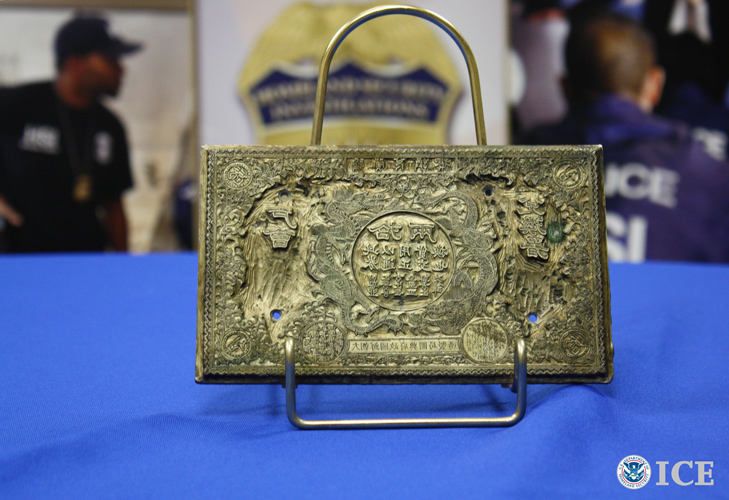
Defendant Cooperates in Korean Currency Plate Case


Wong Young Youn, charged with violations of the National Stolen Property Act (NSPA) for allegedly receiving and transporting a stolen Korean Hojo currency plate, is cooperating with federal authorities. His testimony supported the February 12, 2013 arrest of James Amato in Michigan. Amato is the owner of Midwest Auction Galleries. Both defendants' cases are before the federal district court in Detroit.

Amato is charged with two counts of violating the National Stolen Property Act (NSPA 18 U.S.C. § 2314 and 18 U.S.C. § 2315) and with making a materially false statementand providing a falsedocument knowing the same to contain a materially  false,fictitious,or fraudulent statementsor entry in violationof 18 U.S.C. § 1001.
 
The Hojo currency plate is said to be one of three currency plates in existence from the 1890's.
Court records allege that Amato sold the currency plate in 2010 to Youn for $35,000 despite efforts by the Korean Embassy and the U.S. State Department to warn them that the sale could violate the NSPA.

U.S. Immigration and Customs Enforcement's Homeland Security Investigations (HSI) issued a customs summons to Midwest Auction Galleries on June 29, 2012. In response, the gallery "provided an invoice stating the item  was  purchased  by  'Weng Liang' of 'Hunan, China,' for $9,990, according to an HSI affidavit filed with the court this month. The affidavit reveals that Youn allegedly told HSI officials in January that he himself bought the currency plate and that he does not know a person named Weng Liang.

All defendants are presumed innocent unless and until the prosecution proves guilt beyond a reasonable doubt.

This post is researched, written, and published on the blog Cultural Heritage Lawyer Rick St. Hilaire at culturalheritagelawyer.blogspot.com. Text copyrighted 2012 by Ricardo A. St. Hilaire, Attorney & Counselor at Law, PLLC. Any unauthorized reproduction or retransmission of this post is prohibited. CONTACT: www.culturalheritagelawyer.com

Thứ Sáu, 15 tháng 2, 2013

ACCG Files Cert Petition in U.S. Supreme Court

Bronze doors inside the U.S. Supreme Court.
Photo by David Lat.
Following losses in the district and appellate courts, the Ancient Coin Collectors Guild (ACCG) has brought another court action against the executive branch, this time in the U.S. Supreme Court. The case of ACCG v. U.S. Customs and Border Protection Agency, Department of Homeland Security et al. (docket 12-996) challenges America's import controls over Chinese and Cypriot cultural property.

The U.S. government initiated import controls on ancient coins from China and Cyprus after finding that the cultural objects required protection from pillage and illegal trafficking under the Convention on Cultural Property Implementation Act (CPIA). The ACCG designed a test case in 2009 to contest these import restrictions by attempting to bring ancient Chinese and Cypriot coins into Baltimore from abroad.  U.S. Customs seized the coins, and the ACCG sued.

The ACCG failed to win its case in federal district court in 2011 and appealed.  But the fourth circuit court of appeals struck down the case unanimously in October 2012. The ACCG then filed a petition for rehearing, which the appeals court also rejected.

The ACCG has now filed a petition for certiorari in the U.S. Supreme Court, arguing that the appeals court committed legal errors.  The U.S. Solicitor General has by March 15, 2013 to reply before the justices vote on whether to hear the ACCG's case.

It is not likely that the case will be accepted since the supreme court rejects almost three quarters of petitions for cert.


This post is researched, written, and published on the blog Cultural Heritage Lawyer Rick St. Hilaire at culturalheritagelawyer.blogspot.com. Text copyrighted 2012 by Ricardo A. St. Hilaire, Attorney & Counselor at Law, PLLC. Any unauthorized reproduction or retransmission of this post is prohibited. CONTACT: www.culturalheritagelawyer.com

Thứ Năm, 27 tháng 12, 2012

4th Circuit Court Denies ACCG's Request for Rehearing

"The court denies the petition for rehearing en banc."  That was the order of the Fourth Circuit Court of Appeals on December 18 in the case of Ancient Coin Collectors Guild v. U.S. Customs and Border Protection; U.S. Department of State; Assistant Secretary of State, Educational and Cultural Affairs.

The ACCG set up a test case in 2009 to challenge import restrictions covering ancient Chinese and Cypriot coins.  The import controls were enacted pursuant to the Convention on Cultural Property Implementation Act (CPIA).  The Guild failed to win its case in federal district court in 2011 and appealed.  The federal appeals court thereafter struck down the ACCG's challenge in October.  The ACCG, in response, filed a petition in November for a rehearing on the matter.  The appellate court denied the request, and on Tuesday issued a mandate to effect its October 22 ruling.


This post is researched, written, and published on the blog Cultural Heritage Lawyer Rick St. Hilaire at culturalheritagelawyer.blogspot.com. Text copyrighted 2012 by Ricardo A. St. Hilaire, Attorney & Counselor at Law, PLLC. Any unauthorized reproduction or retransmission of this post is prohibited. CONTACT: www.culturalheritagelawyer.com

Chủ Nhật, 2 tháng 12, 2012

The Cultural Property Importer's Responsibility

When cultural material is brought into the United States from abroad, the country of origin must be listed accurately on customs import forms. See 19 U.S.C. 1304. There are some, nevertheless, who argue that this duty and many other import mandates are too difficult to bear.  It has even been claimed in some instances that these requirements should be shifted from cultural property importers to customs officials. But such interpretations of federal law are incorrect. Three cases this year, in fact, reinforce the notion that cultural property import requirements are borne by importers, particularly--as one appeals court judge observed--because they possess the most knowledge about the goods that they seek to import.

In the case of Ancient Coin Collectors Guild v. U.S. Customs and Border Protection et al., the fourth circuit court rejected the ACCG's claim that information requirements concerning ancient coins from China and Cyprus should be placed on the customs officials who enforce the Cultural Property Implementation Act's (CPIA) import restrictions. One judge during oral argument commented that there is only a "slight burden" placed on importers to explain where regulated coins would have been located during the last few years. A unanimous court ultimately pointed out that importers bear responsibility for complying with customs rules, writing that "CBP [U.S. Customs and Border Protection] need not demonstrate that the [Chinese and Cypriot] articles are restricted; rather, the [CPIA] statute 'expressly places the burden on importers to prove that they are importable.'"

The case of United States v. One Tyrannosaurus Bataar Skeleton also advanced the proposition that the cultural property importer has legal responsibilities that cannot be shirked.  In upholding the sufficiency of the government's complaint to forfeit imported dinosaur bones, the New York federal district court disagreed with the dinosaur importer's "conten[tion] that the failure of the government to provide regulatory guidance on determining the proper country of origin or value of fossils leaves importers 'hard-pressed to respond to a customs broker's inquiry about the country of origin of a dinosaur fossil that existed millions of years before the emergence of Homo sapiens and even longer before the concept of a 'country' was established.'"  The court wrote that "[t]he prohibition in [the anti-smuggling statute] against importation by means of 'any false statement' is not vague or ambiguous, and it does not make reference or in any way depend upon regulatory guidance concerning the proper country of origin or value of fossils."


US Customs House, New Orleans. Courtesy  CBP
Meanwhile, an October 2012 Customs and Border Protection (CBP) tariff classification ruling (N233501), which addressed ancient coins, affirmed that cultural property importers bear the burden to comply with legal requirements. (The case also demonstrates the mechanism by which U.S. Customs can help importers who seek assistance with compliance).  In this case, the goods reviewed by CBP's National Commodity Specialist Division were "a collection of 12 ancient Greek coins ... obtained from different places and spanning different periods of time" and collectively labeled "The Ancient Greek World – 12 Silver Coin Collection." Also examined were "The Roman Love," described as two coins from the Roman Empire bearing portraits of Antonius Pius and Faustina I.

The customs ruling explained the importer's duty under 19 CFR 134.1(b) to declare the coins' "country of origin," accurately describing the country of manufacture or production. The ruling proposed the following sound advice to help the petitioning importer comply with the law: "Ionia (ancient Greek) is an ancient region of central coastal Anatolia in present-day Turkey. As such, it would not be unreasonable that some or all of the coins in The Ancient Greek World – 12 Silver Coin Collection be marked with country of origin Turkey and the 2 coins in The Roman Love in Genuine Silver (Pius and Faustina I) be marked with country of origin Italy.  If evidence exists that the coins were made in multiple modern day countries, but uncertain as to which specific country or countries, then list all possible countries in which the coins could have been made."

What these cases demonstrate is that cultural property importers who bring goods into the United States must openly and accurately--to the best extent possible--disclose where cultural objects come from as well as any other legally required information. Arguments to the contrary will continue to be rejected by legal officials.  That is because importers are in the best position to describe their products to customs officers, who often must rely on importers' declarations to either permit or stop goods from entering the country.

More on this topic can be found by reading Importing Cultural Objects Legally.


This post is researched, written, and published on the blog Cultural Heritage Lawyer Rick St. Hilaire at culturalheritagelawyer.blogspot.com. Text copyrighted 2012 by Ricardo A. St. Hilaire, Attorney & Counselor at Law, PLLC. Any unauthorized reproduction or retransmission of this post is prohibited. CONTACT: www.culturalheritagelawyer.com

Thứ Hai, 22 tháng 10, 2012

Appeals Court Sides with Federal Attorneys in ACCG Baltimore Coin Case

The Fourth Circuit Court of Appeals today sided with the United States in the Ancient Coin Collectors Guild (ACCG) Baltimore test case.   We "have reviewed the Guild's various claims and find them to be without merit," the judges wrote in their October 22 decision.

The court's unanimous decision in the case of Ancient Coin Collectors Guild v. U.S. Customs and Border Protection; U.S. Department of State; Assistant Secretary of State, Educational and Cultural Affairs, rejected the invitation to "engage in a searching review of the government's implementation of CPIA import restrictions on Chinese and Cypriot cultural property."  The judges exercised restraint, cautioning that "[a]ccepting such an invitation ... would draw the judicial system too heavily and intimately into negotiations between the Department of State and foreign countries, injecting the courts into an area of law covered by statutorily conferred executive discretion and congressional oversight."  The court added that "[s]uch judicial interference would be especially problematic because Congress has already prescribed civil forfeiture as a vehicle through which importers can challenge the seizure and detention of articles allegedly covered by CPIA restrictions."

The ACCG initiated the court action in order to challenge the federal government's application of the Cultural Property Implementation Act (CPIA). The CPIA is the law that implements the 1970 UNESCO Convention on the Means of Prohibiting and Preventing the Illicit Import, Export, and Transfer of Ownership of Cultural Property.  The ACCG imported ancient coins from a London dealer in 2009, transporting them to Baltimore, Maryland on a British Airways flight.  The coins were minted in China and Cyprus, but they had no provenance and no description of their find spots. U.S. Customs and Border Protection (CBP) detained the coins, sanctioned by the import restrictions placed on Chinese and Cypriot ancient coins.  The import restrictions were enacted pursuant to bilateral agreements negotiated between those countries and the United States under the authority of the CPIA.

The ACCG filed a civil action in federal district court attacking the import controls over ancient coins and lost.  It appealed the decision, and both the government and ACCG filed briefs before making oral arguments on September 19, 2012.  The court of appeals issued its written decision today.

While agreeing with the idea that "[c]oins are portable objects," the appeals court remarked "that is not the whole story." "The often worn and mysterious beauty of ancient coins renders them invaluable cultural artifacts, helpful not only in dating archaeological finds but in revealing how distant civilizations once conducted their civic and commercial life. Whether coins (or sculptures or pottery) should be exempted from coverage as cultural property presents a lively policy debate, but the tension is resolved for us through the medium of law."

In its decision, the appeals court provided a primer on the law supporting the CPIA regime and highlighted that the judiciary should only reluctantly insert itself in diplomatic negotiations or congressional action:

"Congress set out an elaborate statutory scheme for promulgating import restrictions on culturally sensitive items and gave the Executive Branch broad discretion in negotiating Article 9 [bilateral] agreements with foreign states. Congress itself retained oversight of the CPIA process ... and placed significant responsibility in the hands of CPAC [the Cultural Property Advisory Committee], a body composed of experts in the fields of archaeology and ethnology. Congress also provided forfeiture procedures through which importers could challenge any seizures made pursuant to the CPIA. The conclusions to be drawn from the entirety of this statutory scheme are clear. The federal judiciary has not been generally empowered to second-guess the Executive Branch in its negotiations with other nations over matters of great importance to their cultural heritage, to overrule CPAC in its conclusion that import restrictions on coins were necessary to protect the cultural patrimonies of Cyprus and China, or to challenge Congress in its decision to channel CPIA disputes through forfeiture proceedings."

The ACCG argued that the import restrictions placed on Chinese and Cypriot  ancient coins as well as their execution by the government were ultra vires (extralegal).  The coin collectors group also asserted that the government violated the Administrative Procedures Act (APA) and that it transgressed the First and Fifth Amendments of the U.S. Constitution.  The appellate court rejected each of these assertions.

The court of appeals, like the federal district court below, found that the conduct of the government had not been been ultra vires or extralegal as the ACCG had alleged.  Citing established case law, the court explained that the government only acts outside in an extra legal fashion when it "'is not doing the business which the sovereign has empowered him to do or he is doing it in a way which the sovereign has forbidden.'" (Citation omitted).  The court emphasized that it would not probe the foreign relations functions of the executive and congressional branches of government, writing:

"The [CPIA] statute . . . involves a sensitive area of foreign affairs where Congress itself has delegated the Executive Branch significant discretion.  Given that approach, a searching substantive review of the State Department's diplomatic negotiations or CPAC's application of its archaeological expertise would be singularly inappropriate in this forum."

The federal appeals court pointed to specific examples of how authorities followed the CPIA appropriately with regard to Chinese import restrictions, and the fourth circuit sided with the lower federal district court by repeating  that the State Department "complied with the statutory requirements in placing import restrictions on Cypriot coins."

Despite compliance with the CPIA, the fourth circuit judges considered the ACCG's allegation that China did not make a request for bilateral protection of ancient coins--an assertion disputed by the government. The court looked beyond this charge, writing "In making this argument ... the Guild seeks to add a provision to the statute that is simply not there, namely a requirement that a request ... 'include a detailed accounting of every item eventually covered by an ... agreement.'"  (Citation omitted). The court made clear that a request by a foreign government for U.S. protection of cultural property under the CPIA "need not include a comprehensive list" of every archaoelogical and ethnological object included in a final bilateral agreement. To say otherwise, the court wrote, is a burden that "Congress nowhere mentioned ...."

By the same rationale, the appeals court rejected any contention that the State Department was required to publish in advance a detailed list of every cultural object that might have been considered for import protections under the CPIA. "To scrutinize the adequacy of the State Department's publication and require a verbatim publication of a foreign request would involve the judiciary in the very early stages of the CPIA process and place upon the State Department a burden that Congress did not intend," the court wrote.  The appeals court judges observed that the "detail required by the statute at the conclusion of the process is altogether different from the level of detail required before negotiations between our country and another nation have even so much as begun," making note that "Congress sought to strike a balance here between the need for notice and transparency on the one hand, and the need for confidentiality in sensitive matters of diplomacy on the other."

The court addressed the ACCG's further complaint "that State and CBP acted ultra vires by placing import restrictions on all coins of certain types without demonstrating that all coins of those types were 'first discovered within' China or Cyprus."  The court disagreed by explaining that "State and CBP are under no obligation to list restricted items with more specificity than the statute commands, and they are certainly not required to impose restrictions on a coin-by-coin basis. Such a requirement would make the statutory scheme utterly unworkable in practice."

The circuit court acknowledged that there will be cultural objects imported into the U.S. without provenance or export permits, but that there is a process that allows importers to show that the objects are legal: "In those cases, the statute expressly provides that CBP may seize the articles at the border: 'If the [importer] of any designated archaeological or ethnological material is unable to present to the customs officer' the required documentation, the 'officer concerned shall refuse to release the material from customs custody . . . until such documentation or evidence is filed with such officer.' 19 U.S.C. § 2606(b). In short, CBP need not demonstrate that the articles are restricted; rather, the statute 'expressly places the burden on importers to prove that they are importable.'" (Citation omitted).

The court implied that the burden of proof imposed on importers by the CPIA is not as high as might be suggested because "[t]he importer need not document every movement of its articles since ancient times. It need demonstrate only that the articles left the country that has requested import restrictions before those restrictions went into effect or more than ten years before the date of import."  The court commented that "the Guild need not have documented every movement of its coins since ancient times. To comply with § 2606 [of the CPIA], the Guild need demonstrate only that the Cypriot coins left Cyprus prior to 2007 and that the Chinese coins left China prior to 2009. It never so much as attempted to do so."

Attending to the ACCG's argument that the Administrative Procedures Act was violated, the court rejected this claim.  "We have emphasized throughout the restricted scope of judicial review when it comes to the statutory discretion Congress has conferred upon the Executive Branch in carrying out the international obligations of the United Sates under the Convention. These cautions are nowhere more pertinent than where this nation's protection and recognition of another's cultural patrimony is involved. Congress recognized that the CPIA 'is important to our foreign relations, including our international cultural relations,' and it enacted the statute to ensure that the United States did not become an illegal market for foreign cultural property, a development that would have 'severely strain[ed] our relations with the countries of origin, which often include close allies.' S. Rep. 97-564, at 23 (1982)."  The court added, "Even were we to assume that State was fully subject to the APA, none of its actions were remotely arbitrary or capricious."  The court concluded that CBP acted appropriately as well.

The appeals court also took up the constitutional issues raised by the ACCG.  It relied on the district court's conclusion, in part, that "'the government's interest in combating the pillage of archaeological materials is unrelated to the suppression of free expression.'"  Moreover, due process claims would be addressed by forfeiture proceedings where the government would be required to outline its arguments supporting the seizure of the imported cultural objects, and where the "Guild must then demonstrate that its coins are not subject to forfeiture in order to prevail."

UPDATE 11/14/12: The ACCG filed a petition on November 13, 2012 for rehearing en banc in the matter.  A rehearing before the full court of appeals (en banc) is usually rejected unless the case is of great significance.


This post is researched, written, and published on the blog Cultural Heritage Lawyer Rick St. Hilaire at culturalheritagelawyer.blogspot.com. Text copyrighted 2012 by Ricardo A. St. Hilaire, Attorney & Counselor at Law, PLLC. Any unauthorized reproduction or retransmission of this post is prohibited. CONTACT: www.culturalheritagelawyer.com

Bài đăng phổ biến