Hiển thị các bài đăng có nhãn fossils. Hiển thị tất cả bài đăng

Thứ Ba, 28 tháng 5, 2013

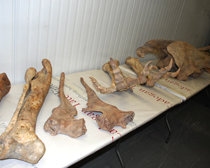
Paleontological Resources Preservation Act Regulations Proposed

Administrative regulations to implement the Paleontological Resources Preservation Act (PRPA) were introduced last week.

PRPA was enacted into law in 2009. It is a federal statute that empowers public authorities to protect paleontological resources on federal lands, providing criminal and civil penalties for fossil theft and vandalism and requiring permits for collecting paleontological resources.

In a public notice dated May 23, 2013, the U.S. Department of Agriculture (USDA) explains "The rule would address the management, collection, and curation of paleontological resources from Federal lands including management using scientific principles and expertise, collecting of resources with and without a permit, curation in an approved repository, maintaining confidentiality of specific locality data, and authorizing penalties for illegal collecting, sale, damaging, or otherwise altering or defacing paleontological resources."

The proposed rule seeks to "clarify that science, rather than other values, will be the primary management tool for paleontological resources on Forest Service lands."

The regulations, if adopted, would require a permit for collecting paleontological resources from Forest Service administered lands.  But those in engaged in the "casual collecting of a rock, mineral, or fossil" would not require a permit.

Written public comments will be accepted on the proposed regulations until July 22, 2013.  They may be submitted by online by visiting www.regulations.gov.

Photo credit: dyet

This post is researched, written, and published on the blog Cultural Heritage Lawyer Rick St. Hilaire at culturalheritagelawyer.blogspot.com. Text copyrighted 2010-2013 by Ricardo A. St. Hilaire, Attorney & Counselor at Law, PLLC. Any unauthorized reproduction or retransmission of this post is prohibited.  CONTACT INFORMATION: www.culturalheritagelawyer.com

Thứ Năm, 27 tháng 12, 2012

Guilty Plea in Dinosaur Smuggling Case

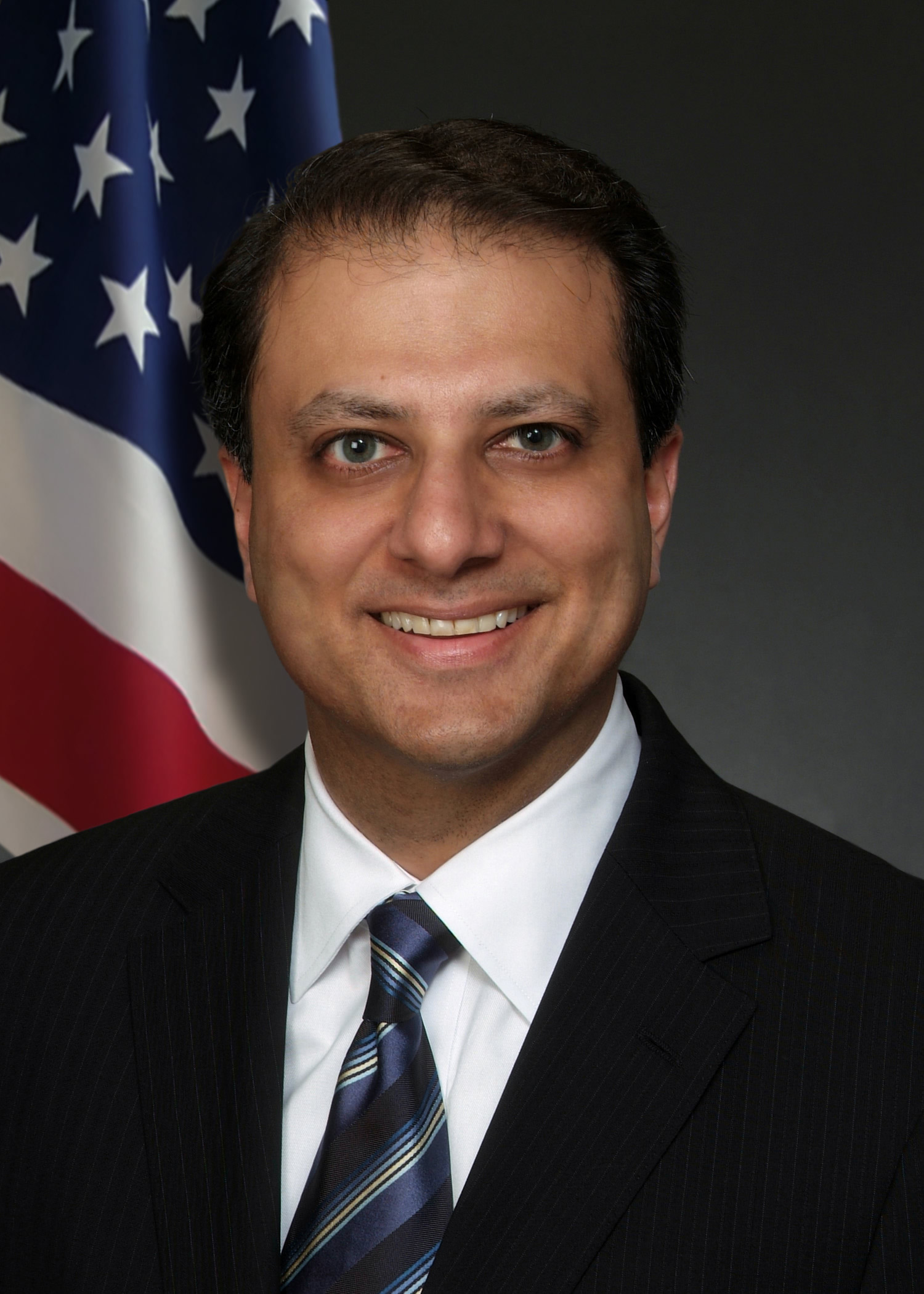
Eric Prokopi pleaded guilty on Thursday in a case involving the smuggling of dinosaur fossils.  In a press release, Preet Bharara, the U.S. States Attorney for the Southern District of New York, announced:

U.S. Attorney Preet Bharara
PROKOPI, 38, pled guilty today to an Information charging him with one count of conspiracy with respect to the Chinese flying dinosaur, one count of entry of goods by means of false statements with respect to the Mongolian dinosaurs, and one count of interstate and foreign transportation of goods converted and taken by fraud. ... In addition, PROKOPI has agreed to forfeit the proceeds of his offense, including but not limited to, the First Bataar, the Second Bataar, any and all interest in the Tyrannosaurus skeleton believed to be in Great Britain, the Saurolophus and Oviraptor skeletons that had been in PROKOPI’S custody, and any and all other fossil parts of Mongolian origin that PROKOPI brought into the country between 2010 and 2012."

Federal authorities arrested Prokopi after the government's initial forfeiture case intensified in October.  Readers will recall that federal prosecutors first filed a forfeiture complaint in June seeking the return of Tyrannosaurus Bataar bones that were auctioned for sale.  Yesterday's resolution in the criminal case also resolves the civil forfeiture case.


This post is researched, written, and published on the blog Cultural Heritage Lawyer Rick St. Hilaire at culturalheritagelawyer.blogspot.com. Text copyrighted 2012 by Ricardo A. St. Hilaire, Attorney & Counselor at Law, PLLC. Any unauthorized reproduction or retransmission of this post is prohibited. CONTACT: www.culturalheritagelawyer.com

Chủ Nhật, 2 tháng 12, 2012

The Cultural Property Importer's Responsibility

When cultural material is brought into the United States from abroad, the country of origin must be listed accurately on customs import forms. See 19 U.S.C. 1304. There are some, nevertheless, who argue that this duty and many other import mandates are too difficult to bear.  It has even been claimed in some instances that these requirements should be shifted from cultural property importers to customs officials. But such interpretations of federal law are incorrect. Three cases this year, in fact, reinforce the notion that cultural property import requirements are borne by importers, particularly--as one appeals court judge observed--because they possess the most knowledge about the goods that they seek to import.

In the case of Ancient Coin Collectors Guild v. U.S. Customs and Border Protection et al., the fourth circuit court rejected the ACCG's claim that information requirements concerning ancient coins from China and Cyprus should be placed on the customs officials who enforce the Cultural Property Implementation Act's (CPIA) import restrictions. One judge during oral argument commented that there is only a "slight burden" placed on importers to explain where regulated coins would have been located during the last few years. A unanimous court ultimately pointed out that importers bear responsibility for complying with customs rules, writing that "CBP [U.S. Customs and Border Protection] need not demonstrate that the [Chinese and Cypriot] articles are restricted; rather, the [CPIA] statute 'expressly places the burden on importers to prove that they are importable.'"

The case of United States v. One Tyrannosaurus Bataar Skeleton also advanced the proposition that the cultural property importer has legal responsibilities that cannot be shirked.  In upholding the sufficiency of the government's complaint to forfeit imported dinosaur bones, the New York federal district court disagreed with the dinosaur importer's "conten[tion] that the failure of the government to provide regulatory guidance on determining the proper country of origin or value of fossils leaves importers 'hard-pressed to respond to a customs broker's inquiry about the country of origin of a dinosaur fossil that existed millions of years before the emergence of Homo sapiens and even longer before the concept of a 'country' was established.'"  The court wrote that "[t]he prohibition in [the anti-smuggling statute] against importation by means of 'any false statement' is not vague or ambiguous, and it does not make reference or in any way depend upon regulatory guidance concerning the proper country of origin or value of fossils."


US Customs House, New Orleans. Courtesy  CBP
Meanwhile, an October 2012 Customs and Border Protection (CBP) tariff classification ruling (N233501), which addressed ancient coins, affirmed that cultural property importers bear the burden to comply with legal requirements. (The case also demonstrates the mechanism by which U.S. Customs can help importers who seek assistance with compliance).  In this case, the goods reviewed by CBP's National Commodity Specialist Division were "a collection of 12 ancient Greek coins ... obtained from different places and spanning different periods of time" and collectively labeled "The Ancient Greek World – 12 Silver Coin Collection." Also examined were "The Roman Love," described as two coins from the Roman Empire bearing portraits of Antonius Pius and Faustina I.

The customs ruling explained the importer's duty under 19 CFR 134.1(b) to declare the coins' "country of origin," accurately describing the country of manufacture or production. The ruling proposed the following sound advice to help the petitioning importer comply with the law: "Ionia (ancient Greek) is an ancient region of central coastal Anatolia in present-day Turkey. As such, it would not be unreasonable that some or all of the coins in The Ancient Greek World – 12 Silver Coin Collection be marked with country of origin Turkey and the 2 coins in The Roman Love in Genuine Silver (Pius and Faustina I) be marked with country of origin Italy.  If evidence exists that the coins were made in multiple modern day countries, but uncertain as to which specific country or countries, then list all possible countries in which the coins could have been made."

What these cases demonstrate is that cultural property importers who bring goods into the United States must openly and accurately--to the best extent possible--disclose where cultural objects come from as well as any other legally required information. Arguments to the contrary will continue to be rejected by legal officials.  That is because importers are in the best position to describe their products to customs officers, who often must rely on importers' declarations to either permit or stop goods from entering the country.

More on this topic can be found by reading Importing Cultural Objects Legally.


This post is researched, written, and published on the blog Cultural Heritage Lawyer Rick St. Hilaire at culturalheritagelawyer.blogspot.com. Text copyrighted 2012 by Ricardo A. St. Hilaire, Attorney & Counselor at Law, PLLC. Any unauthorized reproduction or retransmission of this post is prohibited. CONTACT: www.culturalheritagelawyer.com

Thứ Năm, 15 tháng 11, 2012

New York Federal Court Denies Prokopi's Motion to Dismiss Dinosaur Forfeiture Case

Dinosaur seized by ICE.  Source: ICE.
Judge P. Kevin Castel yesterday denied Eric Prokopi's motion to dismiss in the case of United States v. One Tyrannosaurus Bataar Skeleton. Prokopi's lawyers petitioned the federal district court in Manhattan to quickly consider the motion following Prokopi's October 17 arrest for alleged illegal dinosaur bone importation and sales.

Prokopi is the claimant seeking the return of a Tyrannosaur Bataar skeleton (the "Defendant Property"), which Immigration and Customs Enforcement (ICE) seized on June 22, 2012 on grounds that the bones are stolen property.  The American government seeks to repatriate the bones to Mongolia.

Prokopi's lawyers argued that the government cannot forfeit the dinosaur skeleton as a matter of law and policy.  The federal court itself raised doubts about federal prosecutors' forfeiture arguments, but permitted the government to file a new complaint.  The claimant thereafter filed a renewed motion to dismiss.

The district court now concludes that the amended complaint filed by the U.S. Attorney's Office for the Southern District of New York "contained sufficiently detailed facts to support a reasonable belief that the government will be able to meet its burden of proof at trial."

The court notes that "the amended complaint alleges that Prokopi is a commercial paleontologist who has excavated skeletons in Mongolia before. This, coupled with Prokopi's alleged attempts to obscure the Defendant Property's country of origin on importation paperwork, raises a reasonable inference that Prokopi knew the Defendant Property was stolen from the Mongolian state."

Judge Kastel makes the following conclusions in his 19 page order:
  • "Prokopi contends that the failure of the government to provide regulatory guidance on determining the proper country of origin or value of fossils leaves importers 'hard-pressed to respond to a customs broker's inquiry about the country of origin of a dinosaur fossil that existed millions of years before the emergence of Homo sapiens and even longer before the concept of a 'country' was established.' (Cl. Br. 14-15.) This argument fails because the statutes in violation of which the Defendant Property is alleged to have been imported do not prohibit the importation of paleontological objects in contravention of certain regulations, vague or otherwise (and indeed, Prokopi submits that there are no applicable regulations). Instead, they prohibit importation by way of knowingly false statements. 18 U.S.C. § 542. The prohibition in Section 542 against importation by means of 'any false statement' is not vague or ambiguous, and it does not make reference or in any way depend upon regulatory guidance concerning the proper country of origin or value of fossils."
  • "The amended complaint alleges facts that ... suggest that the Defendant Property was unearthed, not millions of years ago, but between 1995 and 2005 (Compl. ¶ 44), and that, based on its size and coloration, the Defendant Property came from the Gobi Desert in Mongolia. (Id. ¶ ¶ 42-44, 58-65.) The amended complaint also raises a plausible inference that Prokopi's statements in connection with importation of the Defendant Property were knowingly false."
  • "The amended complaint alleges that Prokopi erroneously listed the country of origin as Japan and Great Britain on importation paperwork when in fact the Defendant Property was from Mongolia. (Id. ¶ ¶ 38,51-54.) The amended complaint further alleges that Prokopi is a commercial paleontologist who had excavated fossils in Mongolia's Nemegt Formation himself before. (Id. ¶ ¶ 82-84.) These facts give rise to a plausible inference that Prokopi unearthed the Defendant Property himself in Mongolia, or, even if he did not, that he had reason to know that such fossils likely carne from Mongolia. The inference of knowing wrongdoing is buttressed by the allegation that Prokopi changed the country of origin on the March 22, 2007 shipment from Mongolia to Japan. (Id. ¶ ¶ 52-53.) There may be an innocent explanation for this change, but on its face the allegation suggests Prokopi's awareness of illegality and his attempt to avoid detection."
  • "The same goes for the value of the Defendant Property. Collectively, the three shipments identified in the amended complaint had a stated value of $69,000, whereas the Defendant Property was listed at auction as having a value between $950,000 and $1,500,000. (Id. ¶ ¶ 38, 51, 54.) While it may be the case that Prokopi's efforts in assembling the contents of the shipments into a single display piece constituting the Defendant Property significantly increased the value of the fossils contained in the shipments, it is not implausible that the declared values--which appear to have understated the value of the Defendant Property by more than an order of magnitude--constituted knowing misstatements, and it is reasonable to draw an inference of wrongdoing on these facts at the pleading stage.
  • "Prokopi's fair notice argument concerning Mongolian law also fails. It may be, as Prokopi contends, that 'fossil collectors could have no fair notice of Mongolia's laws cited in the Complaint,' as these are 'not readily available to the general public' (Cl. Br. 15), or perhaps that Mongolian law itself is impermissibly vague, but this does not appear on the face of the well-pleaded complaint and hence is not appropriate for consideration on a motion to dismiss."
  • "Finally, Prokopi argues that the Defendant Property is not stolen property for purposes of any of the statutory bases of forfeiture because the amended complaint fails adequately to allege that Prokopi knew the Defendant Property was taken from Mongolia without that state's permission, and further because Mongolian law does not make fossils the property of the state. Although this argument raises a question of foreign law that the Court could decide on a motion to dismiss, the Court declines to make a final determination as to the content of Mongolian law in this interlocutory order, finding it sufficient to hold that the amended complaint states a claim for relief ...."
Hat tip: Gary Nurkin

This post is researched, written, and published on the blog Cultural Heritage Lawyer Rick St. Hilaire at culturalheritagelawyer.blogspot.com. Text copyrighted 2012 by Ricardo A. St. Hilaire, Attorney & Counselor at Law, PLLC. Any unauthorized reproduction or retransmission of this post is prohibited. CONTACT: www.culturalheritagelawyer.com

Thứ Tư, 24 tháng 10, 2012

Dinosaur Claimant's Attorneys File Sharply Worded Reply Memorandum and Ask Court for Expedited Hearing

In a sharply worded reply memorandum filed Tuesday in the forfeiture case of United States v. One Tyrannosaurus Bataar Skeleton, lawyers for dinosaur claimant Eric Prokopi ask the Manhattan federal district court to rule on its motion to dismiss "now."  The claimant's attorneys write (with citations omitted):

"Some three months after filing this civil forfeiture action, the Government has arrested Claimant Eric Prokopi ('Prokopi' or 'Claimant') on criminal charges that largely track the allegations in its 'First Amended Verified Complaint' for civil forfeiture ('Amended Complaint'). This sequence of events raises serious questions. If Government investigators honestly believe that Prokopi engaged in criminal conduct cumulating in consigning the Tyrannosaurs Bataar Display Piece ('the Display Piece') for sale in a public auction, why not treat the matter as a criminal one from the start? One might wonder whether the Government is now merely punishing Prokopi for daring to file a claim to property coveted by the President of Mongolia, and is using the criminal complaint to hamstring Prokopi’s ability to reclaim the Display Piece, the fruit of a year of Prokopi’s own work, Prokopi’s own financial investment and Prokopi’s own expertise."

Prokopi assembled the dinosaur bones to sell at an auction this past spring. At the request of the Mongolian government, American officials seized the Tyrannosaurus Bataar and filed a claim for forfeiture in federal court. A judge recently expressed concern about awarding forfeiture, but allowed the U.S. government to resubmit its case. Federal attorneys not only filed a new forfeiture complaint, they arrested Prokopi on charges of conspiracy, false classification of goods, and receipt and transportation of stolen property.

Prokopi's reply memorandum comes on the heels of the government's own court pleading filed soon after Prokopi's arrest. Read the October 20, 2012 update at the bottom of the post for a description of the federal government's memorandum.

The claimant's attorneys conclude their reply memorandum by saying, "The Government should not be allowed to profit from its hardball tactics, nor should it be allowed to seize property based upon obscure foreign laws or unwritten interpretations of 'country of origin' or valuation rules for fossils. Moreover, the Government has not alleged sufficient facts to establish a reasonable basis to believe that it could meet its burden to prove that the component parts of the Display Piece were 'stolen' under U.S. law. For all these reasons, the Complaint should promptly be dismissed and Prokopi should be awarded attorney’s fees and costs."  They attorneys have asked the court for an expedited hearing.

Meanwhile, the federal district court in Manhattan on Monday set the appearance bond in the criminal case of U.S. v. Eric Prokopi (1:12-mj-02634-UA) at $250,000: "Bail terms set in Florida to continue with following amendments: Bond raised to $250,000 to be co-signed ...." Home detention vacated. Wife's passport to be surrendered. Travel SDNY/EDNY and Northern District of Florida and intervening Districts."


This post is researched, written, and published on the blog Cultural Heritage Lawyer Rick St. Hilaire at culturalheritagelawyer.blogspot.com. Text copyrighted 2012 by Ricardo A. St. Hilaire, Attorney & Counselor at Law, PLLC. Any unauthorized reproduction or retransmission of this post is prohibited. CONTACT: www.culturalheritagelawyer.com

Thứ Tư, 17 tháng 10, 2012

Prokopi Arrested after Claim to Dinosaur Bones Prompts Criminal Investigation

U.S. Immigration and Customs Enforcement Homeland Security Investigations (HSI) today arrested Eric Prokopi at his Gainesville, Florida home, where authorities also searched his house.  Prokopi is a self-described "commercial paleontologist" seeking ownership of an assembled Tyranosaurus Bataar skeleton detained in New York.  Prokopi's lawyers and an auction catalog have called the dinosaur skeleton a "Display Piece."  But federal officials have concluded that the bones are stolen and smuggled.

Tyrannosaurus Bataar, courtesy U.S. Homeland Security
The investigation and arrest of Prokopi is an outgrowth of the civil forfeiture case of United States v. One Tyrannosaurus Bataar Skeleton. The criminal complaint, first sealed by the federal district court in Manhattan on October 5 and unsealed today, alleges that Prokopi violated 18 USC 371, 545, 2315.  The three counts against Porkopi charge that he committed the crimes of conspiracy, false classification of goods, and receipt of stolen property.  HSI Special Agent Daniel Brazier headed the investigation, and Attorney Martin Bell of the Complex Frauds Unit in the U.S. Attorney's Office for the Southern District of New York is prosecuting the case.

A person who has been charged with a crime is presumed innocent.  The prosecution must prove the elements of each offense beyond a reasonable doubt before a criminal defendant may be found guilty.  The current complaint alleges criminal counts based on the lower standard of probable cause.

Count One charges Prokopi with conspiracy to commit crimes of smuggling, false statements, and receiving and disposing stolen goods valued at $5,000 or more under 18 USC 545, 1001 and 2315.  It is alleged that between March 2012 and June 2012 Prokopi "sent price lists to vendors regarding the potential sale of a stolen Tyrannosaurus bataar skeleton in his possession;" that in April 2012 Prokopi "directed another individual to make misstatements on customs forms ultimately submitted to United States Customs and Border Protection concerning the transport of a Microraptor fossil;" and that in December 2011 he "attempted to sell the fossilized remains of an Oviraptor Mongoliensis to another individual."

Count Two alleges that between  January 2012 and May 2012 Prokopi, with intent to defraud, "caused the mislabeling of customs forms relating to the fossilized remains of a Tyrannosaurus bataar skeleton, allowing the skeleton to enter into the United States."

Count Three charges that Prokopi, sometime between January 2012 and May 2012, "sold a Tyrannosaurus bataar skeleton to a buyer in Manhattan, knowing the same to have been stolen from Mongolia."

The government asserts that "that there is probable cause to believe that Eric Prokopi, the defendant, has engaged in a scheme to unlawfully import the fossilized remains of numerous dinosaurs into the United States."  Authorities describe how he "owns a business in Florida called 'Everything Earth' and has also owned a business known as 'Florida Fossils.' Among other things, Prokopi has bought and sold whole and partial dinosaur skeletons."  The case investigator reports that he has "reviewed numerous customs forms dating back to 2007 in which Eric Prokopi, the defendant, accepts shipments on behalf of his business," reporting that "between 2010 and 2012, Eric Prokopi, the defendant, procured dinosaur fossils in Mongolia and unlawfully transported them to the United States, in violation of Mongolian law and with the knowledge that they were stolen. He then sold or attempted to sell them to other individuals. Prokopi also bought dinosaur fossils from individuals in other countries and, in importing the fossils, caused misrepresentations to be made to United States Customs."

The listed dinosaur bones alleged to have been "unlawfully procured, transported, sold and/or negotiated by Prokipi" include:

"a. A Tyrannosaurus bataar skeleton stolen from Mongolia and sold at auction in Manhattan in or around May 2012 for $1,052,500.

"b. A Saurolophus angustirostris skeleton stolen from Mongolia and sold to the I.M. Chait auctionhouse (sic) in or around May 2012 for approximately $75,000.

"c. A Microraptor skeleton purchased from an individual in China and unlawfully brought into the United States by Prokopi in 2010.

"d. Gallimimus and Oviraptor whole or partial skeletons as well as Tyrannosaurus bataar parts."

The federal complaint against Prokopi relies on experts to frame its case. The paleontology experts describe where specific dinosaur fossils are located, namely in Mongolia.  Meanwhile, legal experts describe the force of Mongolian cultural patrimony law.  It is concluded that "Mongolian law dating back nearly nine decades establishes that fossils discovered or excavated in Mongolia are the property of Mongolia and there has been no legal mechanism to export them since that time, absent an official decree from the Mongolian government."  Both the factual and legal assertions are sure to be challenged by defense lawyers in the coming months just as they have been challenged in the civil forfeiture case.  Already a federal district court judge raised doubts about the prosecution's civil forfeiture case, but that was before the prosecution filed a new civil complaint in September and before today's arrest.

HSI cites several pieces of information in support of its arrest of Prokopi regarding the Tyrannosaurus Bataar, many of which have already been mentioned in the civil forfeiture case (see October 10, 2012 post). The government points to additional emails, among them an email dated May 24, 2012 reportedly from Prokopi to a person at Heritage Auctions, Inc., which states, "Although I am sure that everything with this [Bataar] specimen is legal as far back as I can tell, I do know just about all of the people involved in the business of central asian fossils, and could offer ideas and help to make permanent changes that would nearly eliminate the black market and benefit all sides. If the [M]ongolian president is indeed only interested in getting to the bottom of the sources, and wants to look good for his people, I think I can help him do that if he is willing to cooperate and compromise. If he only wants to take the skeleton and try to put an end to the black market, he will have a fight and will only drive the black market deeper underground."

The government adds that it has pictures of Prokopi in the Mongolian desert in 2009.  "I have learned that Mongolian officials have located and interviewed a Mongolian citizen ("Witness-1").  Witness l stated that in or around 2009, he accompanied Eric Prokopi, the defendant, to an excavation site, and witnessed Prokopi taking physically taking (sic) bones out of the ground. ... I have viewed the pictures taken by Witness-1. ... [A]n individual who appears to be Prokopi is standing with others in what appears to be the desert. In one picture, he is holding a clipboard and looking at the ground."

HSI writes in its complaint "that that there is probable cause to believe that Eric Prokopi, the defendant, brought a stolen Saurolophus angustirostris (the "Hadro") skeleton into the United States and sold it to an auction house," specifically I. M. Chait Gallery/Auctioneers.  It is reported that an April 4, 2012 email from Prokopi to the Chait Gallery discusses a Hadro refers to the "[N]emegt formation, Mongolia," where this dinosaur is alleged by experts to be found.

HSI further alleges criminal dealings with an imported Microraptor from China. The government cites emails in its complaint, writing:

"a. Prokopi exchanged e-mails with an individual ('Individual-5') concerning a shipment in April 2010. On April 19, 2010, Individual-5 e-mailed Prokopi complaining that he had received $9,988 instead of $10,000 and asking whether his commission had been lost. Individual-5 also sent  Prokopi a UPS tracking number. That tracking number matches the tracking number in DHS's records of the Microraptor shipment.

"b. On April 21, 2010, Prokopi e-mailed Individual-5, stating that he had received a message from UPS saying that the customer needed to provide an accurate description and value. Prokopi wrote, 'What did you write on the shipment? I need to know what to tell them.' Individual-5 stated that he had written that he was sending a 'sample of craft rock' and that had listed $30 as the value.

"c. On April 26, 2010, Individual-5 e-mailed Prokopi and stated that he had spoken to UPS, which had asked for more detail with respect to the shipment's name and detail. Individual-5 wrote, 'Call and say 'replica, made by rocks, used for study, $200 for value' or something else, if better.'

"d. On April 29, 2010, Individual-5 and Prokopi both wrote that they were concerned that the shipment had been held up. 'I am worried that they will take the item because you declared the value much too low,' Prokopi wrote. 'There is no reason to do that, because there is no tax on fossils.'

"e. Individual-5 later asked, 'Do you want me to hold the other 8 ones for you?'

"f. Individual-5 later wrote, 'I will send this to you. So please tell me how much I can declare the value.'

g. Prokopi responded that Individual-5 should state, 'Geological specimen for collection. Value $1000.'

h. Individual-5 later wrote, within the same mail thread, 'Selling fossils like this is not allowed in China.'"

Regarding other dinosaur fossils, the complaint quotes a July 28, 2010 email purportedly from Prokopi to a trader explaining, "They didn't ask for a specific amount, just told me the more I can send the more they can buy from the diggers. He said they are finding gallimimus skeletons, a couple of tarbo skulls, and a lot of the usual protos, oviraptors, etc."

UPDATE 10/20/12: Federal attorneys in the  case of  United States v. One Tyrannosaurus Bataar Skeleton filed a memorandum of law in opposition to Eric Prokopi's motion to dismiss the forfeiture case. The government's claims are familiar ones made recently, but allegations of Prokopi's criminal conduct are more forceful following his October 17, 2012 arrest.  The pleading may be found here.


This post is researched, written, and published on the blog Cultural Heritage Lawyer Rick St. Hilaire at culturalheritagelawyer.blogspot.com. Text copyrighted 2012 by Ricardo A. St. Hilaire, Attorney & Counselor at Law, PLLC. Any unauthorized reproduction or retransmission of this post is prohibited. CONTACT: www.culturalheritagelawyer.com

Chủ Nhật, 7 tháng 10, 2012

Paleo-Prospector Thief Guilty of Conspiracy to Steal Government Property

A federal district court in Alaska has sentenced  Equinox Wilderness Expeditions (EWE) owner Karen Ann Jettmar to three years probation and a $30,000 fine for unlawfully taking a prehistoric fossil bone from federal land. Jettmar pleaded guilty to a lesser misdemeanor charge of conspiracy to commit theft of government property under 18 USC 371 and 641.  She was originally charged by a grand jury in December 2011 with felony counts of conspiracy and removing a paleontological resource from federal land.

In June 2009, U.S. Bureau of Land Management (BLM) agents began an undercover investigation into EWE and Jettmar.  The federal agency uncovered evidence of illegal "paleo-prospecting," according to the plea agreement filed with the court.  A woolly mammoth tusk recovered during a 2007 Kokolik River expedition and a fossil bone recovered from the Uukok River in 2009 were among the illegal items identified. Both artifacts were taken from the protected National Petroleum Reserve in Alaska.  An October 2007 email from Jettmar to an EWE client remarked, "Good thing your tusk is safe in Pennsylvania. ... wouldn't want BLM coming after you!"

Judge Ralph Beistline accepted the plea agreement between Assistant U.S. Attorney Stephen Cooper and the defense, which included the following terms:

"The defendant shall modify and maintain her Equinox Wilderness Expeditions website, advertising, and other business communications, to ensure that they do not contain any writing, graphics, or other material encouraging or designed to encourage the expectation of collecting natural objects or objects of archeological, paleontological, cultural, historic, or scientific interest on the lands or waters visited; to add the following warning: 'It is illegal on all State and federal public lands and on all privately-owned lands to remove without a permit or authorization any natural objects or objects of archeological, paleontological, cultural, historic, or scientific interest'; and to remove and refrain from stating on the website, advertising, or other business communications, any representation that Equinox Wilderness Expeditions has the permits required for collecting such objects."

"The defendant shall not conduct or participate in or be present with any commercial activity on State or Federal public lands except those conservation units for which, before entering, she obtains and holds permits for activities booked for the 2012 summer season through the time of completion of those activities in the summer of 2012."

Alaskan state statutes also protect cultural resources in addition to federal law.   The law of "The Last Frontier" that preserves history and archaeology can be found here.


This post is researched, written, and published on the blog Cultural Heritage Lawyer Rick St. Hilaire at culturalheritagelawyer.blogspot.com. Text copyrighted 2012 by Ricardo A. St. Hilaire, Attorney & Counselor at Law, PLLC. Any unauthorized reproduction or retransmission of this post is prohibited. CONTACT: www.culturalheritagelawyer.com
Thứ Bảy, 18 tháng 8, 2012

Dinosaur Claimant Files Motion to Dismiss in New York Federal Court

Attorneys for Eric Prokopi on Friday filed a motion to dismiss in federal district court in the southern district of New York. The lawyers argue in the case of United States of America v. One Tyrannosaurus Bataar Skeleton that the government cannot seize and forfeit an dinosaur skeleton on both policy and legal grounds. Prokopi is the claimant seeking the return of the Tyrannosaur skeleton, which he assembled.  It was seized by Immigration and Customs Enforcement (ICE) on June 22, 2012.

Courtesy ICE
The matter came to the attention of law enforcement officials after chairman and curator of paleontology at the American Museum of Natural History in New York raised concerns about the piece advertised for sale at an auction. The auction site listed the object as "SUPERB TYRANNOSAURUS SKELETON, Tyrannosaurus bataar, Late Cretaceous, Central Asia." U.S. Attorney Preet Bharara in Manhattan filed a forfeiture action alleging that the import paperwork for the dinosaur bones misstated the country of origin as Great Britain, not Mongolia; undervalued the skeleton at $15,000; and improperly described the bones as fossil reptile heads, a fossil lizard, and other incorrect items. See the June 26, 2012 blog post for additional background.

In their 28 page legal memorandum urging dismissal of the case, the claimant's lawyers set the stage for their argument to the court:

"Eric Prokopi purchased several groups of fossils on the open market and spent a year of his life and considerable expense identifying and compiling component parts of, and then restoring and mounting, the Tyrannosaurus bataar fossil (the “Display Piece”) so that it could be sold at auction. Prokopi thought he had recouped his considerable investment . . . when the Display Piece sold for $1.05 million at Heritage Auctions (“Heritage”) in New York. But then, a media campaign stirred up by academic paleontologists prompted Mongolia’s President to demand that the Display Piece be sent to Mongolia because it 'must have been stolen from there.' Prokopi and Heritage had entered into negotiations with Mongolia’s President in order to settle the dispute, when on June 18, 2012, the United States filed a Civil Forfeiture Complaint in rem (“Complaint”) seeking forfeiture of the Display Piece." (footnotes omitted)

The claimant's August 17, 2012 memorandum of law argues that the government should not set policy regulating dinosaur bones through the courts. The claimant's advocates write that the "Motion to Dismiss should be granted, not only to ensure that the fruits of his labor are rightly returned to him but to encourage the Government to regulate fossil collecting – if at all  – prospectively through the legislative and regulatory process rather than retroactively through this unprecedented forfeiture action."

Additionally, the lawyers contend that Prokopi did not commit any violations of federal import regulations because he did not have notice of U.S. rules regarding how to list the country of origin or value a paleontological object. "Here, Prokopi could have no fair notice of the 'country of origin' or valuation rules for fossils because none exist," the attorneys submit.  They maintain that in "May of 2006, CBP issued a revised Informed Compliance Publication which included guidance on the proper tariff classification of fossils, but failed to issue guidance on how to determine the country of origin or value of fossils or even of archaeological objects. . . . Since no regulatory guidance exists on how to apply this definition, there is no way for an importer of fossils to know how to proceed."

[Sidebar: Where a cultural property importer has a question about the proper tariff classification, country of origin, or even valuation it can be good practice to file a request for a binding U.S. Customs ruling pursuant to 19 C.F.R. 177.  A rulings letter can provide an official interpretation of the law regarding a specific object to be imported.  See the U.S. Customs web site discussing rulings letters.  See also the CROSS database of rulings letters, which which can also help importers of cultural property comply with applicable regulations.]

The claimant's legal counsel further argue that Prokopi did not have fair notice of Mongolian law "because they are not readily available to the general public much less to attorneys who practice in the 'cultural property' field."  Even if he had knowledge of Mongolian law, the lawyers declare that the dinosaur skeleton could not be considered stolen because current Mongolian law does not clearly define fossils to be owned by Mongolia.  The country, moreover, does not enforce its title vesting law, they aver.  In any case, the claimant's attorneys assert that there is no evidence to support that the bones came from Mongolia or were removed from that country without authority. The attorneys argue that the government cannot show that Prokopi knew the Tyrannosaur bones were stolen.

The claimant's lawyers end their memorandum with the following conclusion:

"It may or may not be time to regulate fossil collecting like antiquities collecting, but surely any such regulatory effort should only be accomplished prospectively through the legislative or administrative process rather than retroactively through a forfeiture action prompted by a media frenzy and foreign politics. The Government should not be allowed to seize property based upon obscure foreign laws or unwritten interpretations of 'country of origin' or valuation rules for fossils. Moreover, the Government has not alleged sufficient facts to establish a reasonable basis to believe that it could meet its burden to prove that the Display Piece was 'stolen.'

The claimant seeks to dismiss the government's forfeiture complaint pursuant to the Supplemental Rule for Admiralty or Maritime Claims and Asset Forfeiture Actions G(8)(b)(i) and Federal Rule of Civil Procedure 12(b)(6).

This post is researched, written, and published on the blog Cultural Heritage Lawyer Rick St. Hilaire at http://culturalheritagelawyer.blogspot.com. Text copyrighted 2012 by Ricardo A. St. Hilaire, Attorney & Counselor at Law, PLLC. CONTACT: www.culturalheritagelawyer.com

Thứ Năm, 19 tháng 7, 2012

Dinosaur Forfeiture Case Rescheduled as Court Waits for Claimant's Verified Claim

HSI seizes the dinosaur bones.
Today's court conference in the matter of United States of America v. One Tyrannosaurus Bataar Skeleton (2012-cv-04760) was rescheduled to September 5 after federal prosecutors issued a gentle reminder that the government remained the sole party in the case.  In a letter submitted to the southern district court of New York, prosecutors wrote:

"This is a forfeiture matter and at the present time the only party to the action is the Government. In order for an individual or entity to become a party to the action, they are required to file a Verified Claim.  As of the date [of] this letter there have been no Verified Claims filed with the Court and the time period for filing has not yet expired. The time period to file a Verified Claim expires on August 26, 2012."

Ancient coin dealer advocates and attorneys Michael McCullough and Peter Tompa filed court appearances in June announcing their representation of Eric Prokopi, the purported claimant seeking the dinosaur bones' return.   They are expected to file a Verified Claim arguing why the dinosaur bones should be awarded to Prokopi.

The U.S. Attorney for the Southern District of New York filed a forfeiture complaint this spring alleging that the dinosaur skeleton was illegally imported into this country in March 2012.  Federal prosecutors seek to repatriate the bones to Mongolia, the country of origin.

More details regarding this seizure and forfeiture case may be found here.

CONTACT: www.culturalheritagelawyer.com

Thứ Ba, 26 tháng 6, 2012

Dinosaur Forfeiture Complaint Now Published in New York Court as Coin Dealer Lawyers File Appearance to Free Arrested Mongolian Tyrannosaurus

Today the federal district court in the southern district of New York electronically published the federal government's forfeiture complaint against a dinosaur skeleton.  And an ancient coin dealers' attorney and lobbyist has filed an appearance as co-counsel on behalf of a claimant who wants the bones back.

Cultural property watchers are aware of the dinosaur's seizure last week when the federal government took legal action against a Tyrannosaurus bataar skeleton offered for sale at auction. The U.S. Attorney for the Southern District of New York filed a forfeiture complaint explaining that the dinosaur bones were illegally imported into this country on March 27, 2012 from Great Britain.  Federal prosecutors allege criminal wrongdoing in their complaint, writing in part:

Source: ICE
"The Customs Importation documents for the Defendant Property [Tyrannosaurus bataar] contain several misstatements. First, the country of origin for the Defendant Property was erroneously listed on the Customs Entry Form as Great Britain rather than Mongolia. Second, the Defendant Property was substantially undervalued in the Customs Importation documents. The importation documents list the value of the Defendant Property as $15,000 contrary to the $950,000 - $1,500,00 value listed in the Heritage Auctions May 20, 2012 Natural History Auction catalog and the actual auction sale price of $1,052,500. Third, the Defendant Property was incorrectly described in the Customs Importation documents as '2 large rough (unprepared) fossil reptile heads;' '6 boxes of broken fossil bones;' '3 rough (unprepared) fossil reptiles;' '1 fossil lizard;' '3 rough (unprepared) fossil reptiles;' and '1 fossil reptile skull.'

Immigration and Customs Enforcement's (ICE) Homeland Security Investigations (HSI) assisted with the case. "As alleged, criminal smugglers misrepresented this fossil to customs officials when they illegally imported it into the United States," commented ICE Director John Morton in a press statement.  While authorities allege specific unlawful acts surrounding the Tyrannosaurus bataar's import, federal officials have thus far only arrested the dinosaur bones.

The U.S. Attorney's stated goal is to seize and forfeit the Tyrannosaurus bataar for repatriation to Mongolia.  Court records do not indicate that law enforcement sought a search warrant to seize the dinosaur for potential evidence as part of a criminal investigation.

The government's complaint lists "commercial paleontologist" Eric Prokopi as the consignor of the dinosaur bones.  Washington, DC based attorney Peter Tompa, who litigates and lobbies on behalf of the Ancient Coin Collectors Guild (ACCG), filed a court appearance today announcing his representation of Prokopi.  Tompa is co-counsel along with Brooklyn cultural property lawyer and ancient coin dealer advocate, Michael McCullough.  McCullough's LinkedIn profile lists him as past associate counsel at Sotheby's.  Experienced cultural property forfeiture prosecutor Sharon Cohen Levin is lead attorney for the government.

CONTACT: http://www.culturalheritagelawyer.com/
(c) Ricardo A. St. Hilaire, Attorney & Counselor at Law, PLLC

Bài đăng phổ biến