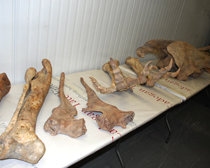
U.S. Immigration and Customs Enforcement Homeland Security Investigations (HSI) today arrested Eric Prokopi at his Gainesville, Florida home, where authorities also searched his house. Prokopi is a self-described "commercial paleontologist" seeking ownership of an assembled Tyranosaurus Bataar skeleton detained in New York. Prokopi's lawyers and an auction catalog have called the dinosaur skeleton a "Display Piece." But federal officials have concluded that the bones are stolen and smuggled.
The investigation and arrest of Prokopi is an outgrowth of the civil forfeiture case of United States v. One Tyrannosaurus Bataar Skeleton. The criminal complaint, first sealed by the federal district court in Manhattan on October 5 and unsealed today, alleges that Prokopi violated 18 USC 371, 545, 2315. The three counts against Porkopi charge that he committed the crimes of conspiracy, false classification of goods, and receipt of stolen property. HSI Special Agent Daniel Brazier headed the investigation, and Attorney Martin Bell of the Complex Frauds Unit in the U.S. Attorney's Office for the Southern District of New York is prosecuting the case.
A person who has been charged with a crime is presumed innocent. The prosecution must prove the elements of each offense beyond a reasonable doubt before a criminal defendant may be found guilty. The current complaint alleges criminal counts based on the lower standard of probable cause.
Count One charges Prokopi with conspiracy to commit crimes of smuggling, false statements, and receiving and disposing stolen goods valued at $5,000 or more under 18 USC 545, 1001 and 2315. It is alleged that between March 2012 and June 2012 Prokopi "sent price lists to vendors regarding the potential sale of a stolen Tyrannosaurus bataar skeleton in his possession;" that in April 2012 Prokopi "directed another individual to make misstatements on customs forms ultimately submitted to United States Customs and Border Protection concerning the transport of a Microraptor fossil;" and that in December 2011 he "attempted to sell the fossilized remains of an Oviraptor Mongoliensis to another individual."
Count Two alleges that between January 2012 and May 2012 Prokopi, with intent to defraud, "caused the mislabeling of customs forms relating to the fossilized remains of a Tyrannosaurus bataar skeleton, allowing the skeleton to enter into the United States."
Count Three charges that Prokopi, sometime between January 2012 and May 2012, "sold a Tyrannosaurus bataar skeleton to a buyer in Manhattan, knowing the same to have been stolen from Mongolia."
The government asserts that "that there is probable cause to believe that Eric Prokopi, the defendant, has engaged in a scheme to unlawfully import the fossilized remains of numerous dinosaurs into the United States." Authorities describe how he "owns a business in Florida called 'Everything Earth' and has also owned a business known as 'Florida Fossils.' Among other things, Prokopi has bought and sold whole and partial dinosaur skeletons." The case investigator reports that he has "reviewed numerous customs forms dating back to 2007 in which Eric Prokopi, the defendant, accepts shipments on behalf of his business," reporting that "between 2010 and 2012, Eric Prokopi, the defendant, procured dinosaur fossils in Mongolia and unlawfully transported them to the United States, in violation of Mongolian law and with the knowledge that they were stolen. He then sold or attempted to sell them to other individuals. Prokopi also bought dinosaur fossils from individuals in other countries and, in importing the fossils, caused misrepresentations to be made to United States Customs."
The listed dinosaur bones alleged to have been "unlawfully procured, transported, sold and/or negotiated by Prokipi" include:
"a. A Tyrannosaurus bataar skeleton stolen from Mongolia and sold at auction in Manhattan in or around May 2012 for $1,052,500.
"b. A Saurolophus angustirostris skeleton stolen from Mongolia and sold to the I.M. Chait auctionhouse (sic) in or around May 2012 for approximately $75,000.
"c. A Microraptor skeleton purchased from an individual in China and unlawfully brought into the United States by Prokopi in 2010.
"d. Gallimimus and Oviraptor whole or partial skeletons as well as Tyrannosaurus bataar parts."
The federal complaint against Prokopi relies on experts to frame its case. The paleontology experts describe where specific dinosaur fossils are located, namely in Mongolia. Meanwhile, legal experts describe the force of Mongolian cultural patrimony law. It is concluded that "Mongolian law dating back nearly nine decades establishes that fossils discovered or excavated in Mongolia are the property of Mongolia and there has been no legal mechanism to export them since that time, absent an official decree from the Mongolian government." Both the factual and legal assertions are sure to be challenged by defense lawyers in the coming months just as they have been challenged in the civil forfeiture case. Already a federal district court judge raised doubts about the prosecution's civil forfeiture case, but that was before the prosecution filed a new civil complaint in September and before today's arrest.
HSI cites several pieces of information in support of its arrest of Prokopi regarding the Tyrannosaurus Bataar, many of which have already been mentioned in the civil forfeiture case (see October 10, 2012 post). The government points to additional emails, among them an email dated May 24, 2012 reportedly from Prokopi to a person at Heritage Auctions, Inc., which states, "Although I am sure that everything with this [Bataar] specimen is legal as far back as I can tell, I do know just about all of the people involved in the business of central asian fossils, and could offer ideas and help to make permanent changes that would nearly eliminate the black market and benefit all sides. If the [M]ongolian president is indeed only interested in getting to the bottom of the sources, and wants to look good for his people, I think I can help him do that if he is willing to cooperate and compromise. If he only wants to take the skeleton and try to put an end to the black market, he will have a fight and will only drive the black market deeper underground."
The government adds that it has pictures of Prokopi in the Mongolian desert in 2009. "I have learned that Mongolian officials have located and interviewed a Mongolian citizen ("Witness-1"). Witness l stated that in or around 2009, he accompanied Eric Prokopi, the defendant, to an excavation site, and witnessed Prokopi taking physically taking (sic) bones out of the ground. ... I have viewed the pictures taken by Witness-1. ... [A]n individual who appears to be Prokopi is standing with others in what appears to be the desert. In one picture, he is holding a clipboard and looking at the ground."
HSI writes in its complaint "that that there is probable cause to believe that Eric Prokopi, the defendant, brought a stolen Saurolophus angustirostris (the "Hadro") skeleton into the United States and sold it to an auction house," specifically I. M. Chait Gallery/Auctioneers. It is reported that an April 4, 2012 email from Prokopi to the Chait Gallery discusses a Hadro refers to the "[N]emegt formation, Mongolia," where this dinosaur is alleged by experts to be found.
HSI further alleges criminal dealings with an imported Microraptor from China. The government cites emails in its complaint, writing:
"a. Prokopi exchanged e-mails with an individual ('Individual-5') concerning a shipment in April 2010. On April 19, 2010, Individual-5 e-mailed Prokopi complaining that he had received $9,988 instead of $10,000 and asking whether his commission had been lost. Individual-5 also sent Prokopi a UPS tracking number. That tracking number matches the tracking number in DHS's records of the Microraptor shipment.
"b. On April 21, 2010, Prokopi e-mailed Individual-5, stating that he had received a message from UPS saying that the customer needed to provide an accurate description and value. Prokopi wrote, 'What did you write on the shipment? I need to know what to tell them.' Individual-5 stated that he had written that he was sending a 'sample of craft rock' and that had listed $30 as the value.
"c. On April 26, 2010, Individual-5 e-mailed Prokopi and stated that he had spoken to UPS, which had asked for more detail with respect to the shipment's name and detail. Individual-5 wrote, 'Call and say 'replica, made by rocks, used for study, $200 for value' or something else, if better.'
"d. On April 29, 2010, Individual-5 and Prokopi both wrote that they were concerned that the shipment had been held up. 'I am worried that they will take the item because you declared the value much too low,' Prokopi wrote. 'There is no reason to do that, because there is no tax on fossils.'
"e. Individual-5 later asked, 'Do you want me to hold the other 8 ones for you?'
"f. Individual-5 later wrote, 'I will send this to you. So please tell me how much I can declare the value.'
g. Prokopi responded that Individual-5 should state, 'Geological specimen for collection. Value $1000.'
h. Individual-5 later wrote, within the same mail thread, 'Selling fossils like this is not allowed in China.'"
Regarding other dinosaur fossils, the complaint quotes a July 28, 2010 email purportedly from Prokopi to a trader explaining, "They didn't ask for a specific amount, just told me the more I can send the more they can buy from the diggers. He said they are finding gallimimus skeletons, a couple of tarbo skulls, and a lot of the usual protos, oviraptors, etc."
UPDATE 10/20/12: Federal attorneys in the case of United States v. One Tyrannosaurus Bataar Skeleton filed a memorandum of law in opposition to Eric Prokopi's motion to dismiss the forfeiture case. The government's claims are familiar ones made recently, but allegations of Prokopi's criminal conduct are more forceful following his October 17, 2012 arrest. The pleading may be found here.
This post is researched, written, and published on the blog Cultural Heritage Lawyer Rick St. Hilaire at culturalheritagelawyer.blogspot.com. Text copyrighted 2012 by Ricardo A. St. Hilaire, Attorney & Counselor at Law, PLLC. Any unauthorized reproduction or retransmission of this post is prohibited. CONTACT: www.culturalheritagelawyer.com
 |
| Tyrannosaurus Bataar, courtesy U.S. Homeland Security |
A person who has been charged with a crime is presumed innocent. The prosecution must prove the elements of each offense beyond a reasonable doubt before a criminal defendant may be found guilty. The current complaint alleges criminal counts based on the lower standard of probable cause.
Count One charges Prokopi with conspiracy to commit crimes of smuggling, false statements, and receiving and disposing stolen goods valued at $5,000 or more under 18 USC 545, 1001 and 2315. It is alleged that between March 2012 and June 2012 Prokopi "sent price lists to vendors regarding the potential sale of a stolen Tyrannosaurus bataar skeleton in his possession;" that in April 2012 Prokopi "directed another individual to make misstatements on customs forms ultimately submitted to United States Customs and Border Protection concerning the transport of a Microraptor fossil;" and that in December 2011 he "attempted to sell the fossilized remains of an Oviraptor Mongoliensis to another individual."
Count Two alleges that between January 2012 and May 2012 Prokopi, with intent to defraud, "caused the mislabeling of customs forms relating to the fossilized remains of a Tyrannosaurus bataar skeleton, allowing the skeleton to enter into the United States."
Count Three charges that Prokopi, sometime between January 2012 and May 2012, "sold a Tyrannosaurus bataar skeleton to a buyer in Manhattan, knowing the same to have been stolen from Mongolia."
The government asserts that "that there is probable cause to believe that Eric Prokopi, the defendant, has engaged in a scheme to unlawfully import the fossilized remains of numerous dinosaurs into the United States." Authorities describe how he "owns a business in Florida called 'Everything Earth' and has also owned a business known as 'Florida Fossils.' Among other things, Prokopi has bought and sold whole and partial dinosaur skeletons." The case investigator reports that he has "reviewed numerous customs forms dating back to 2007 in which Eric Prokopi, the defendant, accepts shipments on behalf of his business," reporting that "between 2010 and 2012, Eric Prokopi, the defendant, procured dinosaur fossils in Mongolia and unlawfully transported them to the United States, in violation of Mongolian law and with the knowledge that they were stolen. He then sold or attempted to sell them to other individuals. Prokopi also bought dinosaur fossils from individuals in other countries and, in importing the fossils, caused misrepresentations to be made to United States Customs."
The listed dinosaur bones alleged to have been "unlawfully procured, transported, sold and/or negotiated by Prokipi" include:
"a. A Tyrannosaurus bataar skeleton stolen from Mongolia and sold at auction in Manhattan in or around May 2012 for $1,052,500.
"b. A Saurolophus angustirostris skeleton stolen from Mongolia and sold to the I.M. Chait auctionhouse (sic) in or around May 2012 for approximately $75,000.
"c. A Microraptor skeleton purchased from an individual in China and unlawfully brought into the United States by Prokopi in 2010.
"d. Gallimimus and Oviraptor whole or partial skeletons as well as Tyrannosaurus bataar parts."
The federal complaint against Prokopi relies on experts to frame its case. The paleontology experts describe where specific dinosaur fossils are located, namely in Mongolia. Meanwhile, legal experts describe the force of Mongolian cultural patrimony law. It is concluded that "Mongolian law dating back nearly nine decades establishes that fossils discovered or excavated in Mongolia are the property of Mongolia and there has been no legal mechanism to export them since that time, absent an official decree from the Mongolian government." Both the factual and legal assertions are sure to be challenged by defense lawyers in the coming months just as they have been challenged in the civil forfeiture case. Already a federal district court judge raised doubts about the prosecution's civil forfeiture case, but that was before the prosecution filed a new civil complaint in September and before today's arrest.
HSI cites several pieces of information in support of its arrest of Prokopi regarding the Tyrannosaurus Bataar, many of which have already been mentioned in the civil forfeiture case (see October 10, 2012 post). The government points to additional emails, among them an email dated May 24, 2012 reportedly from Prokopi to a person at Heritage Auctions, Inc., which states, "Although I am sure that everything with this [Bataar] specimen is legal as far back as I can tell, I do know just about all of the people involved in the business of central asian fossils, and could offer ideas and help to make permanent changes that would nearly eliminate the black market and benefit all sides. If the [M]ongolian president is indeed only interested in getting to the bottom of the sources, and wants to look good for his people, I think I can help him do that if he is willing to cooperate and compromise. If he only wants to take the skeleton and try to put an end to the black market, he will have a fight and will only drive the black market deeper underground."
The government adds that it has pictures of Prokopi in the Mongolian desert in 2009. "I have learned that Mongolian officials have located and interviewed a Mongolian citizen ("Witness-1"). Witness l stated that in or around 2009, he accompanied Eric Prokopi, the defendant, to an excavation site, and witnessed Prokopi taking physically taking (sic) bones out of the ground. ... I have viewed the pictures taken by Witness-1. ... [A]n individual who appears to be Prokopi is standing with others in what appears to be the desert. In one picture, he is holding a clipboard and looking at the ground."
HSI writes in its complaint "that that there is probable cause to believe that Eric Prokopi, the defendant, brought a stolen Saurolophus angustirostris (the "Hadro") skeleton into the United States and sold it to an auction house," specifically I. M. Chait Gallery/Auctioneers. It is reported that an April 4, 2012 email from Prokopi to the Chait Gallery discusses a Hadro refers to the "[N]emegt formation, Mongolia," where this dinosaur is alleged by experts to be found.
HSI further alleges criminal dealings with an imported Microraptor from China. The government cites emails in its complaint, writing:
"a. Prokopi exchanged e-mails with an individual ('Individual-5') concerning a shipment in April 2010. On April 19, 2010, Individual-5 e-mailed Prokopi complaining that he had received $9,988 instead of $10,000 and asking whether his commission had been lost. Individual-5 also sent Prokopi a UPS tracking number. That tracking number matches the tracking number in DHS's records of the Microraptor shipment.
"b. On April 21, 2010, Prokopi e-mailed Individual-5, stating that he had received a message from UPS saying that the customer needed to provide an accurate description and value. Prokopi wrote, 'What did you write on the shipment? I need to know what to tell them.' Individual-5 stated that he had written that he was sending a 'sample of craft rock' and that had listed $30 as the value.
"c. On April 26, 2010, Individual-5 e-mailed Prokopi and stated that he had spoken to UPS, which had asked for more detail with respect to the shipment's name and detail. Individual-5 wrote, 'Call and say 'replica, made by rocks, used for study, $200 for value' or something else, if better.'
"d. On April 29, 2010, Individual-5 and Prokopi both wrote that they were concerned that the shipment had been held up. 'I am worried that they will take the item because you declared the value much too low,' Prokopi wrote. 'There is no reason to do that, because there is no tax on fossils.'
"e. Individual-5 later asked, 'Do you want me to hold the other 8 ones for you?'
"f. Individual-5 later wrote, 'I will send this to you. So please tell me how much I can declare the value.'
g. Prokopi responded that Individual-5 should state, 'Geological specimen for collection. Value $1000.'
h. Individual-5 later wrote, within the same mail thread, 'Selling fossils like this is not allowed in China.'"
Regarding other dinosaur fossils, the complaint quotes a July 28, 2010 email purportedly from Prokopi to a trader explaining, "They didn't ask for a specific amount, just told me the more I can send the more they can buy from the diggers. He said they are finding gallimimus skeletons, a couple of tarbo skulls, and a lot of the usual protos, oviraptors, etc."
UPDATE 10/20/12: Federal attorneys in the case of United States v. One Tyrannosaurus Bataar Skeleton filed a memorandum of law in opposition to Eric Prokopi's motion to dismiss the forfeiture case. The government's claims are familiar ones made recently, but allegations of Prokopi's criminal conduct are more forceful following his October 17, 2012 arrest. The pleading may be found here.
This post is researched, written, and published on the blog Cultural Heritage Lawyer Rick St. Hilaire at culturalheritagelawyer.blogspot.com. Text copyrighted 2012 by Ricardo A. St. Hilaire, Attorney & Counselor at Law, PLLC. Any unauthorized reproduction or retransmission of this post is prohibited. CONTACT: www.culturalheritagelawyer.com