Thứ Ba, 18 tháng 12, 2012

New York State CJC Decides Not To Remove Bronx Surrogate Judge Lee Holtzman

NYS Judicial Conduct Commission Rules Censure, Not Removal, For Bronx Judge Lee Holzman

The New York State Commission on Judicial Conduct has determined that Bronx County Judge Lee Holzman should be censured -- not kicked off the bench, as Commission Administrator Robert Tembeckjian recommended in a rare move this summer.
holzman walking.jpgDaily News investigations revealed that Holzman appointed a friend and political supporter, Michael Lippman, to oversee the estates of Bronx residents who died without wills -- including signing off on $1.5 million in advance fees before Lippman even did any of the alleged work.
Lippman, who had first gotten the estate jobs from Holzman in 2006, according to the Commission, got arrested in 2010 on charges of pocketing $300,000 in excessive fees and faking documents to cover his tracks.
The Dec. 13 Commission determination, made public today, found that Holzman’s doings reflected “poor judgment, rather than knowing concealment of criminal behavior or intent to deceive.” 
The panel also took note of the fact that by law, Holzman, 70, must step down at the end of this year anyway, and cited his “lengthy and unblemished tenure as a judge.”
Three Commission members concurred with Tembeckjian's recommendation to bounce Holzman.
“The Commission and I play different roles in the formal disciplinary process.  I prosecute and make a recommendation, the Commission members render decision, and sometimes we disagree," Tembeckjian, who serves as the group's counsel, said in a statement.
“I believed removal from office was the appropriate result based on the judge’s egregious misconduct.  A majority of Commission members voted instead to censure.  Naturally, I agree with the three who dissented for removal, but now, as always, we move on in good faith to the next case.”
The full determination appears below.
Holzman.Lee.L.2012.12.13.DET

"Maintaining Plausible Deniability": Prosecutors in Sotheby's Duryodhana Case Charge Sotheby's with Avoiding Mention of the Alleged Theft of the Cambodian Statue


Prosecutors rebuked Sotheby's last Friday, accusing the New York auction house in a reply memorandum of failing to disclose information it knew about a Duryodhana statue offered for sale this past spring.  Prosecutors charge the New York auction giant with issuing misinformation to prospective sellers; skirting claims that the statue was stolen from Cambodia in 1972 and trafficked to Thailand; and making unsubstantiated assertions in its last court filing.

Governments lawyers write that "Sotheby's behavior is that of a company seeking to sell an artwork it knew was stolen, while maintaining plausible deniability should the true owner or the authorities become aware of the truth.  Accordingly, it supports the reasonable inference that Sotheby's knew the Statue was stolen, or at least suspected it and closed its eyes to the truth."

The U.S. Attorney's Office for the Southern District of New York filed the reply memo on December 14 to rebut arguments made recently by Sotheby's and Decia Ruspoli di Poggio Suasa, the claimants in United States of America v. A 10th Century Cambodian Sandstone Sculpture.  Readers will recall that federal prosecutors in November filed a petition to amend their original forfeiture complaint after the district court expressed skepticism.  The government seeks to forfeit and repatriate the statue to Cambodia, a sculpture originally from the Prasat Chen temple at Koh Ker and now sitting at the Sotheby's auction house in Manhattan.  

Daniel Patrick Moynihan Courthouse
Creative Commons: Americasroof
The claimants oppose the forfeiture.  They insist that the statue is not stolen property that must be forfeited.  Prosecutors disagree, arguing in their reply memo that "Prasat Chen was ...  the property of Cambodia in exactly the same way that the Daniel Patrick Moynihan United States Courthouse is the property of the United States."  Federal lawyers add, "If Sotheby' s wishes to argue that it was duped ... as a result of a negligent failure to investigate the representations of obviously self-interested parties regarding a statue with numerous indicia of theft, that is an entirely valid argument on the merits."

The prosecutors argue  in their reply memorandum to the court:

"The [government's] proposed amended Complaint adds crucial new allegations that go to the heart of this action.  Most importantly, it contains allegations regarding the theft of the Defendant in rem (the "Statue") from Koh Ker in 1972 by an organized looting network, which transferred it to Thailand. There, it was knowingly acquired from the looting network by a well-known collector of Khmer antiquities (the "Collector").  The Collector in turn sold the Statue in 1975 to the former husband of Claimant Decia Ruspoli di Poggio Suasa ("Ruspoli") on the international art market through an auction house which was also entirely aware of its illicit origin.  These allegations conclusively answer the arguments previously advanced by Claimants Sotheby's Inc. ("Sotheby's") and Ruspoli that the Statue could have been stolen by anyone at any time in the last thousand years.  Moreover, the new allegations in the Amended Complaint demonstrate that Sotheby's communicated closely with the Collector during the sale process, knowing him to be the original seller of the Statue, but failing to disclose that information to other interested parties, while also inaccurately informing such parties that the Statue had been seen by numerous people in the United Kingdom in the late 1960s, at least three years before it was stolen from Koh Ker.

"Claimants fail to acknowledge the significance of these new allegations, and indeed go to great lengths to avoid mentioning the facts concerning the 1972 theft of the Statue in their Memorandum of Law in Opposition to the Motion ("Clmt's Br.").  Instead, Claimants largely focus on various documents and unsupported attorney assertions regarding Sotheby' s supposed intentions that they themselves admit are entirely improper for the Court to consider. (See Clmt's Br. at 2 n.1 (Claimants "do not ask the Court to rely on emails" they attach); 13 (Claimants "do not ask the Court to rely on materials" they go on to discuss at length).)  The Court should, of course, disregard these sections of Claimant's brief entirely.

"As to their actual bases for denial of the motion, Claimants argue that the Motion is futile because it would not survive a motion to dismiss on three grounds.  First, Claimants argue that the Statue was not actually owned by Cambodia at time of the theft.  As described in detail below, the Statue was owned by Cambodia in 1972 pursuant to clear and unambiguous national ownership laws.  Second, Claimants again assert their frivolous argument that British law rendered the Statue no longer stolen six years after the 1975 sale.  As made clear by their very own expert in British law, Claimants bear the burden of proof on the relevant issue even if British law actually applies, and so they cannot prevail on a motion to dismiss.  Third, Claimants continue to assert that the allegations regarding their knowledge that the Statue was stolen are insufficient.  The factual allegations in the Amended Complaint are more than sufficient to show that Claimants knew the Statue was stolen, or at least that they consciously avoided learning the truth about the theft of the Statue.

"Finally, Claimants argue that the Government delayed unduly in filing this Motion, despite being entirely unable to point to any case where a Court found undue delay in similar circumstances.  The Government appropriately filed the Amended Complaint to include facts gathered in the course of its post-Complaint investigation which could 'aid the court in assessing both the adequacy of the complaint and Defendant's remaining arguments in its motion to dismiss.' Michael Miller Fabrics, LLC v. Studio Imports Ltd., Inc., No. 12 CV 3858 (KMW), 2012 WL 4513546, *2 (S.D.N.Y.  October 1, 2012).  Accordingly, leave to file the Amended Complaint should be granted and Claimants' motion to dismiss should be denied as moot.  ld. at *2-3.
....

"The Amended Complaint has clearly alleged sufficient facts to support a reasonable belief that the government will be able to meet its burden of proof at trial by showing that Sotheby' s either knew or consciously avoided learning that the Statue was stolen when it imported it into the United States and attempted to sell it."


This post is researched, written, and published on the blog Cultural Heritage Lawyer Rick St. Hilaire at culturalheritagelawyer.blogspot.com. Text copyrighted 2012 by Ricardo A. St. Hilaire, Attorney & Counselor at Law, PLLC. Any unauthorized reproduction or retransmission of this post is prohibited. CONTACT: www.culturalheritagelawyer.com

Acknowledgement: Gary Nurkin

Thứ Năm, 13 tháng 12, 2012

Importing Cultural Objects Legally: Information Required for U.S. Customs Import Rulings

On December 3, 2012 this blog discussed The Cultural Property Importer's Responsibility.  Today's post continues that discussion by describing the information required by U.S. Customs and Border Protection (CBP) when assessing whether a cultural object may be imported lawfully.

Source: CBP
CBP will issue binding interpretations of law regarding cultural property imports when requested in writing.  19 CFR 177.  CBP, for example, will determine the tariff schedule that a cultural property import falls under, such as subheading 9705.00.0070 of the Harmonized Tariff Schedule of the United States (HTSUS), which typically covers collectors' pieces of archaeological, historical, paleontological, ethnographic, numismatic, and similar categories.  More importantly, CBP will definitively rule whether a cultural object is permitted into the United States.

Museums, antiquities dealers, ancient coin sellers and others are keenly aware of the variety of cultural property, criminal, customs, civil, and other laws that can affect the lawful import of cultural objects.  These laws potentially can subject cultural objects to seizure and forfeiture, and they can prompt criminal charges against individuals for smuggling, receiving stolen property, or other crimes.  That is why a binding customs ruling can be a great benefit.  An official ruling can ensure the legality of an object's import, offering protection from legal liability and preventing "hot" objects from entering the U.S. in violation of American import rules.

A March 10, 2011 customs ruling (NY N148735) describes the types of information that importers or other interested parties should provide to CBP so that the agency can evaluate the lawful entry of a cultural good.  That case ruled on the tariff classification of a silver Dancing Satyr sculpture from the Roman era, and was decided in response to a request filed on behalf of art dealer Robert Haber and Associates.  CBP's National Commodity Specialist Division gives this important advice, applicable to all importers of cultural property:

"If you want a ruling on the admissibility of the Dancing Satyr statue, please furnish to the best of your abilities the following information on the provenance of the antiquity, the history of the item since its removal from the area of origin:

(1) verifiable documentation that the item has been in a private collection or in the same family for several generations or that it was acquired a long time ago,

(2) full names and contact information for all private parties that the seller claims previously owned the item,

(3) full names and contact information of all galleries or auction houses that the seller claims previously owned the item – if the gallery is the owner verifiable information on the previous owner/s as in [1] and [2] above,

(4) an illustration of the item taken from a dated, old auction catalog depicting and describing the exact item,

(5) a dated, signed certificate or statement of authenticity with illustrative photo associated to the item’s description from a respected authority or expert within the field,

(6) all original sales receipts establishing date of purchase,

(7) a film or recording or magazine (literature) talking about the item that can establish time of original purchase or subsequent purchases,

(8) dated letters or papers from recognized experts or authorities discussing the item,

(9) a dated appraisal from a recognized authority or expert with photo and description of the item, and

(10) an analytical investigation report with photo, description and technical write-up establishing a relative timeframe of the piece."

Following customs rules is important and mandatory for cultural property importers.  There is no better way to comply with import regulations than to seek a binding customs ruling and by providing complete information about an object's history to the fullest extent possible.


This post is researched, written, and published on the blog Cultural Heritage Lawyer Rick St. Hilaire at culturalheritagelawyer.blogspot.com. Text copyrighted 2012 by Ricardo A. St. Hilaire, Attorney & Counselor at Law, PLLC. Any unauthorized reproduction or retransmission of this post is prohibited. CONTACT: www.culturalheritagelawyer.com

Thứ Ba, 11 tháng 12, 2012

Ithaca Lawyer Explains the New DSM-5 and Problems for College Student DWI


From noreallylook.com

I am fascinated by the upcoming changes to the DSM (Diagnostic and Statistical Manual of Mental Disorders) aka the shrink's bible, and not in a good way. I wonder and question the confusion of making appropriate diagnoses of my DWI clients, many who are unfortunately (or fortunately) college aged.

Over my years of practice I have poured over numerous journal articles and peer reviewed papers that have been written concerning the mounting trend of binge drinking, and heavy episodic drinking amongst college students.

What is a BINGE?

Remember that 4 drinks at one time for a woman, and 5 drinks for a man is considered (classified) as a "binge." In the UK (United Kingdom) 11 drinks is considered a BINGE! Culturally we are still a puritanical, uptight, and neurotic country. Where else in the world can you vote, contract, marry, and enlist BUT NOT be allowed to consume alcoholic beverages before the age of 21? America.

from CBSnews.com

When is a Binge NOT a Binge?

What is not taken into consideration (in classifying a binge)  is a person's tolerance (over time the adaptation to alcohol) or a person's particular size (bodyweight) or unique genetics (we are all different) or their food consumption with the alcohol or the real time of the consumption (over the course of hours or minutes).

I caution people against being labeled as binge drinking because I have had a number of alcohol evaluators base their final diagnosis primarily upon this one criteria. They have "sentenced" (recommended) people to a once a week sobriety program, for a year! Yeah, a year! I had one client, weighed in at 240 lbs, 6' 4, and loved a six pack with his Saturday football game. He was labeled as a binge drinker.

I don't think he is a binge drinker. For me, at a buck forty dripping wet, 3 drinks is a binge! Seriously, my tolerance ain't what it was in College. I guess I'm staying on the proverbial porch, and not the one pictured below.

from cbsnews.com

Diagnosing Drug/Alcohol Disorders: More Questions than Real Answers

I recently watched a NAADAC (National Association of Alcoholism and Drug Abuse Counselors) webinar about the DSM-V (coming in 2013) versus the old DSM-IV. I was left with more questions than answers.
Considering that this guide (DSM-V) will be used by the NYS OASAS counselors and evaluators in the future along with everyone that they report to (DAs, Judges, Probation) makes it a very important book in my library.

There are 11 criteria for diagnosing a Disorder (the new term) BUT a few are being taken out of the running:

1. Developing Tolerance (a normal physiologic response to continued drug use)
2. Having Withdrawl Symptoms after not drinking (using) (also seen as normal physiologic response to continued drug use)
3. Using Larger Amounts than Intended
4. Unsuccessful Attempts at Controlling (limiting) or Cutting Down consumption of drug/substance
5. Giving Up important activities (in favor of drug use)
6. Time Spent getting drug X or recovering from drug X (alcohol or other substance)
7. Continued Use despite physical and/or psychological problems
8. Major Role Problems: failing to fulfill major role obligations
9. Hazardous Use in dangerous situations (I like to think this is an overlay with #10) ie. DWI
10. Legal Problems: Experiencing legal problems from use ie. DWI, domestic violence, etc.
11. Continued Use despite Social Problems (failed relationships)

The GOOD Changes

I think some of these (11) overlap or can be combined. The new DSM-V drops the value of:
Tolerance
Dangerous Use
Legal Problems

BUT gives greater weight and significance to:
Sacrificing Activities (Giving Up)
Unsuccessful Cutting Down (back)
Time Spent Using

IMO The common sense of these coming changes lies in that using Collateral Contacts (friends, family, co-workers) these second group of criteria can be assessed and investigated more accurately and honestly. Collateral Contacts are people who know you and your behavior. An evaluator must contact, consult, and confirm with them before rendering a final diagnosis.

NOW The BAD Changes

-They are eliminating the bad/good dicotomy of abuse vs. dependence entirely.
This made the old DSM-IV so easy, two main categories, very clear cut, one requiring treatment and one not (merely education)
-Now everyone is either NO diagnosis, or SUD (substance use disorder) or AUD (alcohol use disorder). They are either "Moderate" SUD or "Severe" SUD (the term, dependence would work well here). 

MY Questions of the New DSM-V

1. How are they going to weight the criteria for moderate or severe Substance Use Disorder (SUD) or Alcohol Use Disorder (AUD)?

Differential Diagnosis (of a condition or a disease) is based upon criteria BUT the weighting of the criteria (quality and quantity) is left to the subjectivity of the evaluator. The new guidelines state that 2 or 3 criteria of the 11 = Moderate SUD and 3 or 4 criteria of the 11 = Severe SUD. ALL diagnostic criteria are not created equal. Studies done have shown two main criteria indicate a serious problem (my terms and words):

(a) use of larger and larger amounts than intended, over 37% of people with problem drinking and
(b) hazardous use (use in dangerous situations), almost 25% of people with problem drinking.
BTW "problem drinking" is my term not their's aka serious

2. Where are the real Cut Points between Moderate SUD, and Severe SUD?

2 or 3, or 3 or 4 doesn't sound very clear cut or scientific to make an appropriate diagnosis of a problem. With so few cut points (no diagnosis or moderate or severe) some people may be mis-categorized (up categorized or diagnosed). Where are the degrees of these issues?

3. What are the Clinical (treatment) Implications (recommendations) for these new guidelines?

This is also very nebulous and unspoken. It is purely up to the clinician, evaluator, or mental health professional to decide what is needed or appropriate. An overlay or underlay of mental issues are another matter entirely. How many people are using to deal with mental issues? Confusing one SUD diagnosis with a mental issue can be a real disaster.

More questions than answers. We will see how all of this pans out over time. I believe that DWI/DUI defense attorneys must scrutinize these reports (evaluations), discuss everything before and after with their clients, talk to the evaluators, and be ready to discuss all of this with a Judge and a district attorney.
My final question:

How many Unhealthy Users will be mis-labeled as a person with a DIS-ORDER?

My Disclaimer:
Let nothing I have written have you ever believe that I am pro-drug addiction or pro-alcohol abuse, I believe in the value of substance use, medical or otherwise, IF used appropriately. I enjoy drinking, and see and know the value of drugs in our society. I do believe that some people are genetically predisposed to issues with just about everything. What I am against or concerned about are the curtailing of rights or freedoms without cause or justification. Prohibition was a bad "experiment" and should not be repeated. Scarier still are doctors and/or healthcare providers making inappropriate diagnoses or recommendations.

Lawrence Newman, D.C., Esq.

Doctor of Chiropractic
Attorney and Counselor at Law

504 North Aurora Street
Ithaca, NY 14850

newman.lawrence@gmail.com

http://www.ithacadwi.com


Thứ Hai, 10 tháng 12, 2012

Cracking Down on Antiquities Trafficking by Changing Homeland Security's "Seize and Send" Policy


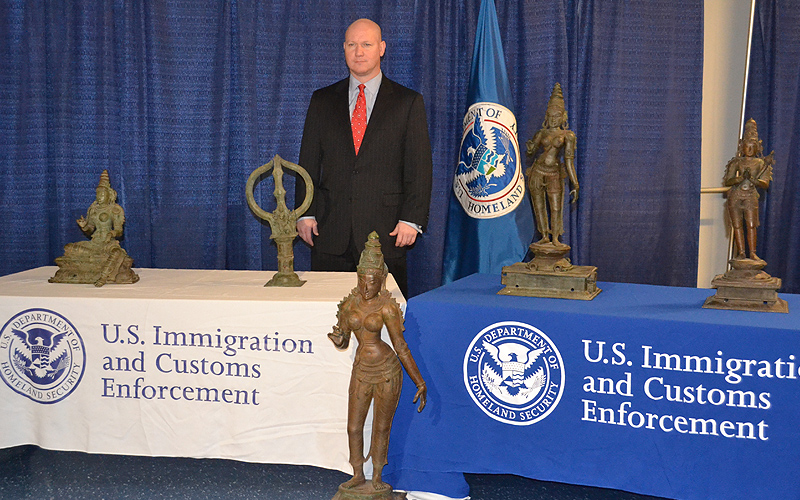
Cracking down on the illegal antiquities trade by regularly prosecuting criminal offenders and dismantling their infrastructure must be a leadership priority for U.S. Immigration and Customs Enforcement's (ICE).  The Homeland Security Investigations (HSI) directorate of ICE currently pursues a "seize and send" policy focused on recovering and repatriating antiquities rather than investigating and indicting criminals.  That policy must change in order to effectively combat a crime that permanently destroys the archaeological record and injures both history and culture. 

HSI Special Agent-in-Charge James Hayes with Indian idols seized last week.
ICE's seize and send policy is illustrated by many of the agency's press releases.  It was restated last week during a Chasing Aphrodite interviewwith James T. Hayes, Jr., Special Agent-in-Charge of HSI New York.  Hayes defended the seize and send policy: "'The focus is always to return stolen property to its rightful owners,' Hayes acknowledged, saying making criminal cases was desirable, but challenging. 'You have to have a legal basis to prove those items, and you have to prove certain things and that proves very difficult.  We’re dealing with laws around the world, in foreign courts and different jurisdictions.'"  HSI's chief added, "At the end of the day, our primary responsibility is to get stolen property back to its rightful owners."

Returning stolen property to owners is a regular goal of many law enforcement agencies.  But there is little indication that simply recovering and repatriating cultural property puts smuggling networks out of business.  Criminals engaged in the illegal antiquities trade surely realize that they face little or no risk of legal accountability for their actions. They must also be aware that the occasional confiscations by police of portions of their inventories do not actually take down their supply, transportation, conservation, distribution, marketing, and sales infrastructures.  That is why prosecutions, coupled with forfeitures of infrastructure assets (instrumentalities forfeitures), should be made part of law enforcement's response.

The decision not to pursue prosecutions and instrumentalities forfeitures on a regular basis produces several negative outcomes:

First, because antiquities traffickers go unindicted, the risk of offenders facing the consequences of prosecution--jail, fines, probation, and/or a criminal record--is eliminated.  Naturally, there is neither general nor specific deterrence against the commission of antiquities trafficking when there is no fear of getting caught.

Second, court sentences will continue to be light in those rare circumstances when antiquities smuggling prosecutions are actually brought forward.  That is because the judiciary, not seeing many cases on their dockets, will believe that this criminal activity is insignificant in scope or impact.

Third, the infrastructures used to facilitate antiquities trafficking will remain intact.  Seizures of ancient pots or Egyptian sarcophagi may remove the fruits of an antiquities trafficker's crime, but their confiscation by authorities likely represents a only portion of the trafficker's illegal inventory at any given moment.  Such limited seizures cannot be expected to shut down expansive global networks operating continuously.  Seizures of the instrumentalities used to commit antiquities trafficking, by contrast, could help dismantle large swaths of trafficking infrastructures.  Just as asset forfeitures in drug cases confiscate the automobiles, boats, planes, homes, etc. used in unlawful narcotics manufacturing and distribution networks, seizures of the instrumentalities used to traffic illegal antiquities could disrupt or shut down antiquities trafficking chains.

Finally, prosecutors and police will continue to confront both a learning curve and inefficiency so long as there iis no change in enforcement policy.  Routine antiquities trafficking prosecutions and enforcement, by contrast, would prompt prosecuting attorneys and detectives to meticulously learn how the crime operates, what evidence is commonly found in such cases, and what legal defenses typically arise.  The experiences gained would foster more efficient criminal investigations in the field and more effective legal cases in the courtroom.

HSI's chief is correct to observe that antiquities trafficking cases can be complex.  But law enforcement authorities over the decades have discovered ways to unravel complex transnational transactions.  If complicated international money laundering, commodities smuggling, and drug trafficking cases can be solved and prosecuted, so too can antiquities trafficking cases.  Indeed, criminal organizations would have little incentive to cease trafficking operations if law enforcement conceded that their activities were too hard to prosecute.

When criminal investigations become too complex to warrant effective action under one set of laws, one enforcement tactic is to separate the overall crime into component parts, examining the parts under different statutes.  So instead of building an antiquities trafficking case broadly around the National Stolen Property Act, for example--which relies on an review of foreign ownership laws to determine if a trafficking suspect has knowingly received stolen antiquities in violation of the statute--authorities might shift their focus to build a case on the basis of false statements.  Put another way, one method of not "dealing with laws around the world, in foreign courts and different jurisdictions" is to focus on the cover-up rather than the crime.

It is widely known that criminals rarely act in the open, committing fraud and deceit to conceal their activities.  That is why criminal cultural property importers oftentimes falsify customs paperwork, classifying looted antiquities as something else on import forms.  Making a false statement on an official customs form is a crimeunder 18 U.S.C. 542, and prosecutions under this statute do not require reliance on anything except evidence of criminal falsification.  Juries simply need to be shown that an ancient antiquity found in a cargo crate is not a "garden table set" or some other false description written down on a customs form. Criminal knowledge of the false statement, meanwhile, can be demonstrated by additional positive evidence and/or by circumstantial evidence--which counts in a criminal case--showing that the criminal defendant was “without reasonable cause to believe the truth of such statement.”  This example demonstrates that there may be other, potentially simpler, legal and investigative options available to authorities.

Cicero said, "What one has, one ought to use: and whatever he does he should do with all his might."  HSI agents are seasoned investigators who should be given the green light to use their skills with all their might in an effort to expose the illegal antiquities trade and take down its networks.  Partnering with prosecutors, HSI should systematically apply the National Stolen Property Act, the false statements law, and many other federal laws to successfully combat antiquities trafficking.  Referring cases for state prosecution should also be a routine consideration rather than an occasional one.  Coupled with the seizure of assets used to facilitate antiquities trafficking, regular prosecutions in the courts would dismantle or disrupt these criminal networks more effectively than the current seize and send policy.


This post is researched, written, and published on the blog Cultural Heritage Lawyer Rick St. Hilaire at culturalheritagelawyer.blogspot.com. Text copyrighted 2012 by Ricardo A. St. Hilaire, Attorney & Counselor at Law, PLLC. Any unauthorized reproduction or retransmission of this post is prohibited. CONTACT: www.culturalheritagelawyer.com

Thứ Bảy, 8 tháng 12, 2012

Ithaca Lawyer Attends 2nd Annual Man vs. Machine DWI Seminar in Brooklyn, NY

View Of X-Mas Courthouse from Brooklyn Bridge Marriott


I love going back to Brooklyn, NY. It holds many special memories and magic. This past Friday, December 7, 2012 (a day that will always live in infamy for me) I attended the:


Man versus Machine (aka Breath/Chemical Alcohol Test) Seminar II : Attacking Portable Breath Tests

They have held this seminar for the last 2 years at St. Francis College at 182 Remsen Avenue, Brooklyn, NY. The venue is perfectly located close to the downtown Courthouses and steps from the Brooklyn Bridge.

Steven Epstein is a wonderful NYC DWI attorney who shares with the DWI/DUI/Defense community in a big way. He is the person in back of this event, he organizes the speakers, the materials, and the "nuggets" of practical wisdom he imparts are in a word "priceless."

Steven Epstein, Esq. and Dr. Jennifer Duffy (Forensic Psychologist)

I will devote the next few blog posts to what I took from this seminar, suffice it to say knowledge and wisdom most definitely build and we never stop learning.

First the Machine:

New York State law enforcement currently uses three different breath alcohol testing units, really Chemical Test (this is the official breath test):

1. The Intoxilyzer 5000, used in the boroughs, and of course, NYC
Soon to be updated to the Intoxilyzer 9000 unit. They are made in the good old USA, Kentucky.
http://www.alcoholtest.com/

The guts of the Intoxilyzer


2. The Draeger, a favorite of the NYS Police (troopers)
3. The Datamaster, upstate (versus downstate) cities, towns, and village police departments

Most attacks of breath testing have common themes and ideas. The machines use similar technology. The Draeger is a dual testing unit with an electrochemical cell and Infrared Spectroscopy testing of breath samples.

Lawrence Newman, D.C., Esq.

504 North Aurora Street
Ithaca, NY 14850

607-229-5184

newman.lawrence@gmail.com

http://www.ithacadwi.com


Thứ Năm, 6 tháng 12, 2012

When Couples Divorce But Still Run A Business Together


Most business owners know not to bring personal issues to work, but that has been especially difficult for Agostinho Ribeiro. That is because he runs his company, a law firm based in Danbury, Conn., with his former wife, Valerie Calistro. More ...

Bài đăng phổ biến