Thứ Hai, 23 tháng 7, 2012

Objection Filed: Prosecution Outlines Factual Claims in U.S. v. Khouli et al.

Assistant United States Attorneys Karin Orenstein and Claire Kedeshian have filed an 87 page objection in response to motions filed on April 30, 2012 by Joseph Lewis, II and Salem Alshdaifat.  The government objects to the defendants' efforts to scuttle the case of United States v. Khouli et al., and the prosecutors take the opportunity to present the court with their evidence.

Lewis and Alshdaifat were charged by a federal grand jury in 2011 with crimes related to antiquities trafficking.  They are presumed innocent unless the government proves beyond a reasonable doubt that they had knowledge of the illegality and acted unlawfully. Another defendant in the case, Mousa Khouli, pleaded guilty to charges in April, while a fourth alleged conspirator, Ayman Ramadan, remains a fugitive at large.

In its objection filed with the U.S. District Court for the Eastern District of New York, the government argues, in part, that
  • the warrants authorizing searches of Lewis' home in Virginia and Alshdaifat's home in Michigan and their execution by federal agents were proper;
  • the search of the two defendants' emails were reasonable and properly authorized by three valid warrants;
  • Alshdaifat did not suffer violations of his right to remain silent or his right to counsel;
  • the smuggling statute (18 USC 545) is not unconstitutionally vague;
  • the government did not engage in any alleged overreaching or misconduct in the case;
  • the venue of the court (eastern district of New York) is proper; and
  • the money laundering conspiracy charge is valid.
Source: ICE
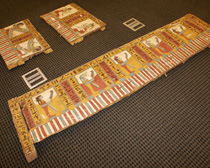
To support its legal arguments, and to paint a picture of the alleged smuggling and money laundering conspiracy, the government presents the court with a narrative describing the movements of an allegedly smuggled Greco-Roman coffin, a mummy board, a 3-piece nesting Egyptian coffin set, and Egyptian boats and limestone artifacts.

Federal prosecutors outline how Khouli and Ramadan smuggled the Greco-Roman coffin into JFK Airport in New York by transferring two payments of $10,000 and $3400 and submitting false customs information.  "While Lewis and Alshdaifat are not charged with smuggling the Greco-Roman coffin . . . the facts surrounding this transaction are revealing with regard to Lewis’s mens rea [i.e. criminal knowledge] for his subsequent transactions with Khouli," write the attorneys. The attorneys highlight that the customs papers listed the Greco-Roman coffin's country of origin as United Arab Emirates and not Egypt and described the coffin as "antique wood panel" valued at $3400. Prosecutors also tell how a sales invoice that did not originate from the actual seller, who was Ayman Ramadan/Nefertiti Eastern Sculptures Trading, was attached to the customs papers.

The government's lawyers go on to describe that the first artifact purchased by Lewis from Khouli was a mummy board, eventually seized by federal agents during a July 13, 2011 search of Lewis' Virginia home:

"Khouli sold an Egyptian mummy board to a customer .... A mummy board is a decorated wooden board that fits inside a coffin along with a mummy. On January 9, 2009, before [the customer] took physical possession of the mummy board from Khouli, Lewis purchased it from [the customer] for $60,000.  The bill of sale between Lewis and [the customer] included a photograph of the mummy board and identified its prior owners as Khouli’s company, Windsor Antiquities (“Windsor”), and previously, a private Dutch collection that acquired the item in the 1960s. The mummy board depicted in the bill of sale appears to have a transverse cut across the middle. On January 14, 2009, several days after the sale, Khouli and Lewis were in direct e-mail contact about shipping the mummy board from Khouli to Lewis.

"On February 10, 2009, Khouli advised Lewis by e-mail that he had obtained the mummy board from a restorer and offered to ship it to Lewis. Lewis inquired as to whether the repair at the 'joints' was invisible, referring to where the cut pieces were joined together."

On the same day, February 10, 2009, an Immigration and Customs Enforcement Agent (ICE) agent questioned Khouli about the importation of the Greco-Roman coffin.  The government reports that "[o]n the following day, February 11, 2009, Khouli offered Lewis two Egyptian antiquities: the Greco-Roman coffin and a bronze figure. Khouli advised Lewis by e-mail, 'Let me know what you think about the two Egyptian pieces[;] these are from my dad[’]s collection[;] he passed away about three years ago and my brothers and I want to sell them and split the money.'"  Lewis reportedly purchased the coffin for $32,500, not $65,000 as proposed by Khouli.

Because "[n]o mention was made of any other objects remaining from Khouli’s father’s collection [and because] Lewis’s dealings with Khouli the previous month indicated that Khouli had ... acquired the mummy board from a private Dutch collection, not from his father," federal prosecutors argue that "[t]hese facts belie Lewis’s argument that he had a basis for believing that every item he purchased from Khouli came from Khouli’s father’s collection."

In fact, government attorneys suggest that Khouli signaled to Lewis that the Greco-Roman coffin did not actually come from his father, stating:

"On March 6, 2009, after Khouli and Lewis had agreed to the sale of the Greco-Roman coffin, but months before Lewis took possession of it, Khouli offered Lewis a mummy linen and mask, writing in an e-mail, 'I just got th[e]s[e] items[;] i described them to you last week . . . .' (Gov’t Exh. 1; emphasis added). On the same date, Lewis responded, in sum and substance, that he already had four such items and that they were not very expensive. Khouli replied on the same date, 'It is very interesting[;] it was inside the coffin you bought from me according to the owner but he sold I[t] to me separately son of a gun.' (Id.; emphasis added). The statement that the Greco-Roman coffin had belonged to a separate 'owner' who 'sold' both the coffin and a related mummy linen and mask to Khouli was inconsistent with Khouli’s earlier representation that the Greco-Roman coffin had been sitting in his father’s collection for decades.  Upon learning this information, Lewis did not cancel the Greco-Roman transaction or request a new provenance from Khouli. Rather, he agreed to purchase the mummy linen and mask. In addition, despite Lewis’s only information about the mummy linen and mask’s provenance being that Khouli had 'just' received them and they were 'sold' to Khouli by another dealer, Lewis’s records for these antiquities include a Windsor bill of sale stating that these items were 'legally acquired by the late Jack Khouli in Israel in the 1960s.' While Lewis is not charged with smuggling the Greco-Roman coffin, his experience with Khouli in early 2009 told him that (1) not every Egyptian antiquity Khouli sold was from his father’s collection, and (2) any provenance that included Khouli’s father was unreliable."

The next day, on March 7, 2009, Khouli offered Lewis both a middle and outer coffin of an ancient Egyptian nesting coffin set, according to the prosecution.  Khouli reportedly went to Dubai in April to view them and discovered a third inner coffin.  Prosecutors say that  "Lewis’s e-mail messages indicate that he believed that the inner coffin was part of the same set as the middle coffin and outer coffin lid, making a three-piece nesting set. In these email messages, Khouli advised Lewis that the inner coffin had already been sold to another buyer and Lewis agreed to pay $150,000 for the inner coffin to avoid breaking up the set. The total agreed price for the nesting set was $310,000. Nothing in these e-mail exchanges suggested that Khouli had previously been aware of any of these coffins let alone that they had ever been in his father’s collection."

The government's lawyers add:
"On April 12, 2009, Lewis sent an e-mail message to Khouli confirming the details of the sale of the three piece coffin set. Lewis’s terms included that Khouli would provide “[p]rovenance from [his] late father’s collection, Israel 1960s” and a guarantee that the items would be cleared by Customs within 30 days of arrival. Khouli agreed to these terms. (Gov’t Exh. 4)."

The nesting coffins were sent to the United States in pieces using different transportation methods--international mail, air cargo, and sea cargo--and sent through separate points of entry, specifically JFK Airport in New York and the Port of Newark in New Jersey.  Prosecutors write in their pleading that the shipments were variously described for Customs as wooden panels, Indian furniture, purchased by a Connecticut third-party, or valued at $900. The coffin set was delivered to a Connecticut address.

Prosecutors further allege that Lewis knew that the Egyptian coffin parts required assembly.  "Lewis was therefore aware that pieces of the inner coffin and the remaining parts of the coffin set were being shipped in pieces, over an extended time period, because there was some risk attached to their importation."  Federal attorneys describe how Khouli sent an email to Lewis on April 29, 2009: "“i (sic) got the first half of the cut inner coffin the second half is on the way, shall I send it to you or should I wait for the second half and have [a certain person] look at it and have it fixed?” (Gov’t Exh. 6; emphases added). Lewis responded, “[The certain person] needs to put them together, when will the other two coffins arrive?” (Id.; emphasis added)."

Then in May 2009, Alshdaifat allegedly sold Khouli two ancient Egyptian funerary boats and five limestone figures for $40,000, which made their way from Ramadan to Khouli by international mail and then to Lewis. Prosecutors say that Ramadan sent the shipping label, which described the package as "antiques," to both Alshdaifat and Khouli.

The defendants may file a reply to the government's objection.  Meanwhile, Khouli's sentencing hearing is scheduled for next month.

CONTACT: www.culturalheritagelawyer.com
(c) 2012 Ricardo A. St. Hilaire, Attorney & Counselor at Law, PLLC

Chủ Nhật, 22 tháng 7, 2012

Assemblyman Keith Wright's Secret Judicial Screening Panels


And, I ask, what about the New York State Supreme Court Judge Geoffrey Wright  who seems to have the right of way when it comes to cases brought to him - he does whatever the "Fixers" want. His brother Keith is the titled head of the Democtratic Party here in New York City. If anyone has any comments about Judge Greg Wright, please email them to: betsy.combier@gmail.com, as I'm researching the Wright Brothers.
Betsy Combier

Judge Geoffrey Wright


Syracuse Mayor Stephanie Miner And Assembly's Keith Wright To Take Over NYS Democratic Party

Out with Jay Jacobs, in with Keith Wright and Stephanie Miner.
keith wright facebook.jpgGov. Cuomo, the de facto head of the state Democratic Party has spoken: Syracuse Mayor Miner and Wright (pictured), a Harlem Assemblyman and head of the New York County branch of the party, will take the helm after what should be a perfunctory vote on June 5.
“Mayor Miner and Assemblyman Wright are outstanding leaders both for our party and our state," Cuomo said in a statement announcing the picks, which also included laudatory canned quotes about the new racially/geographically/gender balanced partnership from Sen. Chuck Schumer and Assembly Speaker Sheldon Silver.
"They have been dedicated community leaders and champions of the key missions of the Democratic Party. I thank them for agreeing to serve in these critical positions and look forward to working with them in their new roles.”
Jacobs announced a week ago today that he planned to step down as chairman of the party. He will remain head of the Nassau County party.
“I expect to turn the Chairman’s gavel over to both of them with full confidence that they will continue the good work we have done over the last few years supporting our elected leaders and candidates at all levels of government in the State," Jacobs said in a release.
I wonder what this means for Wright's much-rumored, if currently un-acted-upon, interest in Rep. Charlie Rangel's job...


The Flacks Report
Note:  The following was written before the 18 June 2012 N.Y. County Democrats judiciary committee meeting where the committee decided to make the screening panelists names public at the time they begin their work.  It's worth reading.  As the dean of the screening panel process attorney Stanley Geller says, “The panelists' names are public; their work is confidential.”  Judiciary committee co-chair District Leader Louise Dankberg said that making the names public at the outset provides transparency of the process.  We shall see if the County Leader makes good on this when the Supreme Court screening panel convenes.

KEITH WRIGHT'S SECRET JUDICIAL SCREENING PANELS
By Alan Flacks - (212) 840+12.34
        
        
In 1977, the New York County Democratic party incorporated a screening panel for judges in its rules.  These were to be--and were--open panels.  The names of the panelists were made public before they began their interviews.  In fact, at one time the New York Law Journal also published the names of the panelists.

        Under County Leaders Miriam Bockman and Herman Denny Farrell (1977 to 2009) the panelists’ names were public at the outset of their work.  Indeed, Farrell's co-law chair Arthur Grieg stated at the March, 2012, County District Leader meeting that he gave the panelists names to all applicants.  "Candidates have an absolute right to know the names of panel members reviewing their applications and which group designated them. I always gave the list to any candidate who requested the list. . . I found that candidates having the names of panel members aided the process by identifying possible issues of bias, conflict with a panel member. . . . "

        With the advent of Keith Wright as county leader, the panelists names are kept secret, and he has been chastised thrice for doing that in Daily News editorials.  Former N.Y.C. Councilmember and former chair of the New Democratic Coalition's Manhattan Judiciary Committee Jane Trichter says that Keith Wright is destroying our legacy.
  
        Former panelist and panel administrator attorney Steven De Castro wrote in part:  "It is absolutely right that the panelists have a duty to protect themselves from outside influence, but that is not related to the issue of whether the panelists' names are released. . . The complaint of potential conflicts of interest commonly arises every year, but I don't see how this problem can ever be addressed if the panelists' names are kept secret. . . ."

         Secrecy from the public causes the appearance of impropriety said former Lexington Dems Club State Committeeman Bud Plautz.  And former Supreme Court Justice Emily Jane Goodman said:  "I was the first panel administrator under reform rules when Miriam Bockman became County Leader.  No-one ever said they were secret or treated them that way; in fact, every panelist was introduced to every applicant by name and organization whose leader sent them."  Indeed, attorney Stanley Geller, who started the panel screening (initially called "The Geller Panels") said "The panelist names are public; their work is confidential."

        Secret Keith Wright Panels.  Yet here are the current myriad open panels where all the panelists' names are made public before they interview candidates:  The Governor's four Appellate Division screening panels; the State Constitution's Court of Appeals screening panel; the Mayor's Committee on the Judiciary [for Family, Criminal, & interim Civil courts]; the Office of Court Administration's thirteen judicial qualification panels; Sen. Schumer's screening panel for the Federal judiciary; and--lo! [after Clarence Norman went to prison for selling judgeships]--the Kings County "Regular" Dems screening panel is public.  BUT NOT KEITH WRIGHT's, who has secret screening panels after years of open panels under Bockman and Farrell (1977 to 2009)!  This is a serious attack on the whole screening panel system and an attempt to go back to the Tammany Hall DeSapio days.
***********************************************************************
    Now is the winter of our fiscal discontent
    Made glorious summer by this sun of Mario;
    And all the clouds that lour'd upon our Senate
    In the deep bosom of the Catskills buried.
From  ALAN FLACKS  at:   alphlax@yahoo.com
Tele.:  (212) 840+12.34
http://www.TheFlacksReport.blogspot.com/


He's for the gov

  • Last Updated: 9:33 AM, October 1, 2009
  • Posted: 3:15 AM, October 1, 2009
  • LINK
Assemblyman and Manhattan Democratic Chairman Keith Wright (Manhattan), who supports David Paterson for governor:
"As far as I'm concerned, there is no race for governor. New York County is behind David Paterson.
"He's done a lot of things he has not received recognition for.
"The question is whether David Paterson is going to be the people's pick in New York state. How does he overcome it? If there's a way, he'll do it. I've known the man for over four decades. He's persevered."


Thứ Năm, 19 tháng 7, 2012

Dinosaur Forfeiture Case Rescheduled as Court Waits for Claimant's Verified Claim

HSI seizes the dinosaur bones.
Today's court conference in the matter of United States of America v. One Tyrannosaurus Bataar Skeleton (2012-cv-04760) was rescheduled to September 5 after federal prosecutors issued a gentle reminder that the government remained the sole party in the case.  In a letter submitted to the southern district court of New York, prosecutors wrote:

"This is a forfeiture matter and at the present time the only party to the action is the Government. In order for an individual or entity to become a party to the action, they are required to file a Verified Claim.  As of the date [of] this letter there have been no Verified Claims filed with the Court and the time period for filing has not yet expired. The time period to file a Verified Claim expires on August 26, 2012."

Ancient coin dealer advocates and attorneys Michael McCullough and Peter Tompa filed court appearances in June announcing their representation of Eric Prokopi, the purported claimant seeking the dinosaur bones' return.   They are expected to file a Verified Claim arguing why the dinosaur bones should be awarded to Prokopi.

The U.S. Attorney for the Southern District of New York filed a forfeiture complaint this spring alleging that the dinosaur skeleton was illegally imported into this country in March 2012.  Federal prosecutors seek to repatriate the bones to Mongolia, the country of origin.

More details regarding this seizure and forfeiture case may be found here.

CONTACT: www.culturalheritagelawyer.com

Thứ Tư, 18 tháng 7, 2012

American Museums and Subhash Kapoor's Artifacts


Inside the Art of the Past gallery in New York.
Source: Google Local
The arrest and extradition of Subhash Kapoor has made headlines in India and garnered the attention of several cultural heritage observers.  He stands accused by Indian police of allegedly participating in an antiquities trafficking ring.  Artifacts from Kapoor are reportedly located in American museums' collections.

Kapoor is an American citizen and antiquities dealer who last year celebrated 35 years on Madison Avenue in New York City. Kapoor is the owner of the Art of the Past, Inc. gallery in Manhattan as well as Nimbus Import Export, a corporation formed on August 17, 2005 and bearing the same address as Art of the Past according to New York Department of State records.

Kapoor wrote in his March 2011 Art of the Past catalog, “There have been some obstacles and hardships during the past thirty-five years, but there have been many more rewards.” A hardship currently faced by Kapoor is his arrest in Germany on October 30, 2011, which resulted in his extradition to India on July 14, 2012.

Kapoor is presumed innocent. India follows the common law system where the burden is on the prosecution to show a crime has been committed beyond a reasonable doubt before a person is judged guilty.

The Art of the Past web site, now shut down, once described how its gallery’s artifacts could be found in the collections of major American cultural institutions. The “About Us” web page noted that “[t]he gallery has sold to some of the most celebrated public and private collections in the world. These include The Metropolitan Museum of Art, New York City; Arthur M. Sackler Gallery, Washington D.C.; Los Angeles County Museum of Art, Los Angeles; Museum of Fine Arts, Boston; Asian Art Museum of San Francisco, San Francisco (sic); The Art Institute, Chicago; and Virginia Museum of Fine Arts, Richmond; Honolulu Academy of Arts, Honolulu ....”  An internet search shows that the Birmingham Museum of Art in Alabama and the Norton Simon Museum in California list objects from Kapoor.

The Toledo Museum of Art, in its fiscal year 2007-2008 annual report, catalogs the accession of many Indian pieces from Kapoor in 2007.  A representative sample of the 44 objects gifted to the museum include:

• Indian, Gupta Period, Seated Mother, 5th century, terra cotta, terra cotta, Gift of Subhash Kapoor, 2007.107

• Indian (Chandraketugarh), Mithuna Plaque, 1st century B.C.–1st century A.D., terra cotta, Gift of Subhash Kapoor, 2007.109

• Indian (Chandraketugarh), Fertility Goddess Sitting with Star, 1st century B.C.–1st century A.D., terra cotta, Gift of Subhash Kapoor, 2007.116

• Indian (Uttar Pradesh), Gupta Period, Head, 5th century, terra cotta, Gift of Subhash Kapoor, 2007.147

• Indian (Western India), Female Head, Gupta period, 5th century, terra cotta, Gift of Subhash Kapoor, 2007.158

It is unknown if any museums are currently examining the provenances of their collections.

Sources:
http://www.artofpast.com/wp-content/uploads/2011/02/March11_Cataloge.pdf
http://web.archive.org/web/20080828191430/http://www.artofpast.com/AboutUsPage.html
http://blog.al.com/mhuebner/2011/04/callahan_lecture_to_feature_ar.html
http://www.nortonsimon.org/collections/browse_title.php?id=P.1997.1.1
http://www.toledomuseum.org/wordpress/wp-content/uploads/AnnualReport07081.pdf

CONTACT: www.culturalheritagelawyer.com

Thứ Ba, 17 tháng 7, 2012

The How and Why of NYS DMV Medical License Suspensions


As a attorney who handles many car related matters I need to understand the New York State Department of Motor Vehicles. The New York State DMV has the power to suspend, revoke, require road tests, written tests, medical information, medical examinations, and medical tests of those drivers that they feel are medically impaired. Remember a license is a privilege. A privilege is NOT a right so the proof for license issues is a little bit better than the civil standard of preponderance of the evidence. It is sometimes referred to as the substantial evidence standard. On the scales of justice it is that slight tilt  either for or against you.

What is "Fitness" to Drive?

Many medical conditions can negatively affect the physical and mental abilities of motorists. These disorders can directly affect the driver's functional ability and safety. If a motorist has impaired motor coordination, and a slow mental reaction time the chance of a crash are much higher. Fitness encompass both mental and/or physical ability.

Who Determines the Fitness to Drive in NYS?

Determinations are made by the DMV's DIB (Driver Improvement Bureau) located in Albany, NY. Within the DIB is the MRU (Medical Review Unit). They have 9 Medical Review staff consisting of:
 3 board- certified Neurologists (called the "medical consultants"), and 5 License Examiners, and 1 Clerk. The Neurologists (medical consultants) work on a rotating basis (once per week) to review specific case files.

Who Determines Which Motorists are Reviewed?

There are three ways that a person can wind up being medically reviewed by the MRU.

1. First Time Applications for a driver's license and those renewing an existing license.

You must answer questions regarding any medical conditions you suffer from when obtaining a license for the first time or renewing a license in New York State. The questions range from: "have you, or are you receiving treatment for, or have you had any disabilities, or disabling conditions that are progressively worsening?" If you answer any of this in the positive, as in, "Yes I have or Yes I am experiencing or Yes my condition is worsening" are REQUIRED to take a medical form to their physician for completion and return to the MRU (Medical Review Unit).

Future license holders or those renewing must have seen that physician (been examined for that condition/problem) within the previous 120 days for that doctor to provide the DMV MRU any information.

2. If they are reported to the DMV by an observing authority, ie. police, physician. 

If the motorist has had CONTACT with a doctor, law enforcement, the Court, hospital, or therapist they can report to the DMV. Anonymous observations and reports are not valid for review purposes. Generally these reports occur because these authorities have OBSERVED IMPAIRED BEHAVIOR. Their doctors are under NO legal obligation to report their patients but many healthcare providers feel a moral obligation to report their patients as a public safety hazard.

I have seen within my own practice police officers, county deputies, and state troopers filing referral reports on motorists. In a great many of these cases the motorists caused accidents (single and multi-car), gotten charged with moving and/or other violations, or displayed erratic behavior. Some admitted to the police that they had taken excessive prescription medication, smoked pot, used OTC (over the counter) drugs in dangerous ways, and/or ingested other substances. Some have made statements that were clearly bizarre, and out of alignment with reality. Sometimes if the police do not have a case (of charges/offenses/crimes) that are worthy of being proven (ie. no blood test, no probable cause) they will still try to get the motorist off the road.

The Element of Surprise

The referral to the DMV MRU can come as a complete surprise to the motorist. A letter from the DMV asking them to go to their physician out of the blue was not seen (recognized) as out of the ordinary course of events. Caught unaware and confused these motorists will willy-nilly have their doctors fill out and send in these forms unchecked.

When they are sent a DMV letter of suspension many have called me in a state of shock and panic. What happened? Why did it happen? They rarely relate back the precipitating incident, police stop, or accident and the referral by the authorities (medical or law enforcement) for DMV review. Their prior run in with law enforcement months prior may in fact be not even memorable to them.

Police authorities would have to file the DMV "Police Agency Request for Driver Review" form. If there was an accident involved with their motorist contact they would also submit a copy of the accident report.

Law enforcement must specify within their report why they are making a REQUEST for REVIEW.


What specifically led them to believe that this motorist was functionally impaired?

  • statements made by the motorist
  • circumstances for the crash/accident
  • observations of walking, talking, thinking, acting
  • erratic, reckless, and/or dangerous vehicle operation 

3. Referral from Family Members

I have had clients turn in reports to the DMV. This is where their family felt they were no longer able to drive because of either mental (dementia) and/or physical and/or chemical issues. BTW A diagnosis of dementia in and of itself is not proof to lose driving privileges. The physician needs to state and explain far more than the just a diagnosis.

Sometimes these family referral were unfounded, and sometimes they were of real concern. Anyone can report you to the DMV Medical Review Unit. The referral must be made with a written report on the DMV DS-7 Concerned Citizen Form. Police use the DMV DS-5 form, and Physicians use the DMV DS-6 form.

NOTE: Once Referred there is NO INVESTIGATION UNTIL you are contacted by the DMV for a possible evaluation.

What Happens Post-Referral?

If YOU self report: licensed driver who is renewing
OR a first time license applier
OR the Police report YOU
OR a Doctor Reports YOU:

THE DMV has one of two possible options:

OPTION #1 You will be given a form to take to your doctor for completion. 

NOTE: Remember that there are "Different" doctors needed for "Different" conditions:

If you suffer from epilepsy or convulsions then this must be a certified neurologist or neurosurgeon.
If you suffer from anything else then any primary care doctor will be able to complete the form.
BUT the DMV review until can request (demand) any other certified specialist.

(a) The doctor must give dates, nature of your illness, medications prescribed, testing done, results from testing, diagnosis (what you got), prognosis (what's your predictable) future, AND answer

Can this person drive a car safely?
Is this person a risk to themselves and others?

(b) Episode (symptom) Frequency is evaluated:

If you have been episode free (without symptoms affecting you) for 12 months = Approved by MRU 

If you have had an episode (with symptoms affecting you) within the last 12 months then a review by one of MRU Board-certified Neurologists is mandated.

The following are typical conditions that may require a review by the MRU Board-certified Neurologist:


seizures
hypoglycemia
low blood sugar
head/brain trauma
syncope
heart issues/pacemaker/arrhythmias
sleep/apnea/narcolepsy disorders
stroke disorder 
diabetes

Having the condition (diagnosis) must be coupled with the impact the condition is having upon you and potentially your driving. There are unstable and stable diabetics, there are people with heart problems that are fully functioning, and there are people with a host of mental issues that can still operate a car safely. Determinations have to look at the long view. The big question is "are you now or will you be a threat to the motoring public in the future?"

OR


OPTION #2 The Testing and Investigation Unit of the DIB (Driver Improvement Bureau) may decide to schedule an INTERVIEW with you at a local field office. 

An investigator will determine whether you need to submit further medical information to the MRU (Medical Review Unit) and/or A Road Test. Usually you will have a road test but not before you pass the medical review. Re-examination can also include a vision test, a written test, and/or any other recommended test.

 The Final Decision by DMV

The DMV may impose any of the following:

1. Restrictions to driving: when you drive (daylight only), certain highways, etc.
2. Suspensions to driving: temporary periods of time
3. Revocation of driving: Cancelation of privileges UNTIL ? future medical proof, testing, re-evaluation
4. Periodic Medical Statements or re-exams plus collaterals (testing, reporting, treatment records)

These decisions may be appealed for further review and hearings.

Weaknesses in the System

One of the weaknesses in the DMV license review system is that it does not provide any specialized training to it's examiners in how to observe (and to determine) conditions that could result in impaired driving. This is only compounded by the fact that it relies upon many outside physician reports (with their resultant subjectivity), and the review of it's Medical Review Unit which only has a small percentage of files actually reviewed by a doctor.

Opinions: Everyone has One 

Doctors opinions are just that opinions. They are not always right. Some people may fall through the cracks of this governmental process. People are often mis-diagnosed, overly diagnosed, and basically misread. Driver impairment based upon medical issues can be a difficult thing to assess. If a determination is made without complete information, and the necessary (thorough and proper) testing then someone may lose a license privilege unfairly.

How can I discover who made the referral for a DMV review?

You can make a FOIL request to see your DMV medical file, and forms filed against you. A Freedom of Information Law request will disclose who turned in the form requesting a review of your licensure. This is usually a police officer or physician.


Lawrence (Larry) Newman, D.C., J.D.
Doctor of Chiropractic
Attorney and Counselor at Law

504 North Aurora Street
Ithaca, NY 14850
607-229-5184


Fagan Attempts to Restart Claim Against Czech Republic After Florida Court Halts "Victims of Holocaust Art Theft" Case

Museum of Decorative Arts.  CC Kirgyt12.
Edward Fagan has filed a lawsuit to obtain artwork--alleged to have been looted by the Nazis--following a dismissal of his initial legal claim.  A Florida district court judge dismissed the case of Victims of Holocaust Art Theft v. Czech Republic; National Gallery in Prague; Museum of Decorative Arts of Prague after the plaintiff failed to obtain a lawyer.

The United States District Court, Southern District of Florida, ruled on June 4 that the newly created organization called Victims of Holocaust Art Theft needed an attorney by July 5 or the case would be dismissed.  Fagan, disbarred from the practice law, could not serve as the the organization's attorney.  He filed a lengthy pleading on June 29 urging the court to allow him to go forward in the case pro se (without an attorney) in recognition of the fact that he and "Victims of Holocaust Art Theft" were one and the same.  Michal Klepetář filed a separate letter on the same date stating that he wished Fagan to represent his interests.

District Court Judge James Cohn dismissed "Victims" case on July 9, writing in a footnote (citations omitted):

In response to the Court’s June 4 Order, Fagan filed a “Motion for Permission for Plaintiff Pro Se to Proceed Under the Name ‘Victims of Holocaust Art Theft’ and for other relief.” In that Motion, Fagan asserts that Plaintiff is not a legal entity apart from Fagan himself but instead is a fictitious name that Fagan is using to bring claims in his individual capacity. As the Court previously noted, however, the allegations of the Complaint indicate that other individuals besides Fagan have an interest in Plaintiff.  But even if the Court were to assume that Fagan alone owns and controls Plaintiff, it remains clear that Fagan is seeking to represent the interests of persons other than himself.  More troubling, Fagan reveals for the first time in his Motion that he is “a disbarred lawyer” and that “[e]ven after [his] disbarment,” he has been “sought out by persons and groups with restitution claims who wanted [him] to assist and consult with them.”  This disclosure suggests that Fagan, despite being disbarred from the practice of law, may be using Plaintiff as a vehicle to represent other persons before this Court.  For these reasons, Fagan’s Motion does not alter the Court’s conclusion that Plaintiff may not proceed without counsel, and the relief sought in that Motion is denied.

The next day, Fagan responded by filing a new lawsuit in his own name, captioned Edward D. Fagan v. Czech Republic; National Gallery in Prague; Museum of Decorative Arts of Prague docket 9:12-cv-80743-KAM.

In order to file a civil complaint to obtain property, one must have standing to sue.  Fagan claims in his latest complaint that he "is an owner of certain rights to The Popper Art Collection which were obtained / acquired from Michal Klepetář (Klepetář ), the Popper heir/legal successor.  It remains to be seen if the court will permit the case to go forward.


CONTACT: www.culturalheritagelawyer.com

Lawyer says "Don't Look a Gift Horse in Mouth? or Maybe You Should?"


What the .... ? The old expression don't look a gift horse in the mouth comes from many hundreds of years ago when horses were given as gifts and exchanged regularly. If you were given a "gift" horse then you should not be inspecting it's teeth (as a barometer of it's health or value). You should be grateful for the gift "as is" and expecting nothing more. To look at it (or examine/inspect it) was the act of an ungrateful recipient.

The original latin:


From The Letter to the Ephesians, circa AD 400, which conatins the text 'Noli equi dentes inspicere donati' (Never inspect the teeth of a given horse). 

Which brings me up to today, I recently got a call from a parent whose child was in a car accident. The car was totaled by another driver. The accident was completely, 100% the fault of this other driver. The 

Big BUT

BUT ... The child was never examined, never x-rayed, never evaluated, never checked by any health care provider or practitioner. The child has had no diagnosed injuries, impairments, disabilities, medical bills, or anything relating to this accident. 

THE GIFT HORSE

The mother was offered $1,000 by the "at fault" person's insurance carrier. This to me is the proverbial gift horse. This is a gift that in my legal opinion has to be EXAMINED and QUESTIONED. This is because the acceptance of the gift has concessions attached to it. 

The Concessions

By signing a release (for the $1,000) this indicates that you are Failing to challenge the at fault driver (and their carrier) for damages. This would concede (give up) the right to pursue any future compensation. The statute of limitations is the time period you have to make a claim. In New York State you have three years to file a lawsuit for personal injuries as a result of a New York based car accident. 

Personal Injuries Require Proof

If you are pursuing a claim for pain and suffering damages in NYS you must first meet the NYS threshold. These are referred to as the "human loss damages" and you must prove them. 

RE YOUR INJURIES SERIOUS?

The certain criteria allowing an injury victim to receive pain and suffering money is called the “SERIOUS INJURY” threshold.   Many in NYS call it theBreak or Bruise law. IF You have a break your'e in (you collect) BUT IF you got a bruise (you don't collect). In order to meet the SERIOUS INJURY threshold, the injured person has to show (to prove) one of the following:

  1. ·      A personal injury that results in death;
  2. ·      Dismemberment;
  3. ·      A significant disfigurement;
  4. ·      A fracture;
  5. ·      The loss of a fetus;
  6. ·      Permanent loss of use of a body organ, member, function or system;
  7. ·      Permanent consequential limitation of use of a body organ or member;
  8. ·      Significant limitation of use of a body function or system; or
  9. ·      A medically determined injury or impairment of a non- permanent nature which prevents the injured person from performing substantially all of the material acts which constitute such person’s usual and customary daily activities for not less than ninety days during the one hundred eighty days immediately following the occurrence of the injury or impairment.


In this case we have a fast cash offer of $1,000 to go away and never come back. It is not based on anything but a hunch and the likelihood that this child may have injuries in the future stemming from this event. In my opinion without getting checked out now, and within (or over) the next few months
this is a BAD IDEA. Don't sell your body or your health cheaply, they are your wealth!


Lawrence (Larry) Newman, D.C., J.D.
Doctor of Chiropractic
Attorney and Counselor at Law

504 North Aurora Street
Ithaca, NY 14850
607-229-5184


Bài đăng phổ biến